Sales of luxury goods have significantly declined in Dubai and Abu Dhabi due to the disruption in demand caused by the conflict in Iran, which is impacting this crucial Gulf market.
Sales at Europe’s largest luxury brands have significantly declined in Dubai and Abu Dhabi following the Iran conflict, which has disrupted one of the sector’s rapidly expanding markets. This represents yet another challenge for an industry already facing a three-year contraction.
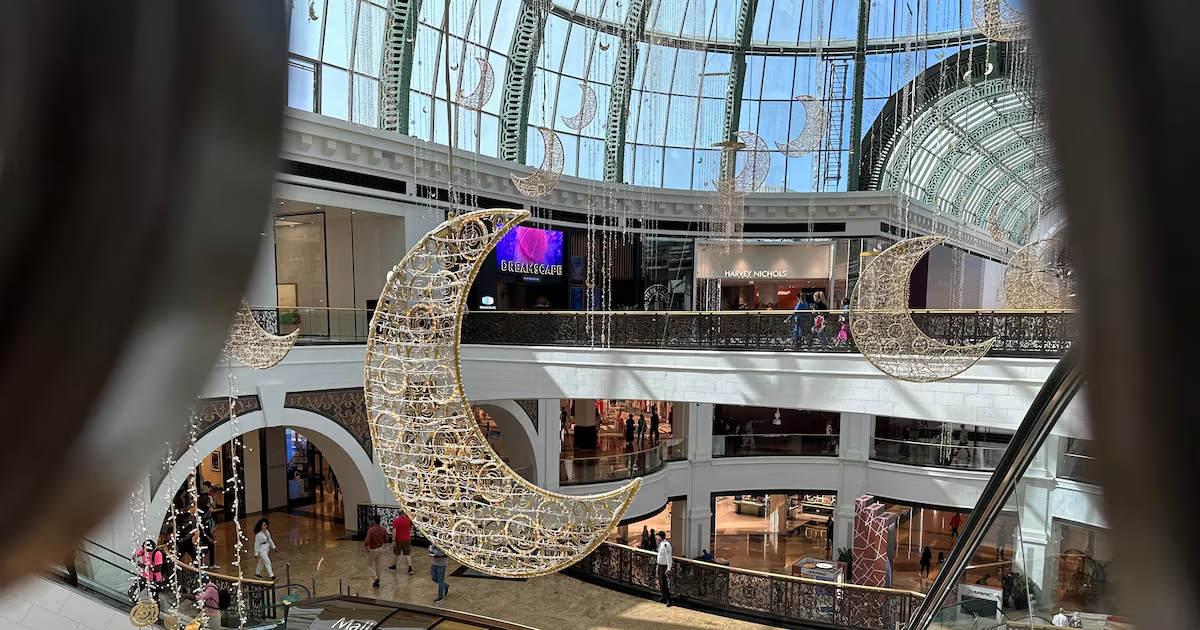
In March, luxury retailers at Dubai’s Mall of the Emirates experienced sales declines ranging from 30% to 50% compared to the same period last year, as reported by a source familiar with the previously unreported figures. The mall experienced a decline in foot traffic of approximately 15% over the course of the month.
The declines arise as global luxury leaders — such as LVMH, Kering, and Hermès — get ready to announce their quarterly earnings this week, providing the initial comprehensive view of how regional instability is impacting consumer demand.
The Mall of the Emirates features flagship stores for renowned brands such as Louis Vuitton, Dior, Gucci, Cartier, Chanel, and Rolex, alongside an indoor ski resort and wellness facilities, making it one of Dubai’s top retail destinations. The operators of Dubai Mall and Galleria did not reply to requests for comment, nor did representatives from LVMH, Kering, or Hermès.
The Middle East, representing approximately 5% of global luxury spending, has emerged as one of the industry’s most robust growth areas recently, despite a decline in demand in China after the COVID-19 pandemic. However, analysts indicate that the recent rise in regional tensions has disrupted that momentum.
The conflict that commenced with US and Israeli strikes on Iran on February 28 has intensified instability throughout the Gulf, jeopardizing Dubai’s reputation as a stable luxury and tourism destination. Drone attack reports impacting infrastructure, particularly near significant sites like the Burj Al Arab and sections of Dubai’s airport, have heightened investor apprehensions.
Carole Madjo, the head of luxury research at Barclays, pointed out that the Gulf has traditionally served as a crucial growth driver for the sector.
“It was undoubtedly a region of enormous strategic importance.” “Everything was okay,” she remarked, alluding to the market’s recent performance prior to the increase in hostilities.
The decline intensifies the challenges faced by an industry that is already contending with diminishing global demand, particularly as companies like LVMH and Kering struggle to adapt to changing consumer preferences and economic conditions. Following the conclusion of the post-pandemic luxury boom in 2022, the total market value of LVMH and Kering has decreased by over €100 billion, representing more than a quarter of their overall worth. According to Bain & Company, sales across the industry experienced a decline of 2% last year.
Experts caution that the disruption in the Gulf may lead to broader consequences if geopolitical tensions affect global consumer sentiment. Analysts from Bernstein indicated that increasing oil prices, travel expenses, and inflation might “easily disrupt” luxury spending beyond the region, extending to the United States as well.
Christopher Rossbach, portfolio manager at J. Stern & Co., remarked that a delay in recovery expectations would not come as a surprise.
“If it now appears that the luxury recovery we anticipated for 2026 is unlikely to occur and is instead deferred at best to the latter half of this year or into next year, I don’t believe anyone should be taken aback by it,” he stated.
Even in the face of economic challenges, Dubai continues to stand out as a leading luxury retail destination worldwide, thanks to its favorable tax environment, robust tourist influx, and significant retail margins. Some flagship stores achieve sales per square meter that greatly exceed the global norm. Analysts suggest that the recent conflict could challenge that enduring advantage, particularly by impacting tourist numbers and consumer spending in the luxury retail sector.