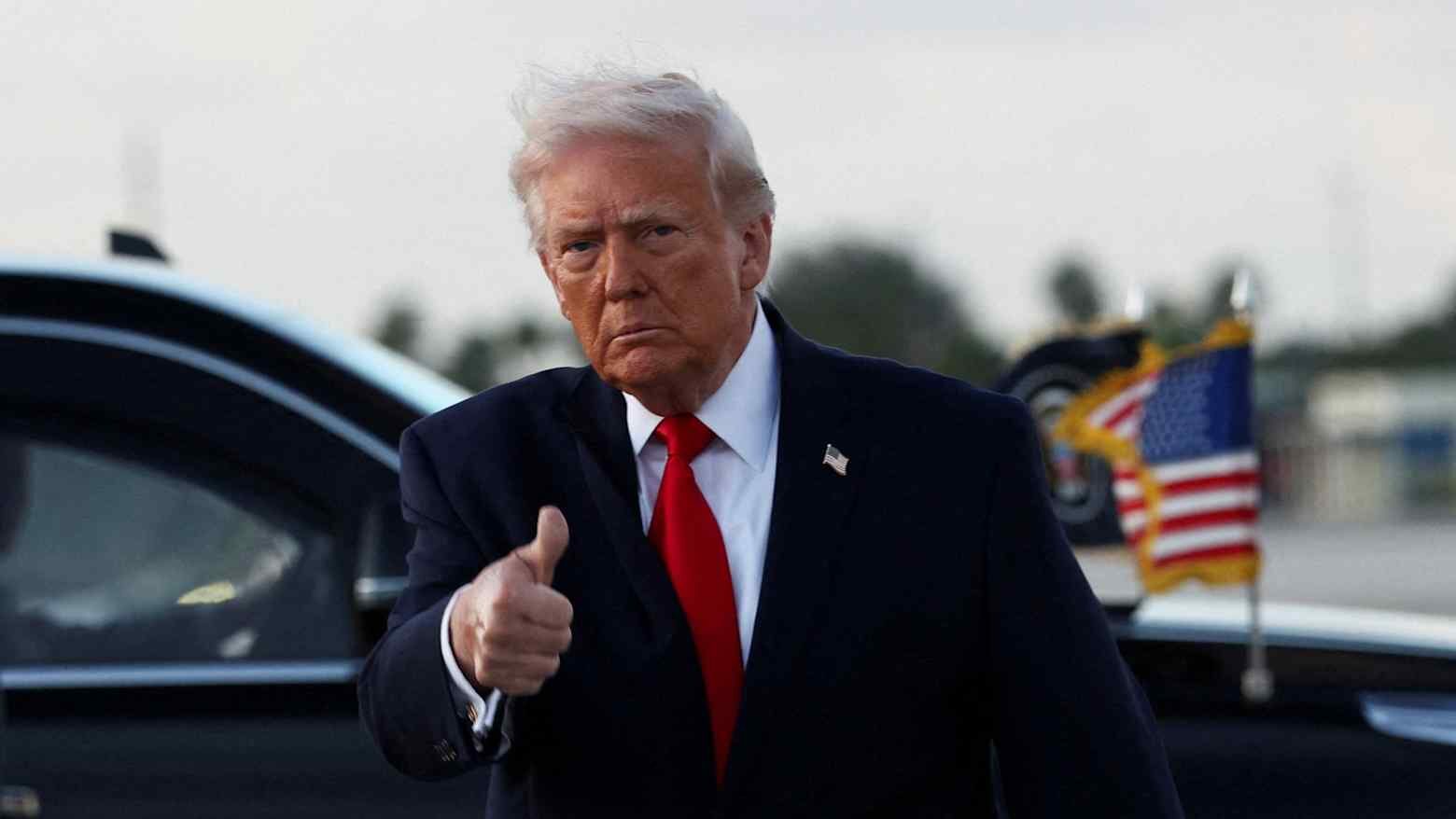
Trump promises to blockade the Strait of Hormuz following unsuccessful Iran peace talks
President Donald Trump on Sunday announced that the U.S. Navy would begin blockading the Strait of Hormuz, escalating tensions following extensive negotiations with Iran that did not result in an agreement to conclude the conflict, putting a delicate two-week ceasefire at risk.
Trump also stated in a post on Truth Social that the U.S. would take action against every vessel in international waters that had paid a toll to Iran and would begin destroying mines that he claimed the Iranians had dropped in the strait, a critical point for approximately 20% of global energy supplies that Iran has obstructed. “No one who pays an illegal toll will have safe passage on the high seas,” Trump wrote, adding: “Any Iranian who fires at us, or at peaceful vessels, will be BLOWN TO HELL!”
Iran’s Revolutionary Guards issued a statement cautioning that military vessels nearing the strait will be regarded as a violation of the ceasefire and will be addressed firmly and decisively, emphasizing the potential for a perilous escalation.
Iran’s Parliamentary Speaker Mohammad Baqer Qalibaf stated that Trump’s recent threats would not impact Iran, as he headed his nation’s delegation to the discussions alongside Foreign Minister Abbas Araqchi.
“Should you choose to fight, we will respond in kind, and if you present your arguments with logic, we will engage with logic,” he stated, as reported by state media.
Six weeks of conflict have resulted in the deaths of thousands, disrupted the global economy, and caused a surge in oil prices as Iran obstructed traffic through the strait.
ADDITIONAL DISCUSSIONS?
During an interview with Fox News following his statement regarding the strait, Trump expressed his belief that Iran would persist in negotiations and described the discussions over the weekend as “very friendly.”
“I truly think they will engage in discussions on this matter, as it seems implausible for anyone to assert, ‘We desire nuclear weapons,’ without having any leverage,” Trump stated to Fox News from his golf course close to Miami, Florida.
Trump also stated that NATO allies, whom he has criticized for not supporting the war he initiated alongside Israel on February 28, expressed a desire to assist with the operation in the strait.
Washington’s allies did not provide an immediate response.
The recent talks in Islamabad, which came after the ceasefire announcement last Tuesday, marked the first direct meeting between the U.S. and Iran in over a decade and represented the highest-level discussions since the 1979 Islamic Revolution. Vice President JD Vance, who led the U.S. delegation, stated, “The bad news is that we have not reached an agreement, and I think that’s bad news for Iran much more than it’s bad news for the United States of America.”
An official from the U.S. stated that Iran has turned down Washington’s request to cease all uranium enrichment, dismantle all significant enrichment facilities, and transfer highly enriched uranium. The two sides were unable to come to an agreement regarding the U.S. request for Iran to stop funding Hamas, Hezbollah, and the Houthis, as well as to fully open the strait, the official noted.
Qalibaf attributed the lack of trust from Tehran to the U.S., even though his team presented “forward-looking initiatives.” Iran’s President Masoud Pezeshkian, in a conversation with Russian President Vladimir Putin, expressed that Tehran seeks “a balanced and fair agreement” regarding the discussions.
“He informed Putin that if the United States adheres to the principles of international law, an agreement is within reach,” as reported by Iranian state media.
Israel persists in its bombing of Lebanon.
The semi-official Tasnim news agency in Iran reported that “excessive” demands from the U.S. have obstructed the possibility of reaching an agreement, particularly regarding issues such as sanctions relief and military presence in the region. Various Iranian media outlets reported that there was consensus on several matters; however, the strait and Iran’s nuclear program remained the primary points of contention, which could hinder future negotiations and stability in the region.
On Saturday, three supertankers, fully loaded with oil, navigated through the Strait of Hormuz, according to shipping data. This marked what seemed to be the first vessels to leave the Gulf following the ceasefire agreement.
Israel has persisted in its bombing of Tehran-backed Hezbollah militants in Lebanon, maintaining—alongside Washington—that this conflict is not included in the Iran-U.S. ceasefire. Iran calls for an end to the fighting in Lebanon.
The Israeli military reported that it targeted Hezbollah rocket launchers overnight until Sunday, with black smoke visible rising from the southern suburbs of Beirut, the Lebanese capital.
In Israeli villages close to the border, air raid sirens blared, alerting residents to incoming rocket fire from Lebanon.