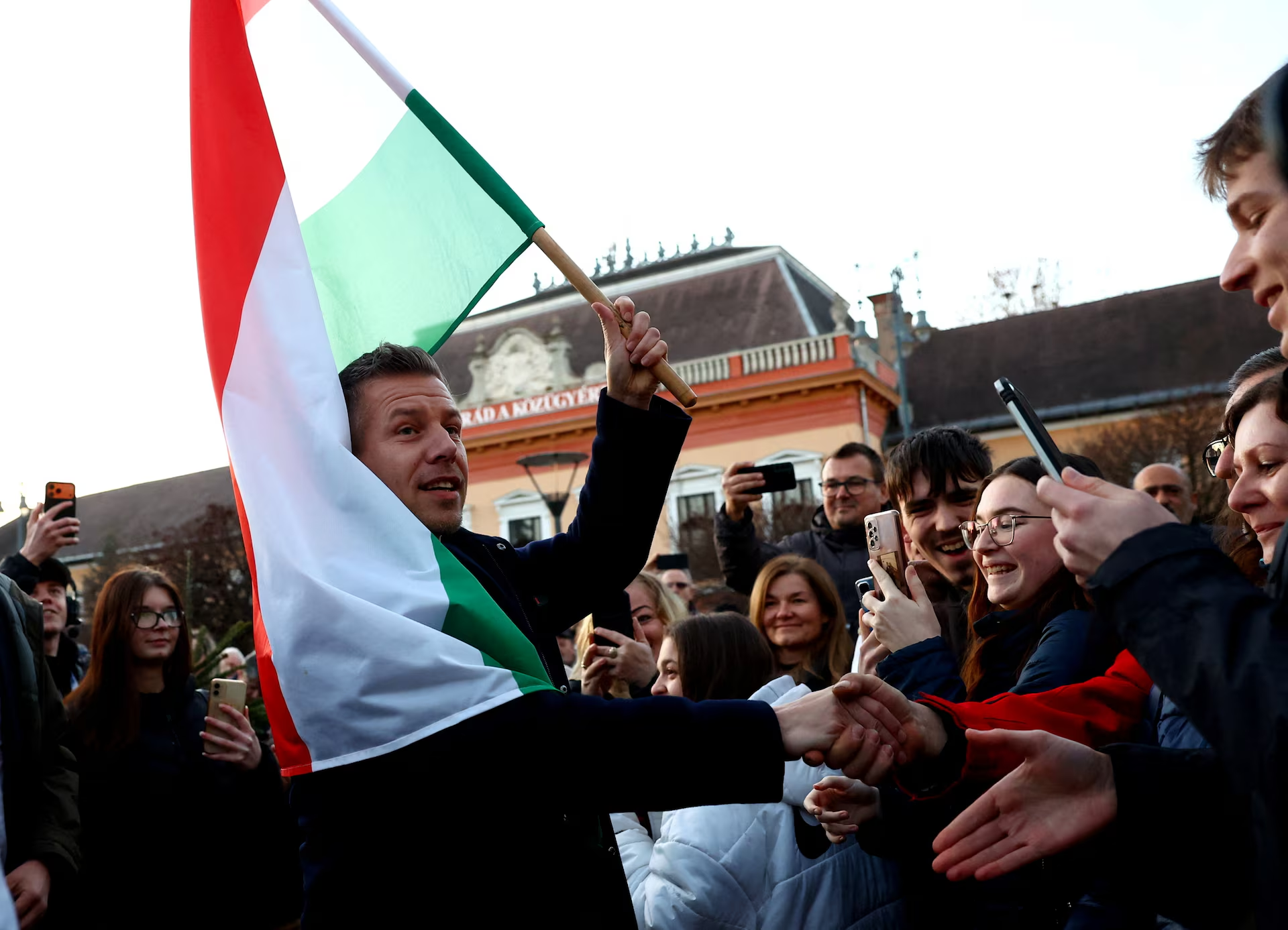
Surveys indicate that Hungary’s opposition Tisza party may secure victory in the upcoming national election on Sunday, potentially marking a significant defeat for long-serving Prime Minister Viktor Orban, who has been an ally of Russia and received considerable backing from U.S. President Donald Trump.
The final polls conducted before voting commenced and released after polling stations closed on Sunday indicated that the emerging centre-right Tisza party, led by Peter Magyar, is receiving 55-57% support, surpassing Orban’s nationalist Fidesz party.
According to pollster Median, this could result in Tisza securing 135 seats in the 199-member Hungarian legislature. According to projections from Pollster 21 Research Centre, Tisza is anticipated to secure 132 mandates.
Several last-minute polls, carried out prior to an election but released only after voting concludes, have demonstrated accuracy in Hungary historically. No exit polls will be available for the election on Sunday.
“We have observed the recent polls, and considering the turnout data and the information we have gathered, we feel optimistic,” Magyar stated during a briefing.
Nonetheless, Orban’s chief of staff Gergely Gulyas expressed that Fidesz was assured of securing a majority following what he described as a democratic vote.
Significant participation
Pollsters anticipated an unprecedented level of voter participation. As of 1500 GMT, the data indicated that 74.23% of voters had cast their votes, an increase from 62.92% at the same time during the 2022 election. Long queues were observed outside several voting stations in Budapest, as reported by Hungarian television.
The official results are expected to be released later on Sunday evening.
Should the opinion poll results hold true, Orban’s loss after 16 years in power would carry considerable consequences not just for Hungary, but also for the European Union, Ukraine, and further afield.
This could potentially mark the conclusion of Hungary’s confrontational stance within the EU, possibly paving the way for a 90-billion-euro ($105 billion) EU loan to war-torn Ukraine that Orban had previously obstructed. The eventual release of EU funds to Hungary could also be implied, which the bloc had previously suspended due to what Brussels described as Orban’s erosion of democratic standards.
Orban’s departure would strip Russian President Vladimir Putin of his primary supporter within the EU and create significant ripples among right-wing factions throughout the West, including Trump’s administration.
A victory for Tisza in Hungary could pave the way for reforms that the party claims would focus on fighting corruption and reinstating the independence of the judiciary and other institutions.
The degree of these reforms will hinge on Tisza’s ability to obtain the two-thirds constitutional majority necessary to overturn significant aspects of Orban’s legacy.
Economic stagnation has negatively impacted Orban’s support.
Orban, a eurosceptic, developed a model of a “illiberal democracy” regarded as a blueprint by Trump’s Make America Great Again (MAGA) movement and its supporters in Europe.
However, a significant number of Hungarians have become increasingly disillusioned with Orban, 62, following three years marked by economic stagnation and rising living expenses, alongside reports of oligarchs connected to the government accumulating greater wealth.
The leader of Tisza, Magyar, seems to have effectively harnessed this frustration.
Casting his vote for Tisza in the Hungarian capital, Mihaly Bacsi, 27, expressed the necessity for change in the country. “We need an improvement in public mood; there is too much tension in many areas, and the current government only fuels these sentiments,” he stated.
Another voter, who identified herself as Zsuzsa, expressed her desire for continuity. “I would truly appreciate it if all the accomplishments of recent years are preserved – and I am deeply concerned about the war,” she remarked, alluding to the ongoing conflict in Ukraine, Hungary’s eastern neighbor.
Orban aimed to frame Sunday’s election as a decision between “war and peace”. Throughout the campaign, the government inundated the nation with signs cautioning that Magyar would lead Hungary into Russia’s conflict with Ukraine, a claim he vehemently refutes.