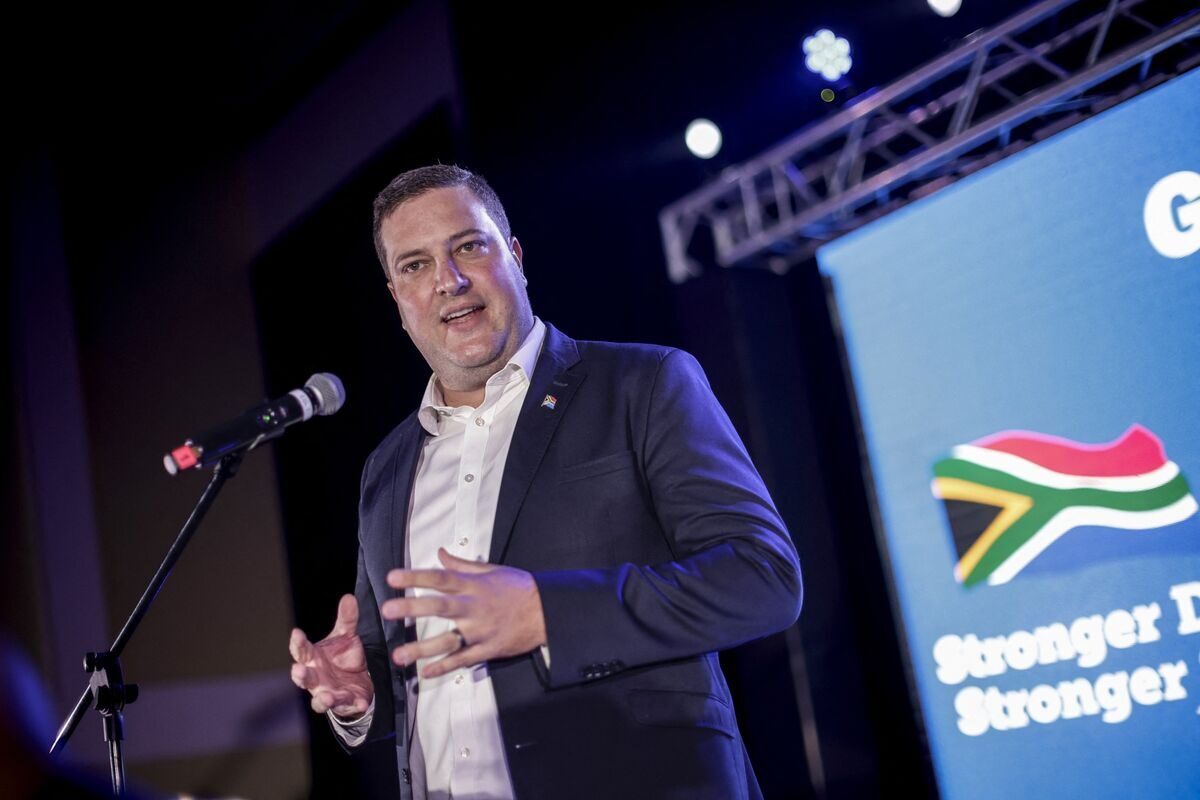
South Africa’s Democratic Alliance (DA) on Sunday elected Geordin Hill-Lewis, the mayor of Cape Town, as its leader. This move comes as the ruling coalition’s second-largest party aims to leverage growing discontent to broaden its influence in the upcoming local elections this year.
The 39-year-old was seen as the leading candidate to take over from Agriculture Minister John Steenhuisen, who has been at the helm of the pro-business party since 2019 and is now stepping aside. “In our efforts, we can achieve victories in more towns and cities than we have ever achieved before,” Hill-Lewis stated during his acceptance speech at a party conference near Johannesburg, outlining his aspirations for the upcoming national election in 2029.
“I am dissatisfied with my role as a junior partner in a coalition government.” “We must strive to take the lead in the national government,” he stated.
Hill-Lewis has provided limited information regarding his plans, yet he is not anticipated to diverge markedly from the policies of his predecessor. The former leader led the DA into a coalition with the African National Congress (ANC) in 2024, while still opposing the ANC on matters such as national health insurance and affirmative action, which the DA stands against.
Africa’s most industrialized country is required to conduct local elections before November, and it is anticipated that President Cyril Ramaphosa’s ANC will experience a decline in its share of the vote once more.
Local polls have historically yielded poorer results for the ANC compared to the national vote, as voters, frustrated by the inability to provide essential services such as water and road repairs, hold accountable the party that has been in power since the end of apartheid in 1994.
DA Faces Challenges in Overcoming Image as a White Party
The DA occupies 22% of the seats in the lower house of parliament, ranking second to the ANC, which holds 41%, and has maintained a similar vote share over the past decade.
The DA is known for safeguarding the interests of South Africa’s white minority, a claim it refutes, and it has not appointed a non-white leader since Mmusi Maimane stepped down in 2019. Some analysts view this as a constraint on growth in a nation that is over 90% non-white. “It would have been significantly simpler for them to connect with a wider audience if there had been a dynamic individual … of a different ethnicity,” stated author and political scientist Susan Booysen.