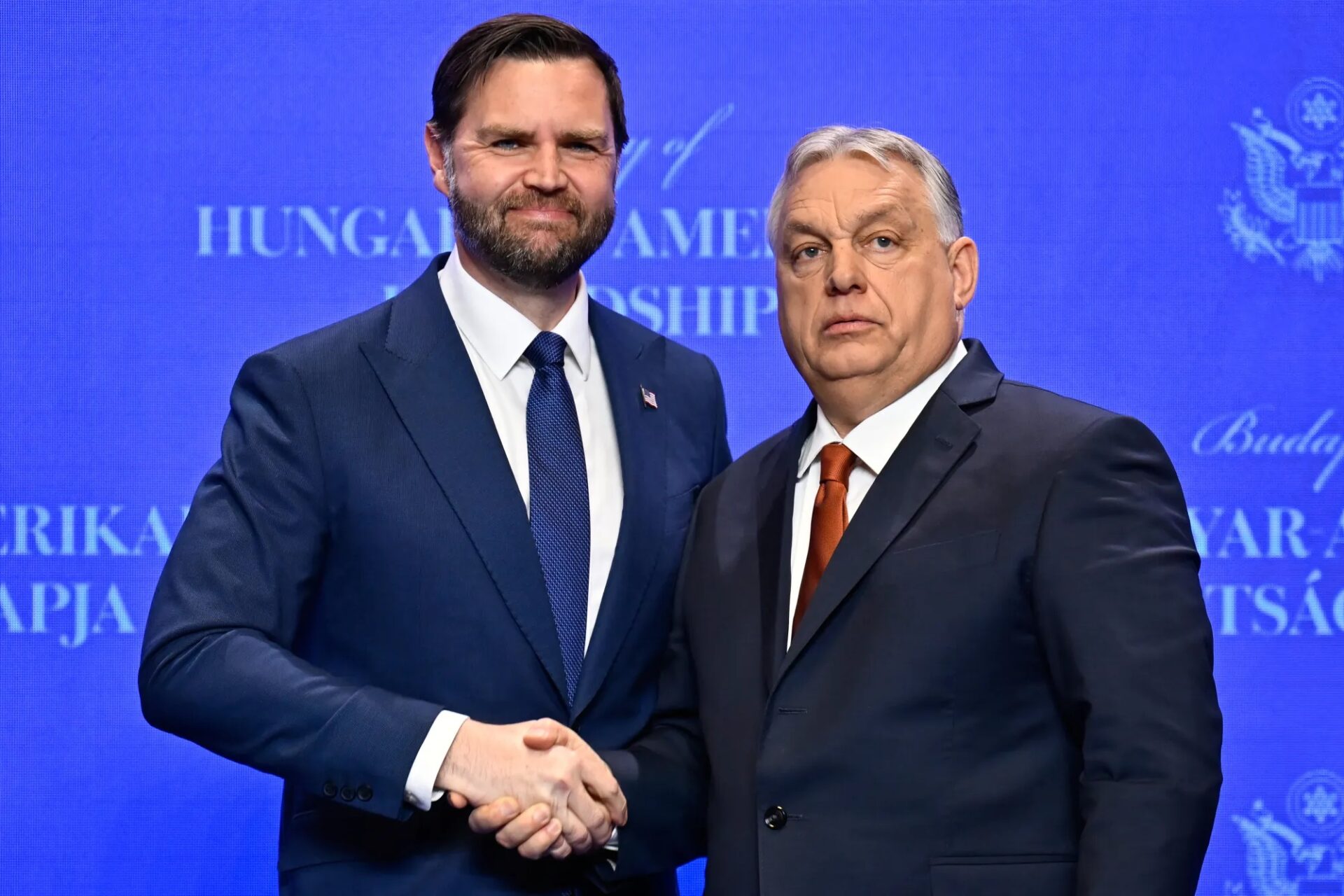
JD Vance Supports Orbán’s Re-Election Campaign in Budapest, Criticizes EU Interference
US Vice President JD Vance supports Viktor Orbán in the Hungarian election, expressing criticism of the EU and voicing concerns regarding allegations of foreign interference.
US Vice-President JD Vance has stepped into Hungary’s election campaign, supporting Prime Minister Viktor Orbán and initiating a new critique of the European Union.
While standing alongside Orbán in Budapest, Vance expressed that he was present in the Hungarian capital “to assist him in this campaign cycle,” although he acknowledged that the US would “collaborate with whoever emerges victorious in this election.”
Péter Magyar, Orbán’s primary opponent, is leading in the majority of opinion polls, presenting the most significant challenge to the long-standing leader in almost forty years of political career.
Vance and his wife Usha arrived in Budapest prior to the vote on 12 April, marking the first high-ranking US visit to Hungary in two decades. Foreign Minister Péter Szijjártó welcomed them, stating that Orbán’s relationship with Donald Trump had brought about a “new golden age” in bilateral ties.
Magyar expressed his appreciation for the visit, stating that his Tisza party would also emphasize strengthening relations with the US if elected, recognizing its role as both a NATO ally and an economic partner.
After discussions with Orbán, Vance strongly condemned the EU and Ukraine, alleging that Brussels was meddling.
He said it was “one of the worst examples of foreign election interference I’ve ever seen or read about… because they hate this guy.”
Vance said he visited partly due to the “disgraceful” interference from Brussels’ bureaucracy.
During a campaign rally, he addressed his supporters: “We want you to decide your future without any outside influences pressuring you or dictating your choices.” I won’t specify who you should vote for, but I will say that the bureaucrats in Brussels should not be heeded because their decisions often undermine national sovereignty and do not reflect the will of the people.
He wrapped up by encouraging voters to “head to the polls this weekend and stand with Viktor Orbán, as he represents your interests.”
EU leaders have expressed frustration over Orbán’s continued veto on funding for Ukraine, with German Chancellor Friedrich Merz describing it as “a gross act of disloyalty.”
Vance reiterated assertions, lacking supporting evidence, that Ukrainian intelligence sought to sway elections internationally, claiming that “elements within the Ukrainian intelligence services [had] tried to put their thumb on the scale of American elections, on Hungarian elections.” This is simply their way of operating.
Orbán has positioned his opposition to Ukraine and its president, Volodymyr Zelenskyy, at the forefront of his campaign.
Reports of explosives discovered near the TurkStream gas pipeline, situated close to Hungary’s border, have led to escalating tensions. Ukraine rejected any involvement, characterizing it as a “Russian false-flag operation.”
Critics, such as Magyar, have alleged that Orbán orchestrated the event with Serbian President Alexander Vucic to enhance his electoral backing, suggesting that this collaboration aims to manipulate public perception and rally nationalist sentiments ahead of the upcoming elections.
Orbán’s partnership with Trump began in 2016, marking him as the sole EU leader to support him during the US election. The Hungarian leader expressed support for Trump’s 2024 re-election campaign and obtained exemptions for Hungary from US sanctions on Russian energy companies.
During a campaign rally, Trump expressed admiration for Orbán, referring to him as “a fantastic man” and emphasizing their “tremendous relationship.”
Hungary continues to depend significantly on Russian oil and gas, pushing back against EU appeals to diversify its energy sources. Nonetheless, supply disruptions have compelled Budapest to utilize reserves and import alternative fuel via Croatia.
Recent controversies have also impacted Orbán’s campaign. Leaked calls indicate that Szijjártó communicated sensitive EU (European Union) discussions to Russian officials and advocated for Moscow, a claim he has characterized as “normal diplomacy.”
The European Parliament has described Hungary as a “hybrid regime of electoral autocracy,” and Transparency International has identified it as the most corrupt country in the EU.
Billions of euros in EU funding are currently being withheld due to concerns regarding rule of law and governance standards, which have been exacerbated by allegations of corruption and undemocratic practices in Hungary.