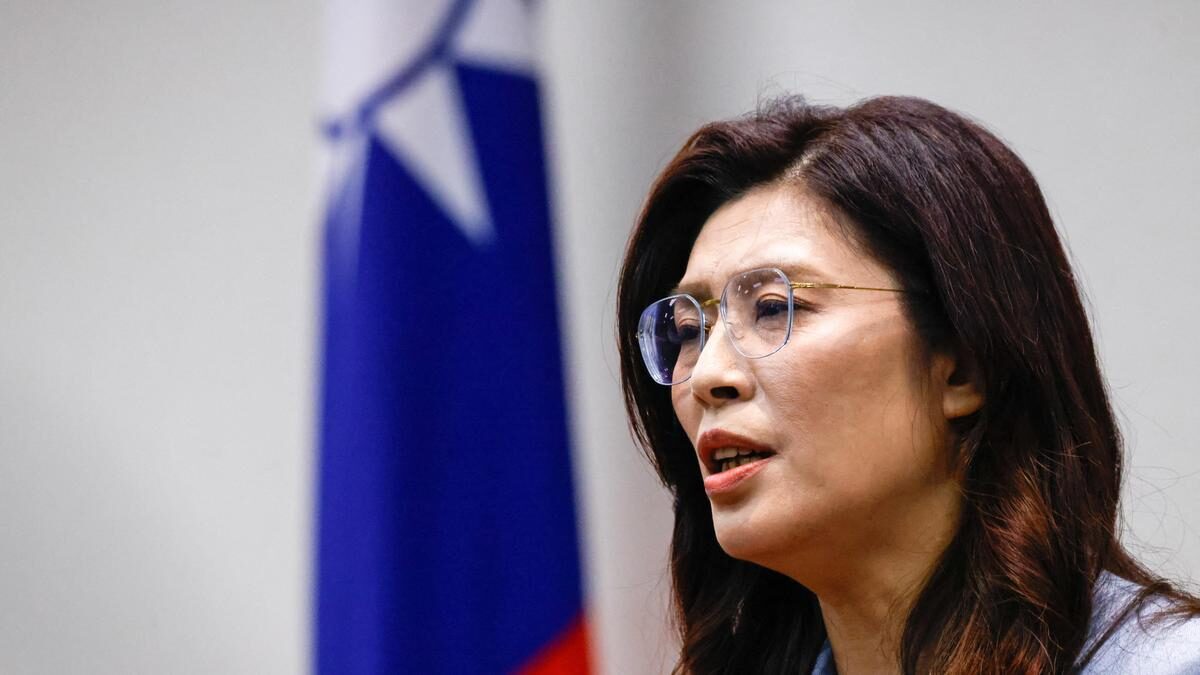
Taiwan’s opposition leader Cheng Li-wun embarks on a peace mission to China amidst rising tensions surrounding the reunification efforts.
Taiwan opposition leader Cheng Li-wun is scheduled to visit China on Tuesday, where she might meet President Xi Jinping. She characterizes this trip as a peace mission, coinciding with Beijing’s increasing attempts to garner support in Taiwan for “reunification.”
Cheng, the chairwoman of the Kuomintang (KMT)—Taiwan’s largest opposition party—is visiting during a period of increased Chinese military pressure on the island, which Beijing asserts as its territory. The journey coincides with the opposition-led parliament in Taiwan postponing the approval of a government proposal for an additional $40 billion in defense spending.
Prior to the visit, the KMT and Taiwan’s ruling Democratic Progressive Party (DPP) engaged in a heated exchange of statements and social media campaigns, each presenting contrasting narratives of peace and security regarding the trip.
“Peace serves as the sole foundation for prosperity and embodies the hope for Taiwan’s future,” the KMT stated in a video message released on Sunday, showcasing young individuals enjoying leisure activities such as swimming and stargazing.
The DPP issued a statement on Facebook, alleging that the opposition party is in alignment with Beijing’s agenda.
The statement indicated that the KMT was attempting to “collaborate with the Chinese communists’ plan to undermine Taiwan’s defense capabilities,” highlighting the postponements in defense spending proposals that have also garnered support from the United States.
Last month, Cheng addressed foreign journalists, asserting that diplomacy should work in tandem with military readiness.
“Peace cannot be attained solely through defense capabilities,” she stated, emphasizing that political engagement is equally vital.
Her visit arrives merely weeks ahead of a scheduled summit in Beijing involving US President Donald Trump and Chinese President Xi Jinping. Both sides are expected to look at limited deals about trade and supply chains, like agriculture and aircraft parts, but major political issues—especially about Taiwan—still need to be sorted out.
During a call in February, Xi advised Trump that the United States “must carefully handle arms sales to Taiwan.”
This is the first visit to China by a KMT leader in ten years, though Beijing has yet to confirm if Xi will meet Cheng, who is set to stay in Beijing starting Thursday.
Taiwan’s Mainland Affairs Council encouraged Cheng to adopt a strong position with Beijing prior to the trip.
She was urged to call on China to cease its military threats and to “respect the Taiwanese people’s right to choose their future.”
Beijing has declined to interact with Taiwan President Lai Ching-te, branding him a “separatist.”
The messaging surrounding China’s ‘reunification’ is becoming increasingly pronounced.
China has not abandoned the option of using force to assert control over Taiwan, although it still advocates for “peaceful reunification” as its favored strategy. Recently, there has been a notable increase in outreach efforts directed at Taiwanese society, efforts that officials in Taipei have dismissed.
On Friday, China’s Eastern Theatre Command, which oversees any potential military operations against Taiwan, unveiled a cartoon illustrating “Taiwan province” during the Tomb Sweeping Festival, implying life under reunification.
The imagery depicted individuals placing flowers at a “Monument for the complete reunification of the motherland,” in front of a sign that alluded to Taipei’s Machangding Memorial Park, the site where accused communist spy Wu Shi was executed by KMT authorities in 1950.
The KMT traces its origins back to 1949, when its forces withdrew to Taiwan following their defeat in the Chinese civil war against Mao Zedong’s communists.
Despite the messaging from Beijing, public opinion surveys in Taiwan have consistently indicated limited support for accepting Chinese sovereignty under the “one country, two systems” model.
When questioned about “reunification” in a press briefing with foreign reporters, Cheng stated that the conditions for such a discussion are not currently established.
“Our focus now should be on establishing peaceful and stable relations across the strait,” she stated.