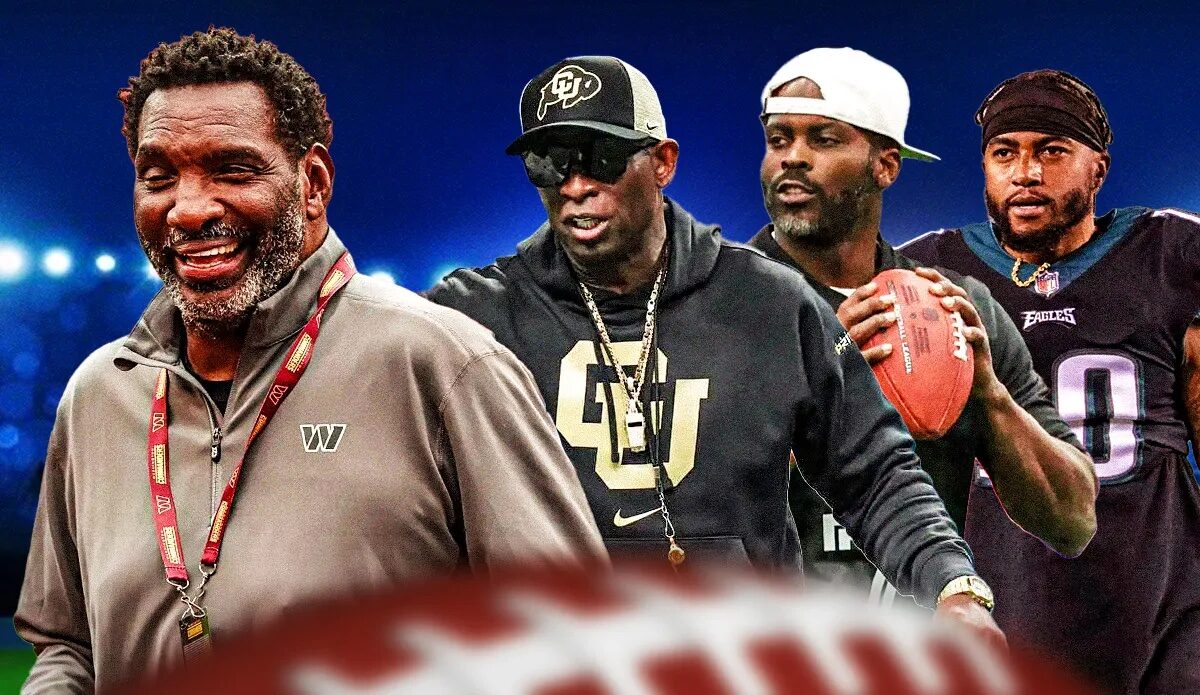
The NFL and NBA deserve to acknowledge HBCUs more than they have in the past
From Jerry Rice and Walter Payton to Shedeur Sanders and Travis Hunter, the HBCU pipeline has always been strong; it was merely the spotlight that faded.
HBCUs to the Pros is a narrative that goes beyond mere sentimentality. This is a correction.
Long before the advent of recruiting services, NIL money, and national TV deals, HBCUs to the Pros had already established itself as the pipeline. The league failed to recognize HBCU talent. It was constructed upon it.
Begin with football, where the crowds are vibrant.
Jerry Rice emerged from Mississippi Valley State University and transformed his performance into legend. He continues to hold the NFL records for receptions, yards, and touchdowns. When discussions of greatness arise, his name is the final word. He accomplished it without the machine supporting him.
Walter Payton, hailing from Jackson State University, set the benchmark for running backs. Nine Pro Bowls. Most Valuable Player in the NFL. A championship ring from the Super Bowl. Ultimately, what truly counted was the way he performed. Unyielding, focused, and indomitable.
Steve McNair from Alcorn State University possessed that same intensity. In 2003, he was co-recipient of the NFL MVP award and led the Tennessee Titans to the edge of a Super Bowl victory. Additionally, he accomplished this while enduring blows that would incapacitate the majority of quarterbacks.
History took another turn when Doug Williams, a product of Grambling State University, stepped onto the grand stage and claimed victory in Super Bowl XXII. He achieved four touchdowns in just one quarter. The discussion surrounding Black quarterbacks has irrevocably changed and can never revert to its previous state.
Then there is Deacon Jones from South Carolina State University, who didn’t just dominate; he epitomized dominance. He originated the term “sack” and informally documented more than 170 of them prior to the statistic being officially monitored. The game needed to align with what he was already accomplishing.
Additionally, Shannon Sharpe from Savannah State University transformed versatility into a formidable asset. Three Super Bowl championships. More than 10,000 receiving yards. He now manages discussions in sports media just as he once commanded defenses.
The narrative extends beyond the realm of football.
Basketball bears the distinct influence of HBCUs throughout its history.
Willis Reed from Grambling State University created one of the most memorable moments in NBA history when he limped onto the court during the 1970 Finals. In a single moment, leadership, toughness, and timing converged, leaving a lasting impact that resonates even now.
Meanwhile, Earl Monroe, fresh from Winston-Salem State University, introduced a style that transformed the game for guards. He was referred to as “Black Jesus” for a specific purpose. His creativity contributed significantly to the evolution of the NBA into the style that the league proudly embraces today.
Sam Jones, hailing from North Carolina Central University, amassed a total of 10 NBA championships. Silently. In an effective manner. While others garnered headlines, he collected rings.
Then Ben Wallace from Virginia Union University changed the narrative completely. Not selected in the draft. Neglected. He achieved the remarkable feat of being named Defensive Player of the Year four times and served as the cornerstone of a championship team. Defense travels, just as hunger does.
Now, fast forward to today, and the energy feels distinct.
Tarik Cohen, hailing from North Carolina A&T State University, compelled the league to adapt due to his remarkable speed and agility. He turned highlight plays into a regular occurrence. Suddenly, scouts found themselves revisiting HBCUs.
Shedeur Sanders arrived at Jackson State University and delivered outstanding performances while under the national spotlight. He accomplished more than merely winning games. He changed the way people viewed things.
When Travis Hunter selected Jackson State as the top recruit in the nation, that choice resonated throughout the entire recruiting landscape. For the first time in a considerable while, a top-ranked player opted for culture instead of convention.
Cam Newton, through Blinn College, has consistently leveraged his platform to enhance HBCU visibility and create opportunities. The advocacy is engaged, rather than merely symbolic.
However, none of this occurs without a framework.
At Grambling State University, Eddie Robinson created a powerhouse. More than 200 players have been sent to the NFL. Years of supremacy. When discussions arise about pipelines, his blueprint remains relevant.
The competition between the Southwestern Athletic Conference and the Mid-Eastern Athletic Conference persists in influencing the development of talent. The SWAC embodies both tradition and abundance. The MEAC provides organization and reliability. Both continue to nurture the next level.
NIL money is now coming into play, and the equilibrium is beginning to change.
Howard University programs are securing significant sponsorship opportunities. Spelman College is actively enhancing its institutional power and visibility. The ecosystem is expanding beyond athletics into culture and economics.
Upon Deion Sanders’ arrival at Jackson State, he compelled the entire sports industry to reassess its perspective. Attendance increased. Media coverage surged. Recruiting conversations transformed in an instant.
He did not originate the talent.
He compelled people to pay attention to it.
The truth is straightforward.
HBCUs have consistently been a source of excellence. For a moment, the world seemed to lose its focus.
It is observing once more.