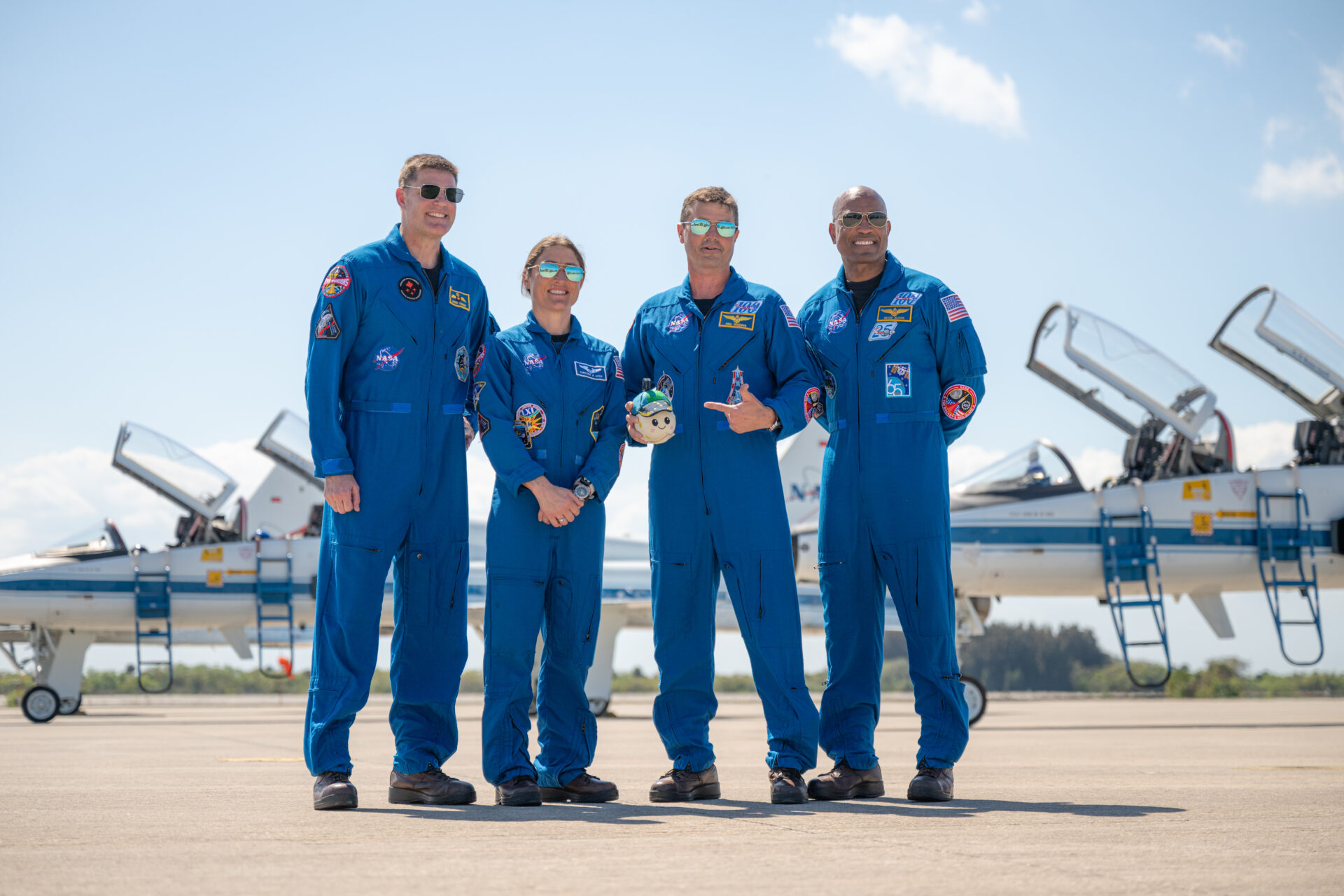
The astronauts of NASA’s Artemis II have arrived in Florida, gearing up for the first crewed Moon mission in more than fifty years.
The four astronauts chosen for NASA’s Artemis II mission arrived in Florida on Friday, marking the beginning of the final preparations for the first crewed journey to the Moon in over fifty years.
NASA astronauts Reid Wiseman, Victor Glover, and Christina Koch, together with Canadian Space Agency astronaut Jeremy Hansen, exited Northrop T-38 jets after flying from Houston, Texas, to NASA’s Kennedy Space Center. They are set to launch into space as early as April 1 aboard NASA’s impressive Space Launch System (SLS) rocket.
They will travel within an Orion crew capsule designed for transporting humans into the depths of space. The mission, lasting approximately 10 days, will take the crew on a swift journey around the Moon and return.
“The nation and the world have been waiting a long time to do this mission again,” Wiseman, the mission commander, told reporters after landing at Kennedy Space Center, adding that he and his crewmates “are really excited to go do this.”
“It has required considerable effort.” It has been a wonderful journey; it feels fantastic to be here in the warm air of Florida,” he added.
Artemis II marks the inaugural crewed mission of NASA’s multi-billion-dollar Artemis program. Although it will not aim for a Moon landing, it will propel astronauts further from Earth than any prior human spaceflight, evaluating the Orion spacecraft’s life-support systems, navigation, communications, and heat shield performance.
Boeing serves as the primary contractor for the SLS core stage, while Northrop Grumman manufactures the rocket’s solid-fuel boosters, and Lockheed Martin is responsible for producing the Orion spacecraft.
The crew has dedicated over two years to training for the mission since their selection in 2023. Since March 18, they have been in standard preflight quarantine at NASA’s Johnson Space Center in Houston and are set to transition to NASA’s Astronaut Crew Quarters in Florida in preparation for launch.
Glover, the pilot of the mission, is set to make history as the first Black astronaut to journey near the Moon. Koch will be the first woman to achieve this milestone, while Hansen will be the first non-American astronaut to venture beyond low Earth orbit.
Every crew member, with the exception of Hansen, has prior experience in space. Wiseman, the mission commander, informed reporters last year that the crew was ready for any eventualities.
“When we leave the planet, we may return home shortly after, perhaps spending three or four days orbiting Earth, or we might head to the Moon, which is our intended destination,” Wiseman stated. “However, this is a test mission, and we are prepared for all possible scenarios.”
In 2014, Wiseman, 50, spent 165 days on the International Space Station, a mission launched with a Russian Soyuz spacecraft. He subsequently assumed the role of NASA’s chief astronaut before leading Artemis II.
Glover, 49, dedicated 168 days to space exploration starting in 2020 as the pilot of NASA’s Crew-1 mission, marking the inaugural operational ISS mission utilizing SpaceX’s Crew Dragon capsule. Prior to his tenure at NASA, he piloted over 40 aircraft throughout his US Navy career, which encompassed combat deployments and responsibilities as a test pilot.
Koch, 47, achieved a remarkable milestone in 2019 by setting the record for the longest continuous spaceflight by a woman, spending an impressive 328 days aboard the ISS. With a background in electrical engineering and physics, she has experience as a NASA engineer and has conducted extensive research expeditions in Antarctica.
Hansen, 50, who became a Canadian astronaut in 2009, will embark on his inaugural spaceflight. His seat symbolizes a deep-rooted collaboration between the US and Canada in human spaceflight, highlighting Canada’s role in providing robotics for use on the ISS, such as the Canadarm2, which is essential for the assembly and maintenance of the station.