Certain family members are spearheading demands for change while Tunisian opposition figures remain incarcerated
The families of numerous imprisoned opposition figures in Tunisia stand out as some of the last voices advocating for democratic freedoms as they strive for the release of their loved ones detained in what rights organizations have labeled a crackdown on dissent by President Kais Saied.
Over the past three years, authorities have imprisoned the leaders of Tunisia’s primary opposition parties, along with numerous politicians, journalists, businessmen, and others. They face allegations of conspiring against state security, money laundering, and corruption—claims they assert are unfounded.
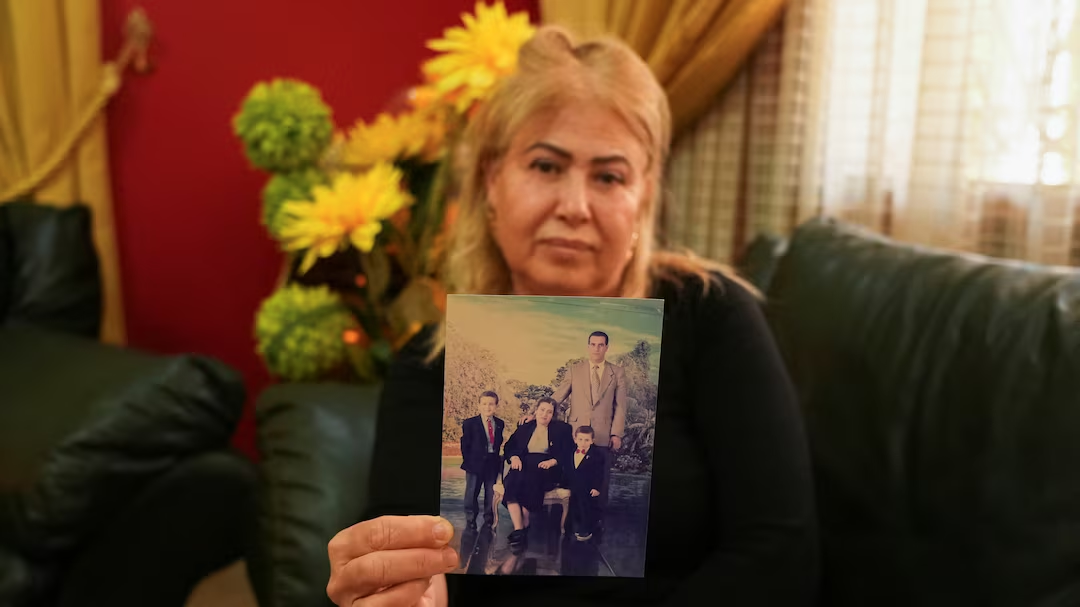
Youssef Chaouachi, a 35-year-old engineer, is among the family members protesting. He became an activist following the detention of his father, a prominent opposition figure, three years ago. Ghazi Chaouachi, a Social Democrat, received a 20-year prison sentence in 2025 for allegedly conspiring to overthrow Saied, a claim he vehemently denies. “We are now the ones organizing protests, engaging with the media, and placing ourselves on the front lines.” “We didn’t choose this role,” said Youssef Chaouachi, who protested on a street in Tunis last month, holding a picture of his father.
The detentions and prosecutions have been extensive, leaving few opposition voices free in a nation that was once celebrated as a success story of the 2011 Arab Spring, according to local and international human rights groups. “It feels like the revolution never happened,” Chaouachi remarked.
The media office of Tunisia’s government has not provided a response to inquiries regarding allegations of a crackdown and the fabrication of charges. The president has consistently stated in discussions with ministers, most recently at the close of 2025, that he is engaged in “the process of cleansing the country of the corrupt and traitors.”
In 2022, the president dissolved Tunisia’s Supreme Judicial Council and dismissed dozens of judges, citing accusations of corruption and obstruction of justice. The opposition claims this action undermined judicial independence.
Last December, Justice Minister Leila Jeffel informed parliament that the courts uphold the law, the ministry is dedicated to justice, and they will not harm anyone. She also stated that the judiciary operates independently and that judges have no reason for concern.
The ministry was unavailable for comment.
The suppression of dissent prompted the four relatives of different detainees interviewed by Reuters to take action beyond merely advocating for their release. They organized marches, established advocacy groups, and participated in media interviews to demand political change and the reinstatement of civil liberties.
Currently in Tunisia, the majority of political parties are either dormant or their leaders are incarcerated.
Sit-ins outside jails
Relatives of the detained have increasingly taken to the streets, participating in protests and sit-ins outside courts and prisons, alongside other civil society activists.
There is scant indication that they can achieve the change they seek, yet they seem to be garnering public sympathy, as evidenced by the increasing number of protesters in at least three mass marches recently, as reported by Reuters reporters.
According to activists, the relatives’ efforts coincide with the challenges faced by Saied’s government, including labor strikes, dissatisfaction over the erosion of civic freedoms, economic difficulties, and environmental decline.
In 2021, Saied dissolved parliament and commenced ruling by decree, aiming to eliminate what he described as widespread corruption and mismanagement. A new parliament was elected in 2022, achieving a voter turnout of 8%.
“Tunisia has become a massive prison,” Youssef Chaouachi proclaimed at a protest in February, with dozens of policemen standing close by.
His father was incarcerated alongside a variety of notable individuals, including moderate Islamist Rached Ghannouchi; Abir Moussi, a supporter of former President Zine El Abidine Ben Ali; as well as veteran left-wing politician Nejib Chebbi and his brother Issam.
Their lawyers asserted that the cases were contrived and driven by political motives, intended to marginalize the opposition, and emphasized that there is no substantial evidence to establish their guilt.
Reuters did not conduct an independent review of the evidence.
The government has stated that the charges were legitimate.
The son of prominent lawyer Ahmed Souab has spearheaded protests that attracted thousands in recent months, culminating in Souab’s release after an appeal ruling. Meanwhile, the son of detained politician Chaima Issa consistently demonstrates outside prisons. ‘INJUSTICE HAS UNITED US.’
Faiza Rahem, the spouse of detained opponent Issam Chebbi, expressed that the lack of opposition leaders motivated her to take action.
“We weren’t involved in politics, but the injustice compelled us to take action,” she remarked, noting that it had brought her together with other families of the imprisoned, even those from various political factions.
The incarcerations now shape the cadence of family life, she stated. When family members arrange to meet or travel, it is essential for them to discuss prison visit schedules and the meals they will bring.
The suburban Tunis home of the Chaouachi family is hauntingly silent. During Ramadan meals, the dinner table seats, once filled with lively discussions, remained empty. In the kitchen, Sofia Ben Agla, Ghazi’s wife, prepared a week’s worth of food to bring him in prison.
Certain relatives have personally encountered legal action.
Ghazi Chaouachi’s son Elyes, Youssef’s brother, is currently in exile and is facing over 70 years in prison after being convicted on multiple charges, including terrorism, defamation for criticizing Saied and judges on Facebook, and inciting violence against judges, all of which he denies. “I could have chosen to remain silent and lead a normal life—visiting my father during holidays. ” However, I opted for a different route. “I decided to be a voice for those who lack one,” he shared with Reuters from his residence in France.
During a meeting at the presidential palace in Carthage last year, the president stated to the prime minister that Tunisia is a nation where freedoms are assured.