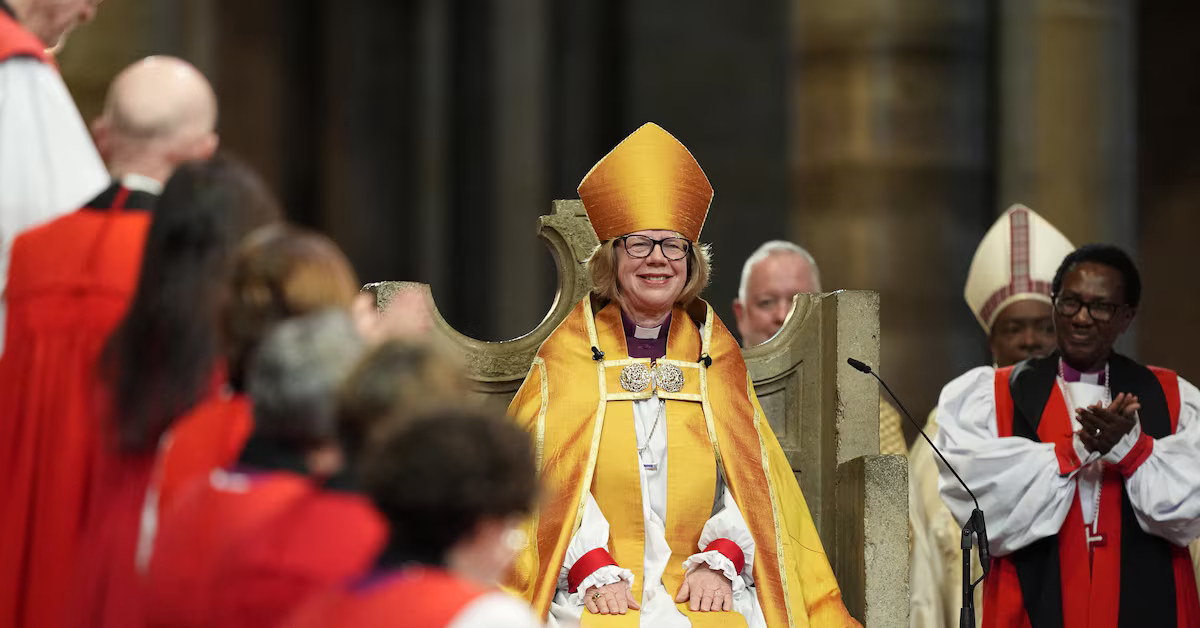
Sarah Mullally has made history as the first female archbishop of Canterbury, committing to fostering unity, justice, and peace in the face of global Anglican divisions and challenges.
Sarah Mullally has officially been installed as Archbishop of Canterbury, signifying the start of her public ministry as the first woman to head the Church of England.
On Wednesday, the former nurse took her place on the historic Chair of St. Augustine at Canterbury Cathedral, in front of a congregation of approximately 2,000 guests. Among the attendees were Prince William, Catherine, Princess of Wales, and British Prime Minister Keir Starmer, as well as various global religious leaders.
While Mullally officially took office in January, the ceremony represented the symbolic beginning of her role as the spiritual leader of the global Anglican Communion, which comprises around 85 million members globally.
In her inaugural sermon, Mullally expressed, “As I commence my ministry today as archbishop of Canterbury, I reaffirm to God: ‘Here I am.'” She prayed for global peace, requesting that “peace prevail” in regions affected by conflict, such as the Middle East, Ukraine, Sudan, and Myanmar.
The 63-year-old recognized previous shortcomings within the Church, especially in safeguarding measures that resulted in the resignation of her predecessor, Justin Welby. She emphasized the importance of accountability, asserting that the Church must “stay dedicated to truth, compassion, justice, and action.”
The installation ceremony commenced with Mullally tapping on the cathedral’s west door, adorned in ceremonial robes featuring a clasp inspired by her previous National Health Service nurse’s belt. Children welcomed her as prayers and readings were shared in various languages, including Urdu.
Mullally also donned a historic ring that was originally presented to former Archbishop Michael Ramsey by Pope Paul VI in 1966, symbolizing the enhancement of relations between Anglicans and Catholics centuries after the division initiated by King Henry VIII.
The ceremony took place during the Feast of the Annunciation, marking the biblical moment when the Virgin Mary received the news of her impending birth of Jesus, a theme that resonated throughout the service.
Prior to the installation, Philip Mounstephen characterized the moment as significant. “It indicates a significant transformation that has occurred within the Church,” he told Reuters, highlighting the importance of a woman taking on a role “older than the Crown.”
Nonetheless, Mullally’s appointment has sparked some controversy. The Global Anglican Future Conference, which includes numerous churches from Africa and Asia, initially expressed opposition to her leadership due to concerns surrounding same-sex blessings and the ordination of women. The group has since decided against appointing a competing figurehead, choosing instead to establish a new council that unites the dissenting provinces.
The Anglican Consultative Council has also decided against a proposal for a rotating presidency, which could have lessened Canterbury’s traditional leadership role, due to worries that it might lead to competing centers of authority.
Disagreements regarding LGBTQ matters and women’s leadership persistently pose challenges for the Anglican Communion, as recent archbishops find it difficult to uphold unity amid growing theological differences.
Mullally previously highlighted the importance of inclusivity while addressing these tensions, stating to Reuters: “We’re a family with a shared root, and with any global church, there is great diversity in it.”
The Church of England, having separated from the Roman Catholic Church almost 500 years ago, continues to be a significant global institution. The Archbishop of Canterbury acts as its symbolic leader within a worldwide Anglican community that has been influenced by centuries of missionary efforts.