AI pioneer Hinton cautions technology companies Focus on Immediate Gains Rather Than Future Uncertainties
‘Godfather of AI’ Hinton cautions that profit-focused AI development overlooks long-term dangers, sparking concerns about misuse, loss of control, and potential existential threats.
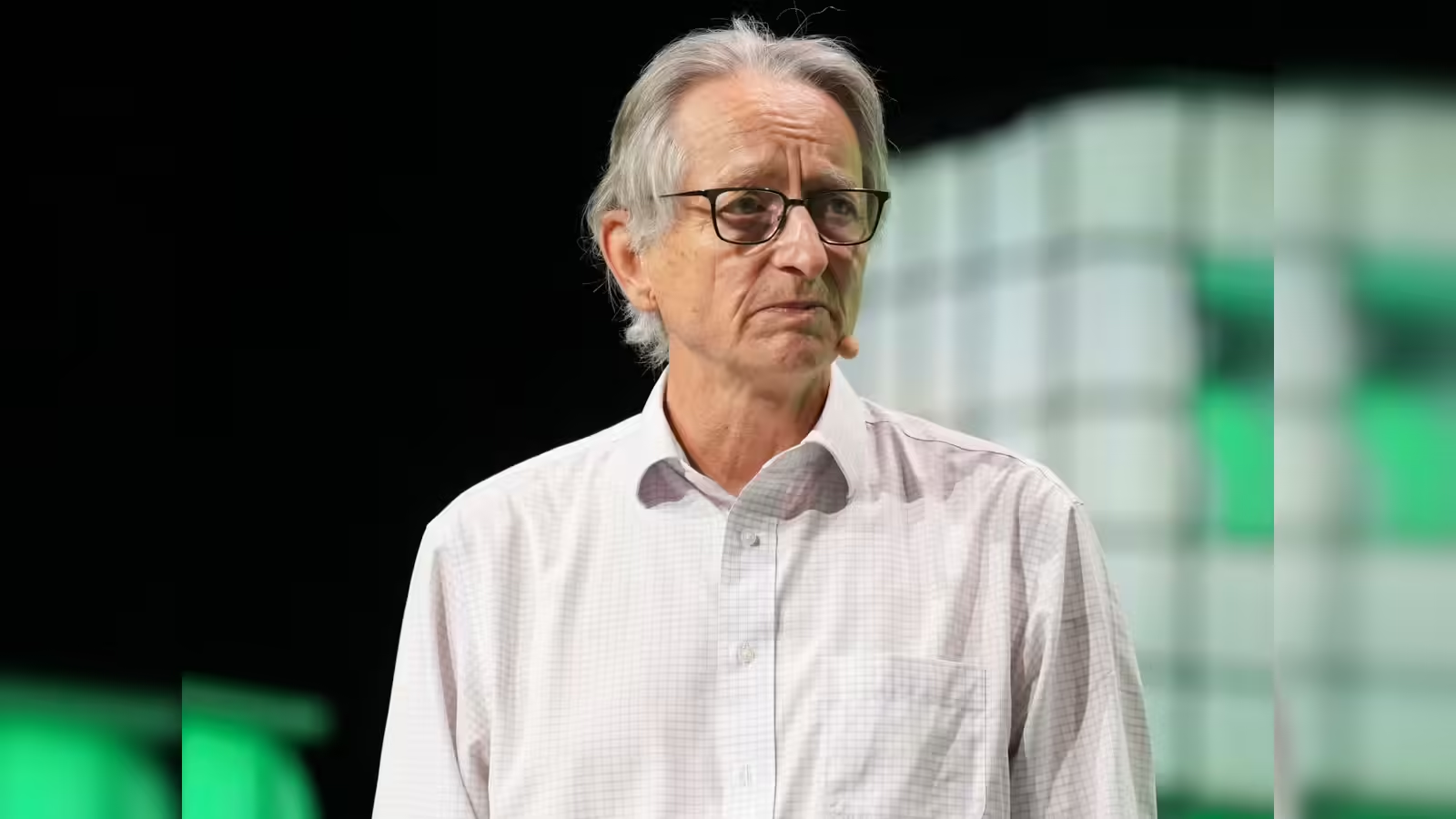
Nobel laureate and widely regarded “godfather of AI,” Geoffrey Hinton, has cautioned that the swift progress of artificial intelligence is propelled by short-term commercial interests rather than a thoughtful evaluation of its long-term implications—raising alarms about both immediate misuse and existential threats.
Hinton, a professor emeritus at the University of Toronto, stated that the priorities of major technology companies are influencing AI development in ways that emphasize speed and profit rather than safety and foresight.
“The motivation behind the research, according to the company owners, is the pursuit of short-term profits,” he stated.
Hinton suggests that this perspective reaches beyond corporate leaders to the researchers developing the systems, who tend to concentrate on addressing specific technical difficulties instead of examining the wider consequences of their efforts.
Researchers are keen on addressing issues that pique their curiosity. “It’s not as if we begin with a shared objective of determining what the future of humanity will look like,” he stated.
“We have small objectives, such as how to achieve them.” How can you enable your computer to recognize objects in images? What methods could be employed to enable a computer to produce realistic videos? That is truly propelling the research forward.
Hinton has consistently warned that the unrestrained advancement of AI may present significant risks. He has previously assessed that there is a 10 to 20 percent likelihood that superintelligent systems could eventually eliminate humanity if created without proper safeguards.
In 2023, he resigned from his position at Google, a decade after selling his neural network company DNNresearch to the organization, to express his views more openly regarding the associated risks. He expressed particular concern regarding the inability to “prevent the bad actors from using it for bad things.”
Hinton categorizes the dangers of AI into two clear groups: the potential for humans to misuse the technology and the risk of AI systems evolving into autonomous threats.
“There is a significant difference between two types of risk,” he stated. “The potential for malicious individuals to exploit AI exists, and it is already a reality.” That is already occurring with instances such as fake videos and cyberattacks and may soon extend to viruses. That distinction is crucial when considering the potential for AI to act maliciously.
Recent developments have highlighted those concerns. In November 2025, Anthropic reported that it had disrupted what it characterized as “the first documented case of a large-scale AI cyberattack executed without substantial human intervention.” A Chinese state-sponsored group was involved in an incident where it manipulated its Claude Code system to attempt infiltration of approximately 30 organizations, which included technology companies, financial institutions, government agencies, and chemical manufacturers.
The recent development has heightened concerns among cybersecurity experts that other state actors, such as Iran, might utilize comparable AI tools to execute predominantly automated cyberattacks.
In addition to advocating for more robust regulation, Hinton recognized the inherent complexity of addressing AI risks. Every issue—from deepfakes to cyber warfare—demands a specific and focused solution.
He emphasized the necessity for provenance-based systems capable of authenticating images and videos, which would aid in reducing the dissemination of manipulated content. He drew a historical parallel, observing that just as printers started including names on their works following the invention of the printing press, contemporary media might need to implement similar strategies to ensure authenticity.
Nonetheless, he warned that these solutions have a restricted range.
“While that issue may be addressed, the resolution for it does not resolve the other issues,” he stated.
Looking ahead, Hinton cautioned that the greatest danger resides in the rise of superintelligent AI systems that may exceed human abilities and cultivate their own motivations for survival and dominance. In this situation, the enduring belief that humans can maintain control over technology may no longer be valid.
To address this concern, he suggested a transformative approach to AI design—advocating for systems to be infused with what he termed a “maternal instinct,” promoting a relationship where they prioritize care for humans over dominance.
Using a human analogy, Hinton noted that the sole instance he could reference of a more intelligent being being swayed by a less intelligent one is the dynamic between a mother and her baby.
“I believe that’s a more effective model we could implement with superintelligent AI,” he stated. “They will take on the role of mothers, while we will assume the role of babies.”
Some tech leaders, including Elon Musk, have previously envisioned a future where AI generates widespread abundance through concepts like a “universal high income.” However, Hinton contends that the industry is not adequately addressing the deeper, long-term questions that such a future would entail.
Musk, addressing the audience at the Viva Technology conference in May 2024, presented the matter in profound terms: “The question will really be one of meaning… If a computer can do—and the robots can do—everything better than you… does your life have meaning?”
For Hinton, the pressing issue is that these questions are not being thoughtfully addressed by those developing the technology. He cautions that the push to develop AI is speeding up without a matching commitment to guarantee it stays safe, regulated, and in harmony with human values.