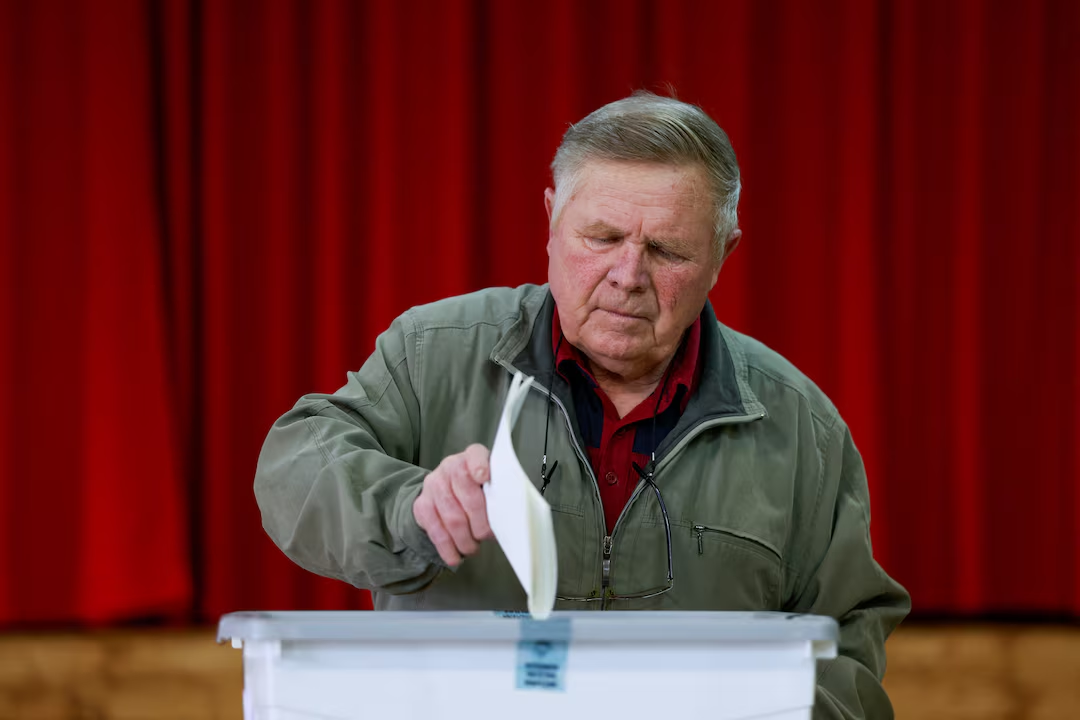
Slovenians participated in a parliamentary election on Sunday featuring incumbent liberal Prime Minister Robert Golob and right-wing populist Janez Jansa. Neither candidate appears poised to secure a majority, with the outcome likely hinging on smaller coalition partners, such as the Green Party and the Social Democrats, who could play a crucial role in forming the next government.
By 11 a.m. (1000 GMT), over 362,000 individuals, representing 21.38% of the electorate, had already voted, surpassing the 21% recorded in the 2022 election, which achieved a historic turnout of 71%. Slovenia’s election commission is anticipated to release preliminary results after 8:30 p.m. local time.
Opinion polls prior to the vote suggested that pro-Donald Trump Jansa’s Slovenian Democratic Party (SDS) and Golob’s Freedom Movement (GS) were poised for a tight contest following a last-minute controversy surrounding claims of foreign interference and corruption.
Jansa stated that the vote is among the most significant in Slovenia’s 35 years of independence and will determine the future trajectory of the nation.
“I express my hope that Slovenia will eliminate the organized criminal organization,” he stated to reporters following his vote in the village of Arnace, located 85 km northwest of the capital, Ljubljana.
Analysts say Jansa, who is seeking a fourth term as premier of the European Union and NATO member state of 2 million people, has a devoted voter base, and the lower the turnout, the higher the chances of him winning the election.
Slovenia’s domestic and foreign agenda is at stake, as the outgoing government concentrated on social and health reforms, yielding mixed results.
Jansa has pledged to implement tax reductions for businesses while reducing funding for civil society, welfare, and media.
Pro-Israeli Jansa, an ally of Hungary’s veteran nationalist leader Viktor Orban, would likely alter Golob’s foreign policy, which positioned Slovenia as one of the few European nations to recognize an independent Palestinian state and, last year, to impose an arms embargo on Israel.
After casting his vote, Golob urged voters to “follow your heart, feed it with love for your country, and the path ahead will be clear,” despite his government imposing restrictions on fuel purchases at the pump, partly due to cross-border fueling and stockpiling related to the Iran war.
Unethical tactics, corruption accusations, and concerns over external interference have emerged as significant issues.
The election campaign, characterized by observers as contentious from the outset, intensified this month with the release of covert videos on an anonymous website that allegedly reveal government corruption.
This week, a report claimed that Jansa had meetings with representatives from the Israeli private intelligence firm Black Cube, which LinkedIn suggested in 2023 was involved in a covert camera operation aimed at activists and journalists prior to Hungary’s 2022 election.
“There was a lack of politeness, and some untruths emerged from both sides, which made me feel that they weren’t sharing the story we, the voters, could understand,” said Ifigenija Simonovic, a 73-year-old writer, after casting her vote in Ljubljana. “So, deciding today was quite challenging.”