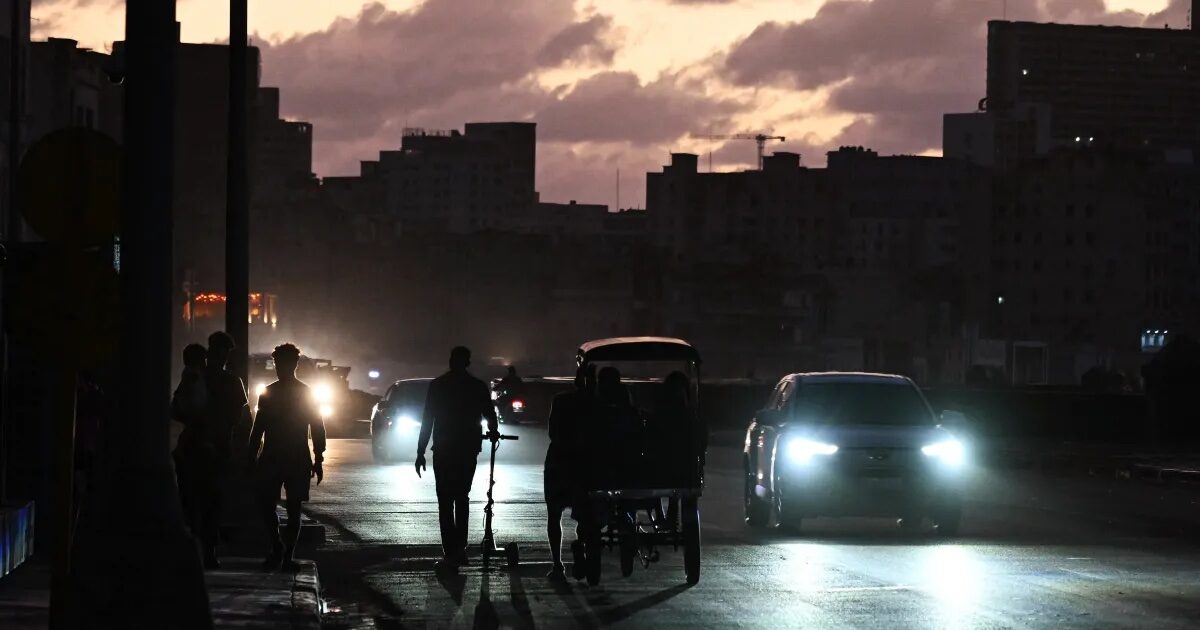
Over 10 million individuals throughout Cuba experience another power outage as grid failures, fuel shortages, and escalating political tensions exacerbate the national crisis.
Over 10 million individuals have experienced power outages in their homes and businesses throughout Cuba following the collapse of the national electrical grid for the second time within a week.
Cuba’s energy ministry announced on social media that “a total disconnection of the National Electrical System has occurred” and noted that “protocols for restoration are already beginning to be implemented.”
The nation’s grid operator, Union Electrica, announced that it is progressively restoring electricity, focusing on what it termed “vital” centers, such as hospitals and water systems.
This month, the Caribbean nation has experienced three significant blackouts, attributed to a US fuel blockade that restricts foreign oil imports essential for operating power stations.
Cuba’s electricity system has faced ongoing challenges due to outdated infrastructure and continuous fuel shortages, exacerbating the effects of the recent outages.
In the midst of the escalating crisis, a coalition of international socialist groups gathered in Havana over the weekend to express their support for the Cuban government, delivering aid donations such as solar panels, essential food kits, and medicines.
The “Nuestra America” convoy, a flotilla transporting supplies from Mexico, faced delays due to rough sea conditions but is anticipated to reach Havana’s port on Monday.
The recent surge of nationwide power outages has ignited uncommon public dissent. Residents in central Havana demonstrated by banging pots and pans on Monday.
In the central Cuban town of Moron, it has been reported that protesters attacked and set fire to the headquarters of the Communist Party on that same day.
Cuba prohibits unauthorized demonstrations, and individuals who challenge this ban risk imprisonment.
The blackout crisis is occurring amidst increased geopolitical tension. Following the capture of former Venezuelan president Nicolas Maduro by US soldiers on January 3, US President Donald Trump has encountered ongoing inquiries regarding the possibility of similar actions being contemplated for Cuba.
Trump is said to be advocating for the ousting of Cuban President Miguel Diaz-Canel, a regional ally of Venezuela, as a prerequisite for lifting the US fuel embargo on the island.
Last week, Trump proposed the idea of a “friendly takeover” of Cuba, later stating that such an action would be an “honor.”
During a conversation with campaigners distributing humanitarian supplies over the weekend, Díaz-Canel stated that the island has a “preparation plan to enhance our people’s readiness for defense” in anticipation of any possible US military aggression.
The American and Cuban governments have engaged in the early stages of bilateral discussions focused on resolving the crisis, as confirmed by Díaz-Canel, though the extent of progress in those talks remains uncertain.
On Friday, Cuban Deputy Foreign Minister Carlos Fernandez de Cossio emphasized that “the political system of Cuba is not open to negotiation, and certainly neither the president nor the position of any official in Cuba is negotiable with the United States.”