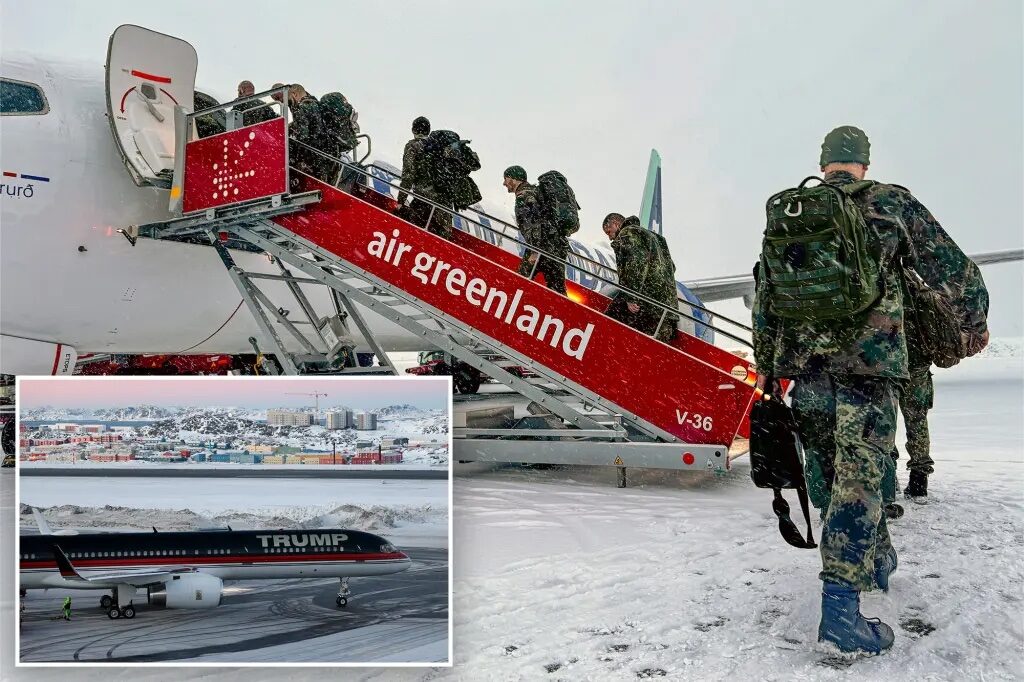
Denmark is said to be ready to undermine Greenland’s runways to prevent a potential US invasion amid escalating tensions regarding the island’s governance.
Earlier this year, Denmark allegedly developed contingency plans to demolish essential airport runways in Greenland due to concerns that the United States, under President Donald Trump, might try to take control of the Arctic territory.
Denmark’s public broadcaster DR reports that Danish troops sent to Greenland in January were provided with explosives and directed to focus on critical infrastructure, such as runways in Nuuk and Kangerlussuaq, to hinder US military aircraft from landing in the case of an invasion. Medical preparations were undertaken, including the transportation of blood supplies to the island to address potential casualties in the event of fighting.
European officials who communicated with the Financial Times subsequently confirmed the report, which referenced various sources from the Danish government, military, and European allies. Denmark’s defense ministry chose not to provide public commentary, whereas a senior military official confirmed that awareness of the operation was limited to a select few because of its sensitive nature.
Greenland, a semi-autonomous territory of Denmark, has emerged as a significant source of friction between Washington and its European allies. President Trump has shown a consistent interest in acquiring the island, highlighting its strategic significance; however, both Denmark and Greenland’s leadership have resolutely dismissed any such proposal.
In early January, elite US forces conducted a swift operation in the capital, Caracas, resulting in the capture of Venezuelan President Nicolás Maduro. This development raised alarms among European governments regarding the possibility of increased American assertiveness on the global stage. Danish officials have reportedly started to contemplate worst-case scenarios, including the potential for direct military action in Greenland.
Copenhagen sought political and military support from key European partners, including France and Germany, along with Nordic allies. A multinational force consisting of Danish, French, German, Norwegian, and Swedish troops was later deployed to Greenland under the pretense of joint exercises referred to as Operation Arctic Endurance.
The deployment featured specialized troops adept in Arctic warfare, alongside air and naval resources strategically placed in the North Atlantic. Although officially labeled as routine exercises, sources suggested that the actual aim was to dissuade any unilateral actions by the US and to guarantee that any effort to take the island would incur substantial costs.
A Danish defense source indicated that the strategy was not primarily aimed at repelling a full-scale US assault, but rather at elevating the stakes enough to deter it. “To acquire Greenland, the US would need to undertake a hostile act,” the source remarked, recognizing the disparity in military strength.
Tensions seemed to diminish later in January when President Trump, addressing the World Economic Forum in Davos, expressed that he did not plan to use force to acquire Greenland. He has since urged for discussions focused on settling the disagreement.
Even with the easing of tensions, the situation emphasizes the significant rifts within NATO regarding Greenland’s future and brings attention to the island’s increasing geopolitical significance in the Arctic area, particularly in relation to resource competition and strategic military positioning among member states.