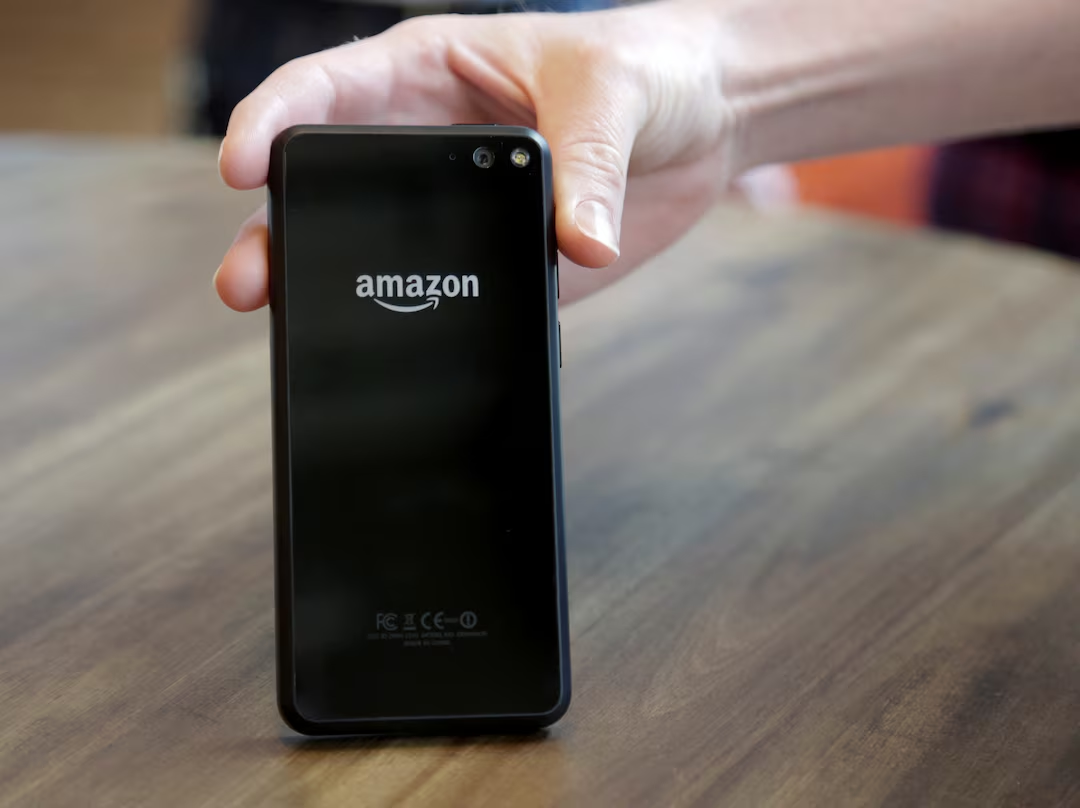
Amazon is set to make a return to the smartphone market over ten years after the unsuccessful launch of the Fire Phone
In 2014, Amazon launched its inaugural smartphone, aiming to compete with Apple and Samsung. The Fire Phone, which was directly overseen by founder Jeff Bezos, was discontinued in just over a year, marking one of Amazon’s most notable failures.
Amazon is now introducing a new phone.
The most recent initiative, referred to internally as “Transformer,” is being created within its devices and services division, as reported by four individuals familiar with the situation. The phone is regarded as a possible mobile personalization device capable of syncing with the home voice assistant Alexa, acting as a link to Amazon customers during the day, according to sources.
The initiative represents the latest development in a prolonged endeavor to realize Bezos’ enduring vision of a pervasive voice-driven computing assistant, reminiscent of the voice-controlled computer featured in the science fiction series “Star Trek.”
Bezos envisioned a smartphone centered around shopping, designed to compete with Apple by providing shipping convenience and discounts via Prime membership. Throughout the journey, Amazon may acquire a significant amount of new data regarding users, accessible solely through mobile devices, along with their purchase history and content preferences.
Amazon has not previously disclosed its initiative to create a new smartphone. Reuters was unable to ascertain certain details, including the expected price of the phone, the revenue Amazon aims to achieve, or the financial investment Amazon has committed to the project.
The timeline for Amazon’s Transformer project remains uncertain, and sources have indicated that it could be abandoned if there are changes in strategy or due to financial issues.
A spokesperson for Amazon chose not to provide a remark regarding this story.
The anticipated personalization features of the new phone are expected to simplify the process of purchasing from Amazon.com, enjoying Prime Video, streaming Prime Music, or ordering food from partners such as Grubhub, according to sources. They requested to remain anonymous, as they were not permitted to speak on internal issues.
According to sources, a primary emphasis of the Transformer project has been the incorporation of artificial intelligence features into the device. This could remove the necessity for conventional app stores, which mandate downloading and registering for applications prior to usage.
The individuals anticipate Alexa to be a crucial feature, although it might not function as the phone’s primary operating system.
Indeed, the brief history of AI-embedded hardware is marked by numerous unsuccessful attempts, including the Humane AI pin and Rabbit R1 assistant, both of which aimed to provide access to generative AI without requiring users to log in to computers or mobile phones. Due to unfavorable critical responses, the gadgets were phased out.
Others remain undeterred in their pursuit of AI-native devices that eliminate the app-driven visual language of smartphones. OpenAI is collaborating with former Apple design chief Jony Ive on various hardware prototypes, while Apple, Google, and Meta are creating new AI-integrated glasses and other devices, including watches and headphones.
Although Amazon’s AWS leads in delivering global cloud computing infrastructure, the company has aimed to address its reputation for lagging in the provision of AI applications as competitors have advanced rapidly.
Alexa, which experienced a multi-year AI-driven overhaul prior to its new launch in 2025, is regarded internally as essential to Amazon’s future in consumer-facing services. The phone, according to the people, represents yet another effort by Amazon to enhance customers’ engagement with AI, whether directly on the device or via Alexa.
DISCONNECTED DEVICE
In 2014, Amazon made its debut in the smartphone market with features like a camera-based shopping tool that identified products, located them for sale on Amazon.com, and added them to customers’ online carts.
The Fire Phone’s unique Fire OS was missing many popular apps found in the Android and iOS app stores. Additionally, it featured a complex multi‑camera screen system designed for displaying 3D images, which consumed a significant amount of battery power, often leading to overheating issues with the device.
Amazon included a complimentary year of Amazon Prime with the Fire Phone, yet it still experienced disappointing sales. Amazon reduced the price from $649 unlocked to $159 and eventually discontinued the phone after 14 months, incurring a $170 million charge for unsold inventory.
Colin Sebastian, an analyst at financial firm R.W. Baird, noted that Amazon’s previous failure with a smartphone does not render future attempts impossible, though he warned that it will be challenging.
“Amazon will need to provide consumers with a strong incentive to change phones, as many individuals are quite loyal to their current app stores,” he stated.
Once again, Amazon confronts the formidable challenge of displacing market leaders Apple and Samsung, which collectively accounted for approximately 40% of global sales last year, as reported by Counterpoint Research, a technology-focused market research firm.
Smartphone shipments are projected to experience their most significant decline in 2026, with an anticipated drop of 13%, as reported by International Data Corporation, due to rising memory chip prices increasing device costs.
DIRECTIVE FOR ‘INNOVATIVE’ DEVICES
A year-old group within Amazon’s devices unit, known as ZeroOne, is leading the project with a mission to develop “breakthrough” gadgets, according to sources. ZeroOne is headed by J Allard, a former Microsoft executive who played a role in the development of devices like the Zune music player and the Xbox gaming console.
Panos Panay, the leader of Amazon’s devices and services unit, has been striving to turn around years of unprofitability in the division. A forthcoming tablet is set to launch that will, for the first time, operate on Android rather than Fire OS and may be priced at approximately $400, as initially reported by Reuters.
According to three individuals involved in the Transformer project, the phone remains in the development phase. The company has explored both a traditional smartphone and a so‑called “dumbphone” with more limited features that could help counter screen addiction. According to these individuals, Amazon has not yet pursued partnerships with wireless carriers for the device.
According to two individuals, one source of inspiration for the new phone has been the Light Phone, a minimalist smartphone priced at $700 that features a camera, map, calendar, and little else, lacking an app store or web browser.
A feature phone could assist Amazon in positioning it as a potential secondary device to complement the iPhones and Samsung Galaxies already in customers’ pockets, according to sources. According to Counterpoint Research, handsets such as the Light Phone and flip phones represented 15% of global handset sales in 2025.
Chetan Sharma, an independent wireless analyst, noted that there is limited information regarding the number of individuals who own multiple phones. He noted that today, this practice is particularly prevalent among white-collar workers seeking a second phone to keep their activities private from employers, as well as parents who wish to provide a device to their teenagers to restrict social media access.