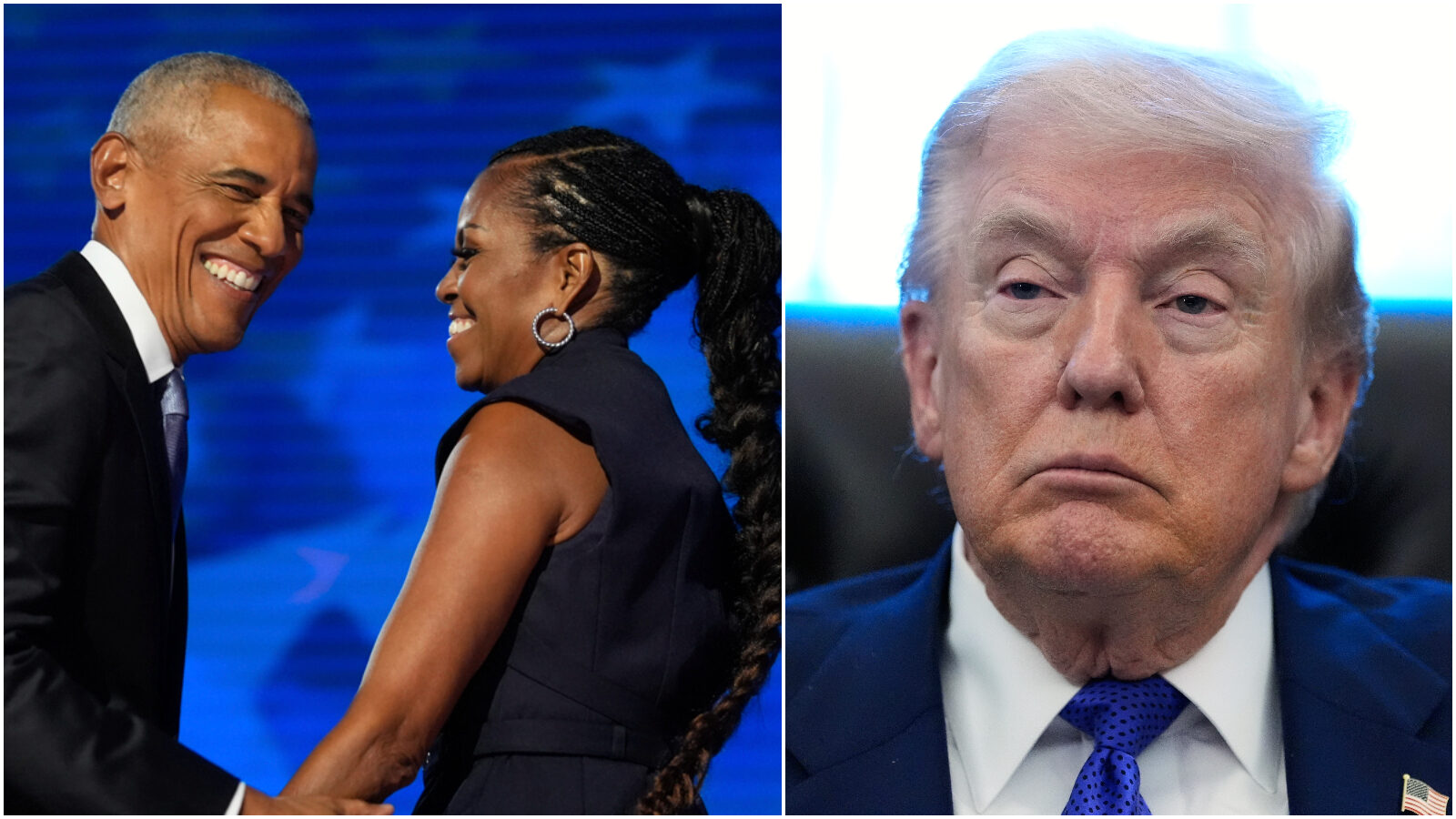
Trump Removes Controversial Obama Video Following Bipartisan Criticism, Attributes Decision to Staffer, Declines to Issue Apology
Trump removes a contentious video featuring the Obamas following criticism, attributes the decision to a staff member, and dismisses demands for an apology despite bipartisan disapproval.
President Donald Trump has removed a contentious social media post that portrayed former President Barack Obama and former first lady Michelle Obama as apes, after facing significant backlash from civil rights leaders, Democrats, and Republicans. This occurred despite the White House’s initial defense of the post, which was later attributed to a staff member.
The video, posted late Thursday on Trump’s Truth Social account, seemed primarily based on a conservative clip that promotes misleading assertions regarding the integrity of the 2020 presidential election. Towards the conclusion of the 62-second video, a captivating image appeared, featuring two primates in a jungle environment with the faces of the Obamas digitally superimposed. The imagery elicited immediate backlash for reflecting enduring racist stereotypes that serve to dehumanize Black Americans.
In response to the backlash, Trump stated on Friday night that he will not issue an apology, informing reporters on Air Force One that he “didn’t make a mistake.” Trump stated that he shared the video because he appreciated its opening and implied that the visuals had not been seen prior to his post. “I saw it and simply passed it along,” he states, adding that “likely no one took a look at the conclusion.”
The White House’s initial response was one of defensiveness. Press secretary Karoline Leavitt rejected the criticism, labeling it as “fake outrage,” and characterized the video as an internet meme that depicts Trump as the “King of the Jungle,” with Democrats represented as animal characters reminiscent of Disney’s The Lion King. The explanation invited additional mockery, given that the 1994 film takes place on the African savannah and features no great apes.
Hours later, facing increasing pressure, the White House acknowledged that the post had been removed and placed the blame on a subordinate who reportedly made the mistake. The unusual recognition of a mistake prompted inquiries regarding the control of Trump’s social media accounts, which he often utilizes to declare policy decisions, intimidate opponents, and promote conspiracy theories.
Trump asserted that the video’s intent was to showcase purported election fraud allegations that had been consistently dismissed by courts, state officials, and even his own attorney general from his first term. The post contributed to a wider overnight wave of messages reinforcing Trump’s unfounded claims that the 2020 election was fraudulent.
The controversy arose in the initial week of Black History Month, shortly after Trump released a proclamation lauding “the contributions of Black Americans” alongside American principles of liberty and equality. A spokesperson for Obama stated that the former president has no comment.
Swift condemnation emerged from all corners of the political spectrum. Tim Scott, the campaign chair for Senate Republicans and the chamber’s sole Black Republican, described the post as “the most racist thing” he has witnessed from the White House and called for its removal. Senator Roger Wicker of Mississippi, a state with the highest percentage of Black residents, described the video as “totally unacceptable” and stated that Trump should issue an apology.
Notable Black leaders dismissed the White House’s rationale. Yvette Clarke, Chair of the Congressional Black Caucus, expressed her belief that the post was not a mere accident, asserting that it illustrates a “toxic and racist climate” within the administration. NAACP President Derrick Johnson described the video as “utterly despicable,” implying that Trump is trying to divert attention from economic issues and the renewed examination of the Jeffrey Epstein case.
During a Black History Month market in Harlem, vendor Jacklyn Monk expressed that the post was embarrassing, even after its removal. In Atlanta, Rev. Bernice King, the daughter of Martin Luther King Jr., referenced her father’s words as she denounced racist dehumanization: “We are not apes.”
The imagery draws upon a profound and enduring history of racism in the United States, where Black individuals have been unjustly likened to animals to rationalize enslavement, segregation, and discrimination. During his presidency and campaigns, Obama encountered comparable portrayals, including racist merchandise that depicted him as a primate.
The episode contributes to Trump’s history of racially charged rhetoric, encompassing birtherism, referring to predominantly Black nations as “shithole countries,” and employing language in recent campaigns that resonates with historical dehumanization. Although Trump stated that he condemns racism, critics contend that his words and actions persist in reinforcing it.
In the face of demands for accountability from both sides, Trump displayed a steadfast resolve, with no indication of retreat and no apology on the horizon.