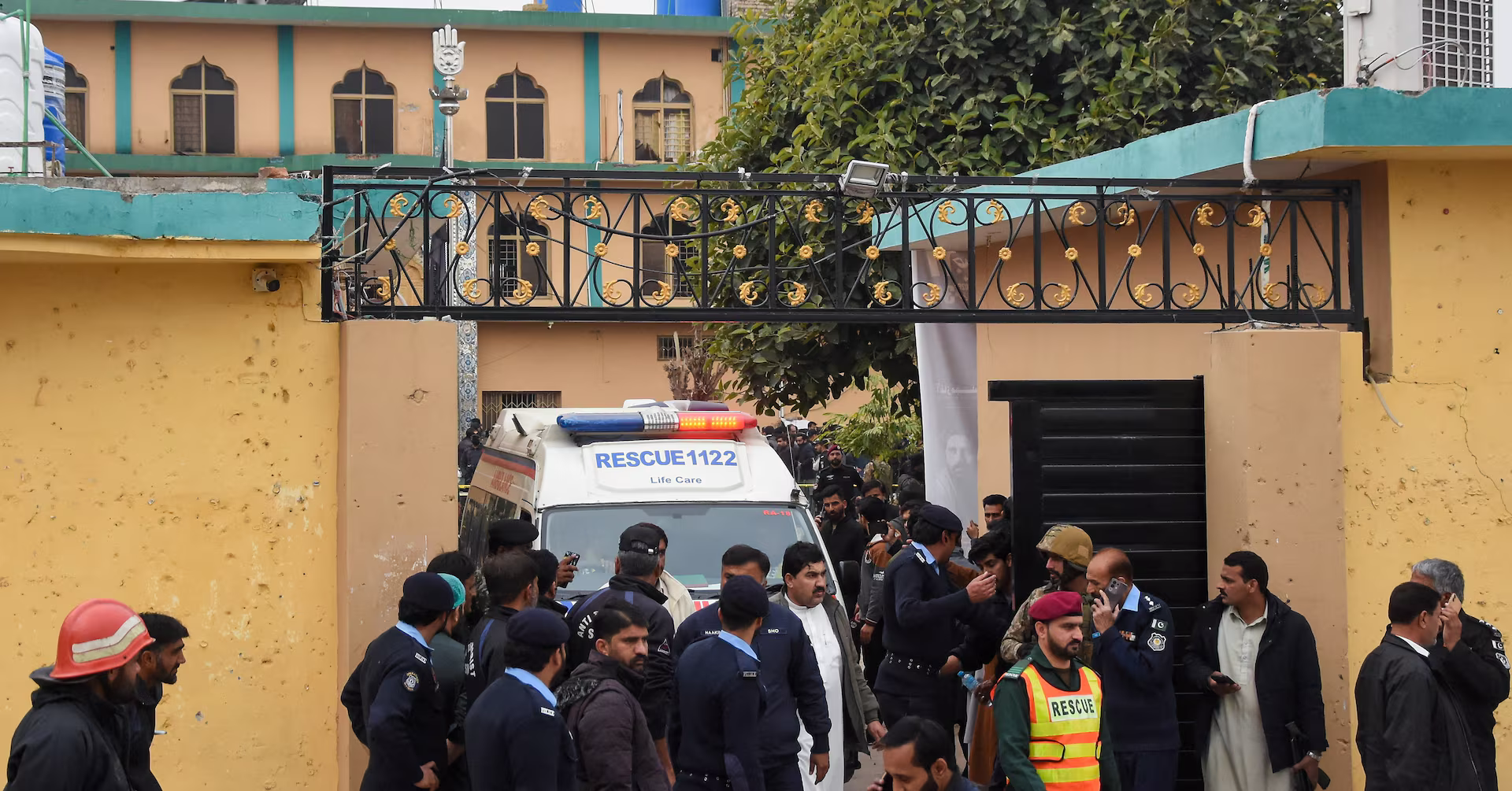
At least 31 people have died in a bombing at a Shi’ite mosque in Islamabad, with the Islamic State claiming responsibility for the attack
An assailant opened fire at the entrance of a Shi’ite Muslim mosque in Islamabad on Friday, subsequently detonating a suicide bomb that resulted in the deaths of at least 31 individuals. This incident marks the deadliest attack of its nature in Pakistan’s capital in over ten years.
The Islamic State took responsibility for the attack in a statement released on its Telegram channel. The militant group additionally published an image that purportedly depicts the attacker wielding a gun, with his face obscured and eyes blurred. The photo could not be immediately verified by Reuters.
Officials reported that over 170 individuals were injured in the explosion, which occurred after guards confronted the attacker as he entered the Khadija Tul Kubra Imambargah compound on the city’s outskirts.
Images from the site depicted bloodied bodies sprawled on the carpeted mosque floor, encircled by shards of glass, debris, and frantic worshippers. Numerous additional injured individuals were sprawled across the gardens of the compound while cries for assistance echoed around them.
Witnesses reported hearing gunfire, followed by a loud explosion, and shortly thereafter, prayers commenced.
The individual detonated explosives in the final row of worshippers, as noted by Defence Minister Khawaja Asif on X.
He claimed that the bomber had previously traveled to Afghanistan and accused neighboring India of sponsoring the attack, yet he did not provide any evidence to support his assertion.
India’s foreign office condemned the attack, characterizing Pakistan’s statement as “baseless”.
“It is regrettable that Pakistan opts to deceive itself by attributing its internal issues to external factors, rather than earnestly confronting the challenges affecting its social structure,” the statement remarked. ‘BLOOD EVERYWHERE’
At the largest public hospital in Islamabad, family members anxiously awaited news outside and in the crowded corridors.
Sarfraz Shah, 46, shared that he had attended the mosque with his younger brother Manzar, 39, as he routinely did every Friday. “I heard the gunshots and was attempting to comprehend what had occurred when a tremendous explosion erupted,” Shah recounted at the Pakistan Institute of Medical Sciences hospital. “It sent people flying in all directions.” Smoke filled the air. None were aware of what had transpired. Then there was blood all around.
With tears in his eyes, he expressed that there was no trace of his brother anywhere, but upon arriving at the hospital, he learned that Manzar was among the deceased.
A devastating explosion occurred at a Shi’ite Muslim mosque in Islamabad.
CAPITAL IS ALREADY ON ALERT FOR THE VISIT
The assault marked the most lethal suicide bombing in Islamabad in over ten years, as reported by conflict monitor ACLED.
Shahid Malik, a police official involved in transporting the injured and deceased to the hospital, described his experience as a nightmare. “I have encountered numerous crime scenes.” “This was truly dreadful, extremely dreadful,” he remarked, noting that there were between 600 and 700 individuals at the mosque.
Shi’ites, a minority within the largely Sunni Muslim population of 241 million, have faced sectarian violence in the past, including attacks from the Islamic State and the Sunni Islamist group Tehreek-e-Taliban Pakistan (TTP).
Bombings are uncommon in the heavily secured capital, yet Pakistan has experienced an increasing surge of militancy in recent years, especially near the border with Afghanistan.
The Foreign Ministry of Afghanistan has condemned the attack. Kabul has consistently rejected allegations that it offers refuge to militants conducting attacks in Pakistan. “A total of 31 people have lost their lives.” “The number of injured taken to hospitals has increased to 169,” stated Irfan Memon, Islamabad’s Deputy Commissioner.
The capital was on high alert on Friday for the arrival of Uzbekistan’s president, Shavkat Mirziyoyev, as roads were blocked by checkpoints and security personnel were stationed throughout the city.
WEEK OF VIOLENCE
Pakistan has accused India of being responsible for militant attacks in the troubled Balochistan province over the weekend, a claim that has heightened the already tense relations between the nuclear-armed neighbors, who experienced their most significant conflict in decades in May.
New Delhi has rejected any claims of involvement in the violence occurring in Balochistan, where Pakistan’s military has been engaged in a prolonged insurgency.
The region came to a halt following a coordinated attack by separatist militants who stormed government buildings, hospitals, and markets, resulting in the deaths of 58 civilians and security officials. The military reported the elimination of 216 militants through targeted operations throughout the province.
On Friday, the military announced that an additional 24 militants associated with the TTP were eliminated in the northwestern province of Khyber Pakhtunkhwa.
A suicide bombing in Islamabad on November 11 resulted in the deaths of 12 individuals and left 27 others injured. Pakistan stated that the act was executed by an Afghan national. No group has taken responsibility for the attack.