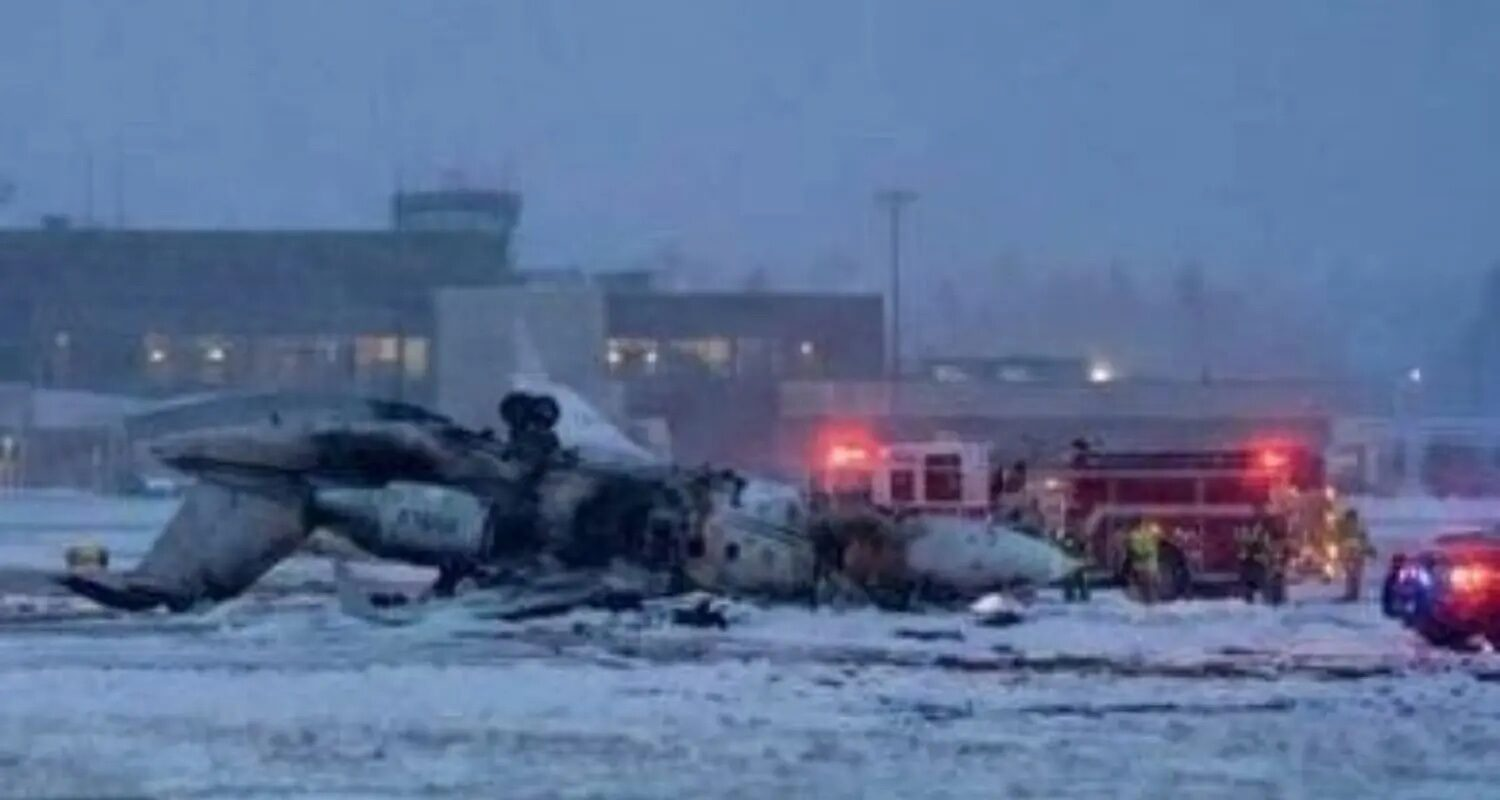
A private jet crashed on takeoff, killing seven people and seriously injuring one crew member at a Main airfield.
The Federal Aviation Administration reports that a private business plane crashed at Bangor International Airport in Maine during a snowstorm, killing seven persons and seriously injuring one crew member.
Around 7:45 p.m. on Sunday, as a massive snow storm impacted much of the country, the Bombardier Challenger 600 carrying eight people crashed during takeoff. Shortly after the incident, the airport, which is roughly 200 miles north of Boston, was closed.
Even though there was a lot of snow falling at the time of the incident, it was only a few inches deep, and other planes were successfully taking off. Arnold and Itkin Trial Lawyers, a personal injury law business, shares an address in Houston, Texas, with the corporation that registered the airplane. The corporation that owns the aircraft lists one of its original partners as its registered agent.
The crash is being looked into by the National Transportation Safety Board and the Federal Aviation Administration. Preliminary information suggests that the aircraft crashed on takeoff and had a post-crash fire, the NTSB said, adding that it would not make any more statements until investigators arrived on the scene within a day or two.
The NTSB said it has no role in releasing information about victims, noting that such details are handled by local authorities. Jose Saavedra, the director of the airport, said during a press conference on Monday that he was “awaiting guidance and support from federal partners” and declined to comment on the victims.
“Aircraft upside down,” was heard on air traffic control audio records. About 45 seconds after the plane was given the all-clear to take off, someone said, “We have a passenger aircraft upside down.” First responders showed up less than a minute later, according to Saavedra.
Following the collision, Bangor International Airport, which provides direct flights to Orlando, Washington, and Charlotte, was shut down. It is anticipated to stay down until at least noon on Wednesday.
Even though planes were landing and taking off at the time of the disaster, Saavedra said the airport had been receiving consistent snowfall on Sunday. Although the precipitation was only getting started when the jet went down, the National Weather Service in Caribou, Maine, estimated that almost 10 inches of snow had fallen overall.
He stated, “We have crews on site that respond to weather storms on a regular basis.” “This is how we usually react to weather events.”
Hundreds of thousands of homes and businesses lost power, aircraft were grounded, roads were blocked, and snow, sleet, and freezing rain were dumped, all of which caused travel disruptions throughout much of the eastern part of the United States. Flight tracker flightaware.com reports that approximately 20,000 flights were delayed and 12,000 planes were cancelled on Sunday, affecting airports in the Southeast and Northeast.
A wide-bodied business aircraft, the Bombardier Challenger 600 can accommodate nine to eleven people. It was the first private jet with a “walk about cabin” when it was initially introduced in 1980, and it is now a well-liked charter aircraft.
The biggest airport in northern and eastern Maine is Bangor International Airport. “Runways are ready rain or shine or snow,” according to its long-standing joint usage agreement with the Maine Air National Guard, which goes by the slogan “A Little Snow Doesn’t Scare Us.”