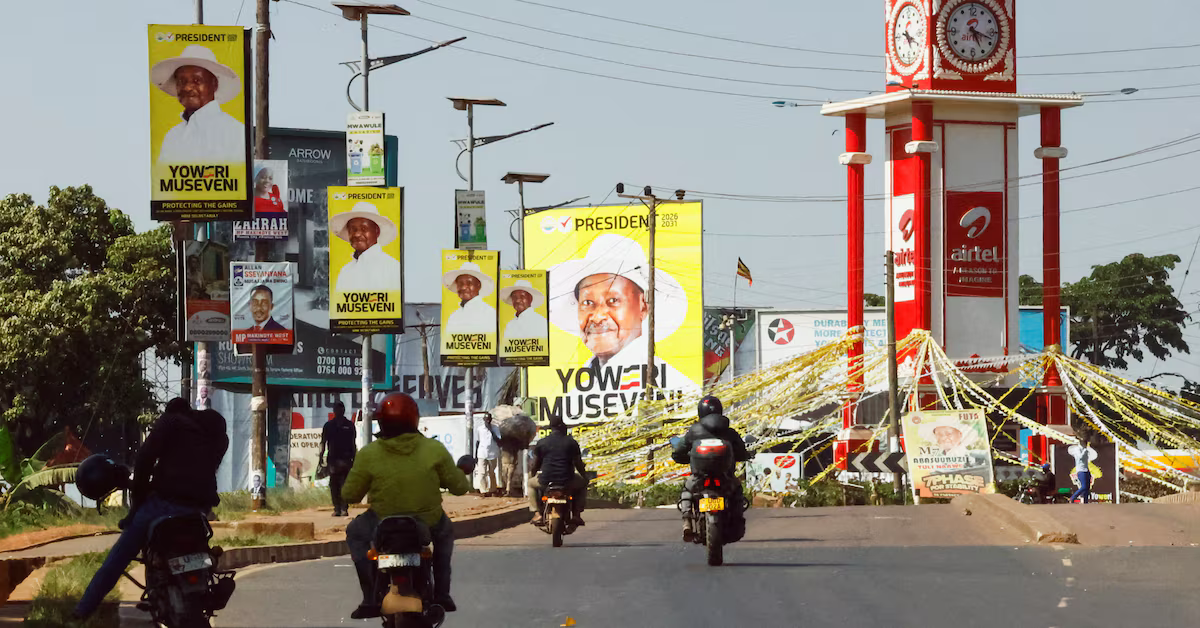
Ugandan authorities partially restored internet services late Saturday following the landslide victory of 81-year-old President Yoweri Museveni, who secured a seventh term to extend his rule into a fifth decade, a result that has been rejected by the opposition.
Users indicated that they were able to reconnect to the internet at approximately 11 p.m. local time (2000 GMT) on Saturday. Additionally, some internet service providers communicated to their customers that the regulator had instructed them to restore services, with the exception of social media platforms.
“We have restored internet access, allowing businesses that depend on it to resume operations,” said David Birungi, spokesperson for Airtel Uganda, one of the country’s largest telecom companies, in a statement to Reuters. The state communications regulator has mandated the shutdown of social media.
The Uganda Communications Commission, a state-run entity, announced that it had suspended internet access to mitigate “misinformation, disinformation, electoral fraud and related risks.” The opposition, however, condemned the action, asserting that it aimed to solidify control over the electoral process and ensure a victory for the incumbent.
Ibrahim Bbosa, the spokesperson for UCC, did not provide a response to a call for comment from Reuters.
On Saturday, the electoral body in the East African country announced that Museveni won Thursday’s poll with 71.6% of the vote, while his opponent, pop star-turned-politician Bobi Wine, received 24% of the vote.
A joint report from an election observer team comprising the African Union and other regional blocs has raised concerns regarding the military’s involvement in the election and the authorities’ choice to sever internet access.
“The internet shutdown enforced two days prior to the elections restricted access to information, hindered freedom of association, and stifled economic activities…it also fostered suspicion and mistrust regarding the electoral process,” the team stated in their report released on Saturday.
Museveni has been in power since 1986 and is currently Africa’s third longest-ruling head of state. His latest victory indicates that he will have held office for nearly half a century by the time his new term concludes in 2031.
It is widely believed that he is grooming his son, Muhoozi Kainerugaba, for succession. Kainerugaba currently leads the military and has shown interest in pursuing the presidency.
Wine, contesting against Museveni for a second time, has dismissed the results of the recent vote and claimed widespread fraud during the election.
Protests from scattered opposition groups erupted late on Saturday following the announcement of the results, as reported by a Reuters witness and police sources.
In Magere, a suburb in northern Kampala where Wine resides, a group of youths set tyres ablaze and built barricades on the road, leading to a police response involving tear gas.
Police spokesperson Racheal Kawala informed Reuters that the protests had been subdued and arrests were conducted, though she noted that the total number of individuals detained would be disclosed at a later time.
Early on Sunday, Wine’s location was unclear after he posted on X about having fled a military raid at his residence. Sources familiar with the situation informed Reuters on Saturday that he was staying at an undisclosed location in Uganda. Wine was placed under house arrest for a short period after the previous election in 2021.
Wine stated that hundreds of his supporters were detained in the months preceding the vote, and that others have suffered torture.
Government officials have refuted those allegations, asserting that individuals who have been detained have breached the law and will undergo due process.