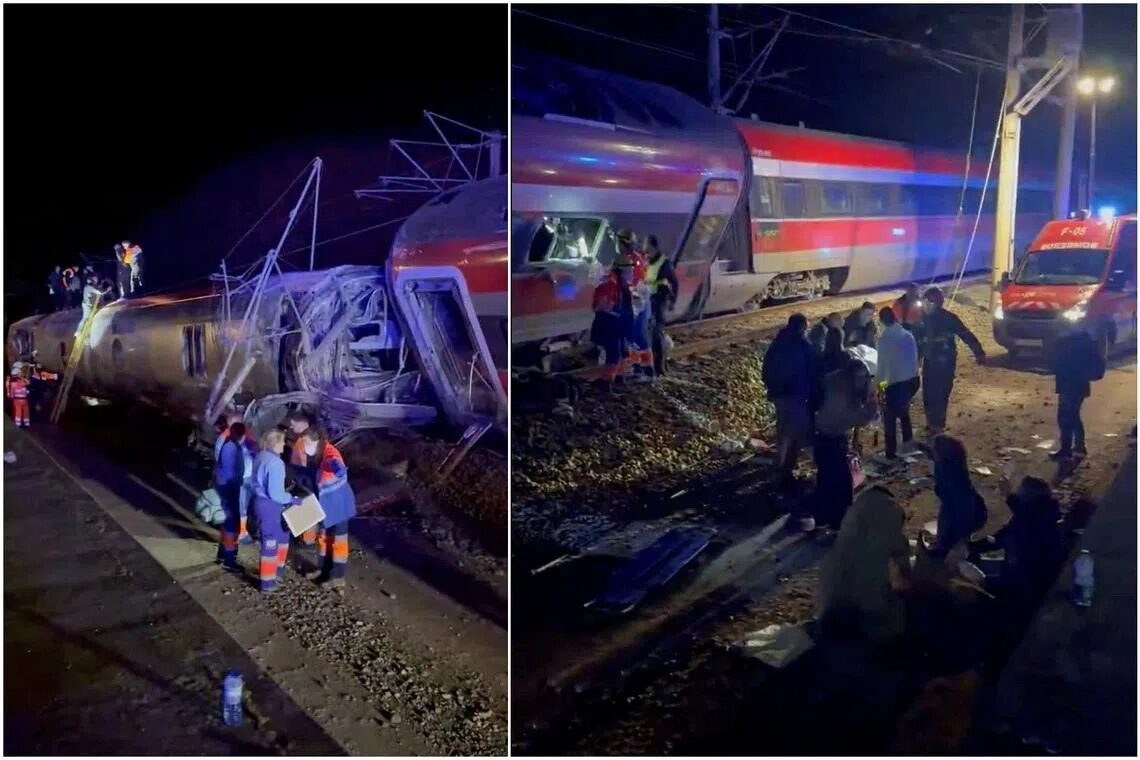
In Spain, two high-speed trains have derailed, resulting in the tragic loss of 21 lives, according to police sources
Police sources told Reuters that at least 21 people were killed in a collision on Sunday in southern Spain when a high-speed train derailed and collided with another oncoming train, driving the second train off the rails.
In the province of Cordoba, the accident occurred close to Adamuz. State station Television Espanola said that 100 people had been hurt, 25 of them critically, and that authorities had confirmed 21 deaths thus far. One of the people killed was the driver of a train that was going from Madrid to Huelva, the TV station continued. “The Iryo 6189 Malaga – (to Madrid) train has derailed from the track at Adamuz, crashing onto the adjacent track.” The rail network’s operator, Adif, posted on social media that the train from Madrid to Huelva, which was using the nearby track, had also derailed.
About ten minutes after the Iryo train departed Cordoba for Madrid at 6:40 p.m. (1740 GMT), according to Adif, the accident occurred.
The Italian state-owned railway company Ferrovie dello Stato owns the majority of Iryo, a commercial train operator. According to a representative for Ferrovie dello Stato, the train in question was a Freccia 1000 that was proceeding between Malaga and Madrid.
In a statement, the firm expressed its sincere regret for the incident and stated it has triggered all emergency procedures in order to collaborate closely with the appropriate authorities to handle the situation.
Renfe, the operator of the second train, did not reply to a request for comment.
All train service between Madrid and Andalusia has been suspended by Adif.
A HORRIBLE SCENER
The Renfe train carried about 100 people, whereas the Iryo train carried almost 300.
The first train from Malaga to Madrid has been evacuated, Cordoba Fire Chief Paco Carmona told TVE.
Two high-speed trains derailed fatally at Adamuz, close to Cordoba
He claimed that the other train’s carriages were severely damaged, with seats and metal twisted. “People are still stuck in this situation. The mission is focused on evacuating people from extremely constrained regions, and we are unsure of the exact number of fatalities,” he stated. “To get to anyone who is still alive, we must remove the bodies. It is turning out to be a challenging task.
According to Transport Minister Oscar Puente, he was monitoring developments from the Madrid offices of train operator Adif.
He said, “The latest information is very serious,” on X. “The Renfe train’s first two carriages were thrown off the track,” describing the horrific impact. At this point, the number of victims cannot be verified. Right now, aiding the victims is the most crucial thing.
Rafael Moreno, the mayor of Adamuz, told the El Pais newspaper that he and the local police were among the first to arrive at the accident scene and that he observed what he thought was a severely cut body a few meters away.
He remarked, “The scene is horrific.” “I don’t believe they were headed in the same direction, but it’s unclear. Helping the passengers is now the top priority for the local mayors and citizens.
MEDICAL CALLS
Local television footage showed a passenger welcome center in the 5,000-person village of Adamuz, where residents were arriving and going with food and blankets in the midst of nighttime temperatures of about 42 degrees Fahrenheit (6 degrees Celsius).
Carmen, a woman, wrote on X that she had traveled to Madrid on the Iryo train. Ten minutes after we left (from Cordoba), the train began to tremble violently, and coach 6 behind us went down. The lights vanished.
An Iryo employee wearing a bright jacket was seen telling passengers to stay in their seats in the darkened compartments, and those with first aid training were instructed to keep an eye on other passengers, according to video shared on X by another Iryo train passenger. Additionally, he advised folks to keep their cell phone batteries charged so they could use their torches when they got off the ship.
Salvador Jimenez, an RTVE journalist who was traveling on the Iryo train, posted pictures of the evacuated passengers sitting on the side of the carriage facing upward, with the train’s rear carriage’s nose resting on its side.
Jimenez, who was standing next to the damaged trains, called TVE to report that two persons had been removed from the upturned carriages on stretchers after passengers used emergency hammers to smash the windows and jump out.
“There’s a certain uncertainty about when we’ll get to Madrid, where we’ll spend the night, we’ve had no message from the train company yet,” he explained. “It’s very cold but here we are.”