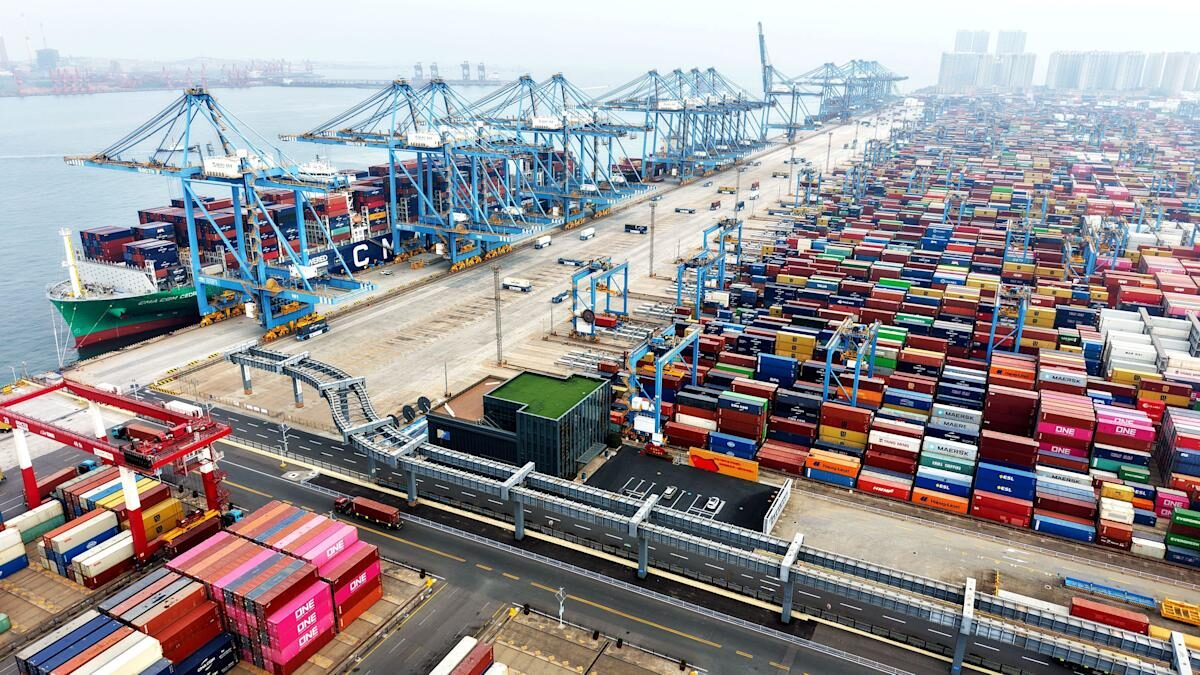
China claims that when trade changes counteracted declining US demand, exports reached all-time highs in 2025.
Despite economic disruption brought on by US President Donald Trump’s tariff policies, China has reported record export numbers for 2025.
Beijing announced the greatest trade surplus in history on Wednesday, totaling $1.19 trillion. This is the first time China’s entire year surplus has surpassed $1 trillion and surpassed the record of $993 billion set in 2024.
According to official statistics, China’s monthly export surpluses exceeded $100 billion seven times last year, suggesting that Trump’s tariff campaign had little effect on China’s overall international commerce.
Exports to other regions, especially South East Asia, Africa, and Latin America, increased, offsetting the drop in trade with the US.
At a news briefing on Wednesday, Wang Jun, deputy head of China’s customs office, referred to the data as “extraordinary and hard-won,” pointing to “profound changes” and growing difficulties in international trade.
He emphasized the rise in exports associated with robots, renewable technology, and products relating to artificial intelligence.
The significant surplus was ascribed by analysts to a sluggish local market, increased trade with partners in South Asia, Africa, and Europe, and strong demand for Chinese goods abroad.
A protracted real estate crisis and growing debt levels have hindered China’s economy by deterring consumer spending and company investment. Imports thus increased by only 0.5%.
The competitiveness of Chinese exports has also increased due to a weaker yuan, robust manufacturing capacity, and inflation in Western countries.
Deborah Elms, a trade policy specialist at the Hinrich Foundation, described the result as a “mixed blessing” for Beijing.
Although China has profited from higher export sales and the development of jobs abroad, she warned that its exports may come under “greater scrutiny” from international markets as they compete.
Elms went on to say that as China’s products and services are further integrated into international supply chains, its export power is probably going to last until 2026.
However, Wang warned that even while China’s worldwide clientele has expanded beyond the US, the country still faces an unpredictable foreign environment.