Gaza children are returning to school after almost two years without formal education
Children in Gaza are once again attending classes in tents with a ceasefire allowing limited education following years of conflict and relocation
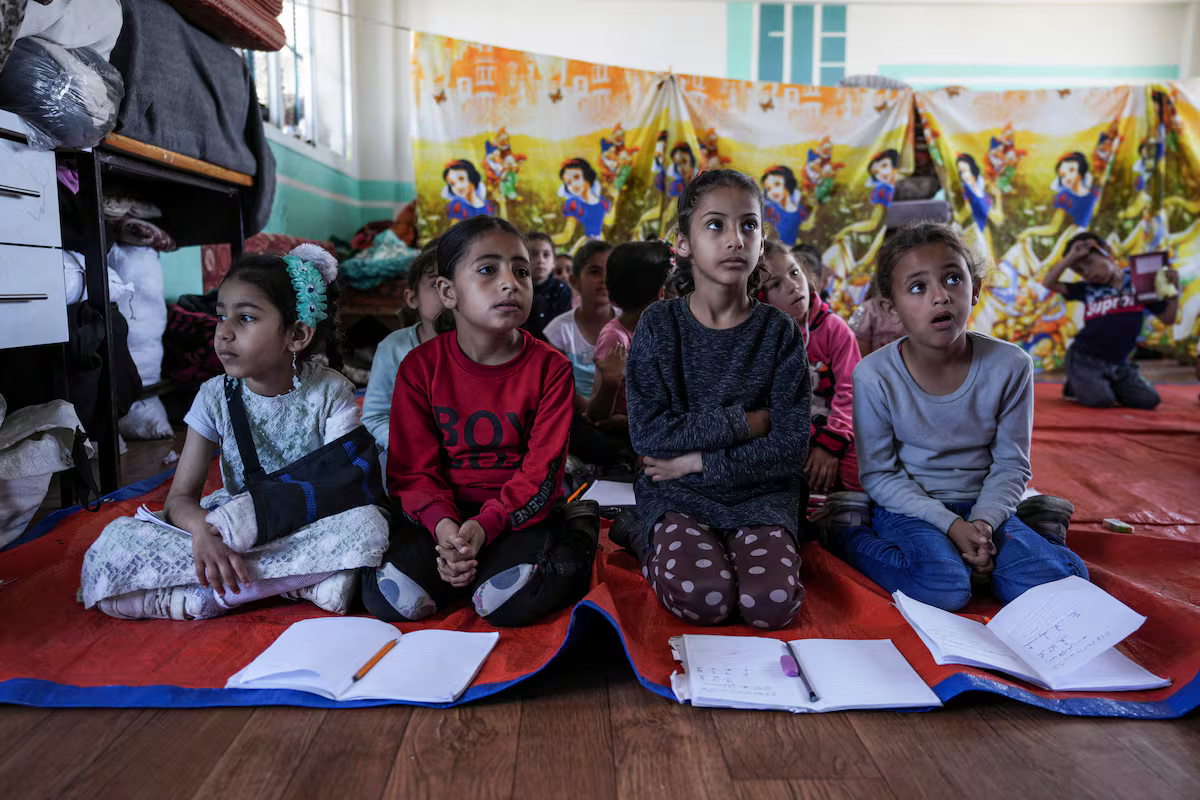
As students return to class after the October ceasefire between Israel and Hamas, the sound of children reciting lessons can be heard in Gaza City for the first time in almost two years.
The Lulwa Abdel Wahab al-Qatami School’s ruins in the Tel al-Hawa neighborhood of southwest Gaza City are currently the site of classes, which are held inside tents. After being hit by Israeli airstrikes in January 2024, the school was used as a temporary learning center and then as a home for displaced families.
As children rush into the tents, teachers write basic Arabic words and English letters on makeshift boards, signaling a tenuous but important return to normalcy after years of interruption.
Over 97% of Gaza’s schools were destroyed or severely damaged during the conflict, according to UNICEF, meaning that the majority of the 658,000 school-age children in the enclave were not formally educated for nearly two years. Many people suffered from starvation, homelessness, and the death of family members during that time.
Naeem al-Asmaar, 14, who was once a student at the school, said going back to school has helped things get back to normal. In the midst of the war, an Israeli airstrike killed his mother.
“It was the most difficult experience I’ve ever had,” he muttered. Before the war, classes were held in actual classrooms. It’s tents now. Despite the lack of room and the fact that we only study four courses, being here is important.
Rital Alaa Harb, a ninth-grader who aspires to be a dentist, is another youngster whose schooling was severely affected by the conflict.
“Schools and study time were nonexistent. She remarked, “I missed my friends and my previous school.
Children who were displaced by the violence as well as those from the old Lulwa school attend the UNICEF-run temporary school. Only Arabic, English, arithmetic, and science are taught; the entire Palestinian curriculum is not covered.
The initiative’s goal, according to the school’s principal, Dr. Mohammed Saeed Schheiber, who has 24 years of experience in the field, is to assist students in making up missed instructional time.
“We began with a resolve to make up for what students had lost,” he stated.
Currently, the facility can hold over 1,100 students over the course of three daily shifts, with boys and girls attending on different days. The school runs without electricity, internet connection, or basic instructional resources, and there are only 24 teachers on staff.
Every kid, according to Dr. Schheiber, has been impacted by the conflict; over 100 have lost one or both parents, had their homes destroyed, or witnessed murders. Although a counselor now offers psychological therapy, demand is significantly higher than supply.
“A sizable camp for displaced people is located adjacent to the school,” he stated. “A lot of kids would like to enroll, but we just can’t accommodate them.”
The return to school brings both comfort and anxiety, according to parents. Due to shortages and growing expenses, education has grown more challenging, according to Huda Bassam al-Dasouki, a mother of five who was uprooted from southern Rimal.
“A notebook used to cost one shekel, but now it costs five,” she remarked. There are some kids who have lagged four years. My son is not proficient in reading or writing.
Restrictions on aid entering Gaza, according to UNICEF, have made matters worse. According to Jonathan Crickx, its spokesperson, mental health kits and necessary educational materials are still mostly unavailable.
“Psychosocial support recreational kits, notebooks, pens, and paper have not been permitted in,” he stated.
A number of humanitarian organizations and the United Nations doubt Israel’s claims that it is fulfilling its responsibilities under the truce and enabling more assistance supplies. Israel has cited claimed Hamas infractions as justification for its ongoing airstrikes in spite of the ceasefire.
Even still, kids still go to school.
Their perseverance, according to educator Kholoud Habib, highlights the importance Palestinians place on education.
“We lose everything, including homes and money,” she remarked. “The one thing we can still invest in our children is knowledge.”