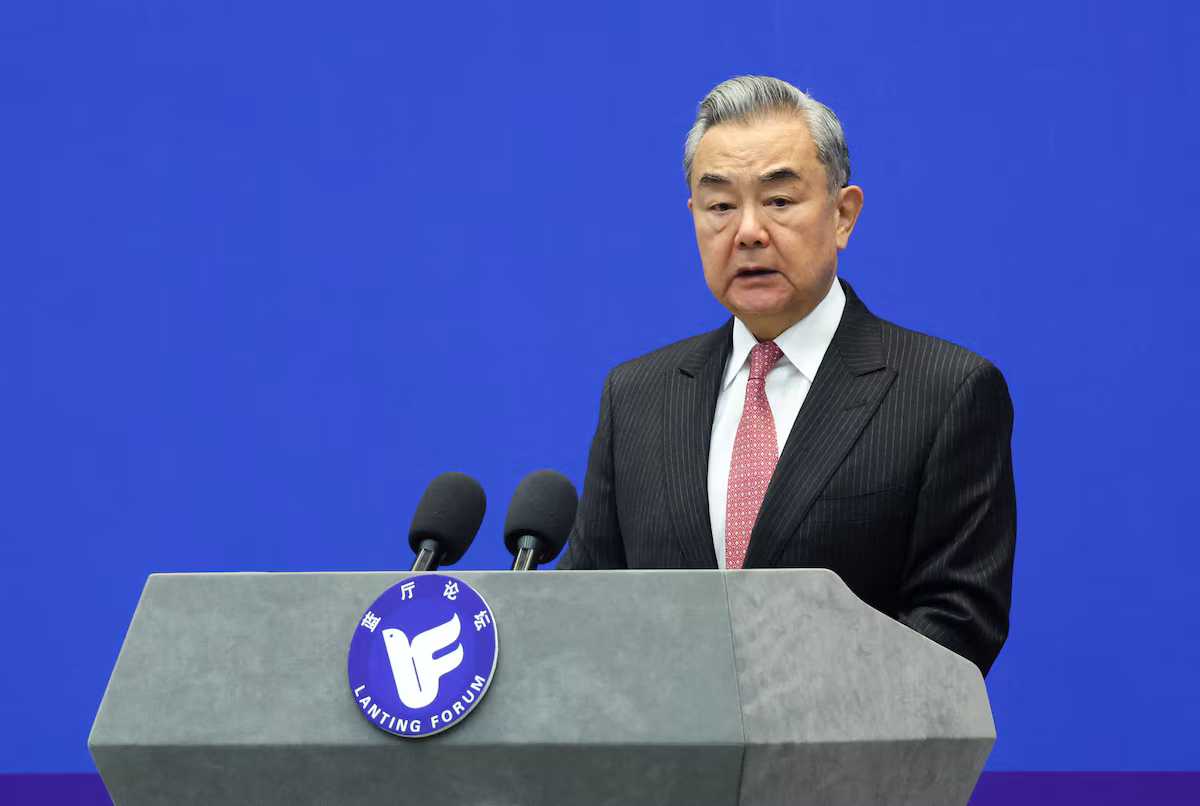
China’s top diplomat kicked off his yearly New Year tour to Africa on Wednesday, concentrating on crucial trade access throughout eastern and southern Africa as Beijing aims to secure important maritime lanes and resource supply lines
Foreign Minister Wang Yi will visit Ethiopia, the fastest-growing large economy in Africa; Somalia, a state in the Horn of Africa that provides access to important international shipping lanes; Tanzania, a logistics hub that connects the Indian Ocean to central Africa, which is rich in minerals; and Lesotho, a small southern African economy that has been squeezed by U.S. trade policies. This year, he is traveling through January 12.
Beijing wants to boost export markets, especially in young, more wealthy economies like Ethiopia, where the IMF predicts growth of 7.2% this year, and to promote nations that it sees as model partners of President Xi Jinping’s major “Belt and Road” infrastructure program.
As countries affected by pandemic-era debt difficulties increasingly prefer investment to loans, China, the largest bilateral lender in the world, is facing increasing competition from the European Union to finance African infrastructure.
“the ‘Africanization’ of Chinese investment, not merely its presence, will be the true litmus test for 2026. “The conversation needs to go beyond building roads to building factories as Wang Yi visits hubs like Ethiopia and Tanzania,” stated Judith Mwai, policy analyst at Development Reimagined, a firm that focuses on Africa.
“For African leaders, this tour is an opportunity to demand that China’s ‘small yet beautiful’ projects specifically target our industrial gaps, turning African raw materials into finished products on African soil, rather than just facilitating their exit,” she declared.
Wang traveled to Namibia, the Republic of Congo, Chad, and Nigeria at the beginning of 2025.
In decades, the first diplomian mission to Somalia
His trip to Somalia will be the first by a Chinese foreign minister since the 1980s, and it is anticipated to give Mogadishu a diplomatic boost following Israel’s formal recognition of the Republic of Somaliland, a northern region that gained independence in 1991.
Beijing is eager to increase its influence in the Gulf of Aden, which is the Red Sea’s entry and a crucial route for Chinese trade passing through the Suez Canal to Europe. Beijing reaffirmed its support for Somalia following the Israeli declaration in December.
Tanzania, located further south, is essential to Beijing’s strategy for gaining access to Africa’s enormous copper reserves. The Tazara Railway, which travels through China and into Zambia, is being renovated by Chinese companies. In November, Li Qiang traveled to Zambia for the first time as a Chinese premier in twenty-eight years.
The railroad is often viewed as a counterbalance to the Lobito Corridor, which is supported by the United States and the European Union and links Zambia to ports in the Atlantic through Angola and the Democratic Republic of the Congo.
The Chinese champions’ free trade in Lesotho
Wang intends to draw attention to Beijing’s efforts to establish itself as a champion of free trade by traveling to the country of Lesotho in southern Africa. In keeping with a promise made by Chinese President Xi Jinping at the 2024 China-Africa Cooperation meeting in Beijing, China this year granted the world’s poorest countries tariff-free market access to its $19 trillion economy.
With a GDP of just over $2 billion, Lesotho is among the world’s poorest countries. Last year, U.S. President Donald Trump imposed sweeping tariffs that led to taxes of up to 50% on its exports to the United States, making it one of the hardest-hit countries.