The temporary administration of Venezuela claims to be unified behind Maduro following his abduction by the unified States
The government of Venezuela will remain united behind President Nicolas Maduro, whose abduction by the United States has created a great deal of concern about the future of the oil-rich South American country, according to a top official on Sunday.
Maduro is being held in a detention facility in New York while he awaits his court appearance on drug-related charges on Monday. Donald Trump, the president of the United States, ordered his seizure from Venezuela on Saturday and declared that the United States would assume leadership of the nation. He went golfing on Sunday.
However, high-ranking members of Maduro’s administration remained in control in Caracas, where they have referred to the detentions of Maduro and his wife Cilia Flores as kidnapping.
Here, there is just one president, Nicolas Maduro Moros, and the revolutionary force’s unity is virtually certain. In an audio tape made public by the ruling PSUV socialist party, Interior Minister Diosdado Cabello stated, “Let no one fall for the enemy’s provocations.”
Venezuelans were shocked to see pictures showing the 63-year-old Maduro opening a new tab while tied and blindfolded on Saturday. Since the invasion of Panama 37 years prior, the operation was Washington’s most contentious action in Latin America.
Defense Minister General Vladimir Padrino stated on state television that the U.S. attack murdered soldiers, civilians, and a “large part” of Maduro’s security detail “in cold blood,” but he did not provide specifics.
He claimed that in order to ensure sovereignty, Venezuela’s military had been called into action.
With the approval of Venezuela’s highest court, Vice President Delcy Rodriguez, who is also the country’s oil minister, assumed the role of interim leader, although she has stated that Maduro is still in office.
Rodriguez has always been regarded as the most practical person in Maduro’s inner circle due to her ties to the private sector and her extensive knowledge of oil, the nation’s main source of income. However, she has openly disputed Trump’s assertion that she is open to cooperating with the US.
Rodriguez might suffer a greater price than Maduro “if she doesn’t do what’s right,” Trump stated in an interview with The Atlantic magazine.
A request for comment on that statement was not immediately answered by Venezuela’s communications ministry.
“AN OIL QUARANTINE”
The next leader of Venezuela should be in line with American interests, according to U.S. Secretary of State Marco Rubio. These include preventing drug trafficking and preventing U.S. rivals from controlling Venezuela’s oil economy. As leverage, he mentioned the ongoing sanctions-imposed U.S. ban on tankers.
“That means their economy will not be able to move forward until the conditions that are in the national interest of the United States and the interest of the Venezuelan people are met,” he stated on ABC’s “This Week.”
Trump’s remark on Saturday that big U.S. oil corporations will go in was heavily criticized by Venezuelan officials, who have claimed for months that Trump is trying to seize the nation’s abundant natural resources, particularly its oil.
Cabello continued, “We are furious because in the end everything was revealed—it was revealed that they only want our oil.”
Once one of Latin America’s wealthiest countries, Venezuela’s economy collapsed under President Hugo Chavez in the 2000s and continued to decline under President Maduro, resulting in one in five Venezuelans leaving the country in one of the largest exoduses in history.
In Brooklyn, New York, Venezuelan immigrants rejoice outside the Metropolitan Detention Center.
QUIET STREETS
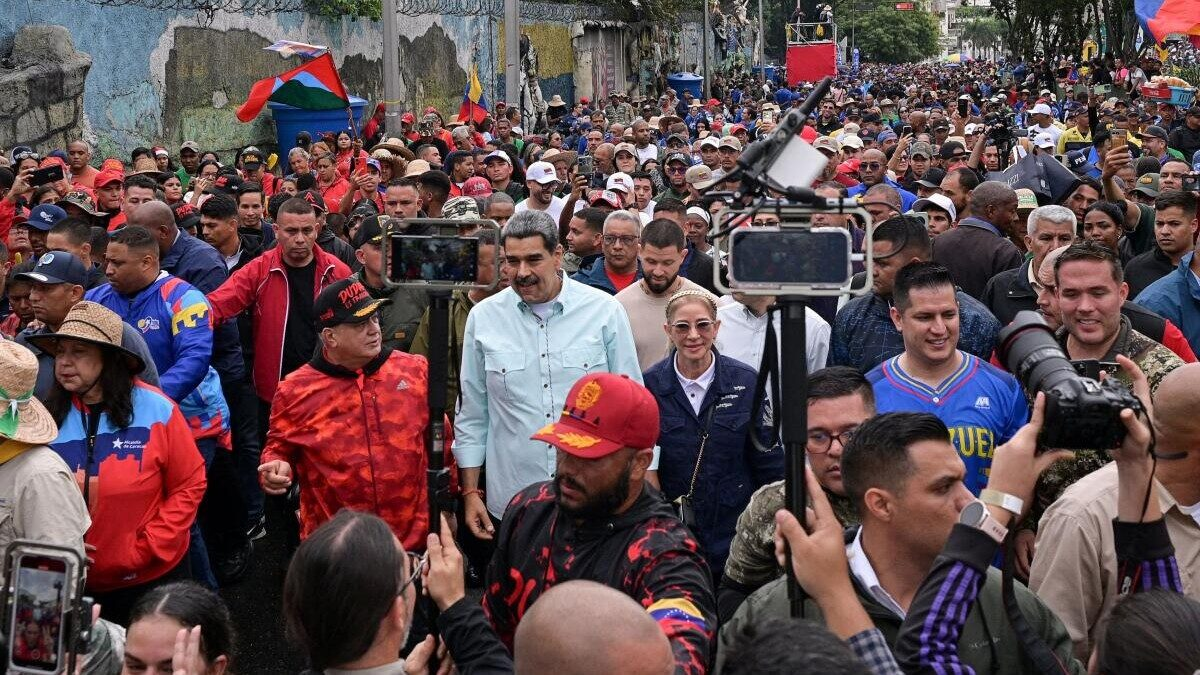
On Sunday afternoon, a few Maduro supporters assembled in Caracas for a protest march organized by the administration.
Reinaldo Mijares, a protester, stated that Venezuela’s “people must not surrender, nor should we ever become a colony of anyone again” after being dominated by Spain. “This nation is not one of the vanquished.”
Security personnel appeared to be less present on Sunday than normal, and Maduro’s detractors in Venezuela have been reluctant to celebrate his capture.
Joggers and cyclists were out as normal, and some bakeries and coffee shops were open despite the tense atmosphere. A few residents were stockpiling necessities.
“I was terrified to go yesterday, but I had to today. I need to find a solution because this circumstance left me without meals. In the oil metropolis of Maracaibo, a single mother who purchased rice, vegetables, and tuna remarked, “After all, Venezuelans are accustomed to enduring fear.”
The opposition in Venezuela is disappointed that Trump dismissed the idea of 58-year-old opposition leader and Nobel Peace Prize winner Maria Corina Machado taking over, claiming she lacked backing.
Despite being barred from running in the 2024 election, Machado has stated that her 76-year-old supporter, Edmundo Gonzalez, who the opposition and some foreign observers claim won that poll handily, has a democratic mandate to become president.
LOOMING QUESTIONS
Trump faces the danger of offending some followers who are against foreign interventions, and it is unclear how he intends to manage Venezuela.
The White House has not stated how long the United States plans to remain in Venezuela or how many American forces may be needed, according to U.S. Senate Democratic Leader Chuck Schumer.
“The American people are worried that this is creating an endless war — the very thing that Donald Trump campaigned against,” Schumer stated on ABC’s “This Week.” Though its chances may be slim because Trump’s Republicans control Congress, he said lawmakers will consider a resolution to limit additional Trump administration intervention in Venezuela.
Even though Maduro is opposed by many Western countries, there have been several calls for the United States to uphold international law, and concerns have been raised over the legitimacy of taking over a foreign head of state.
U.S. Attorney General Pam Bondi described the action as a “law enforcement mission” to compel Maduro to face U.S. criminal charges filed in 2020, including narco-terrorism conspiracy, in a statement released on Sunday. This statement echoed the Trump administration’s message since Maduro’s abduction.
Maduro has refuted any criminal responsibility.
The attack was scheduled to be discussed during the U.N. Security Council meeting on Monday. The United States has come under fire from China and Russia, two of Venezuela’s biggest supporters.