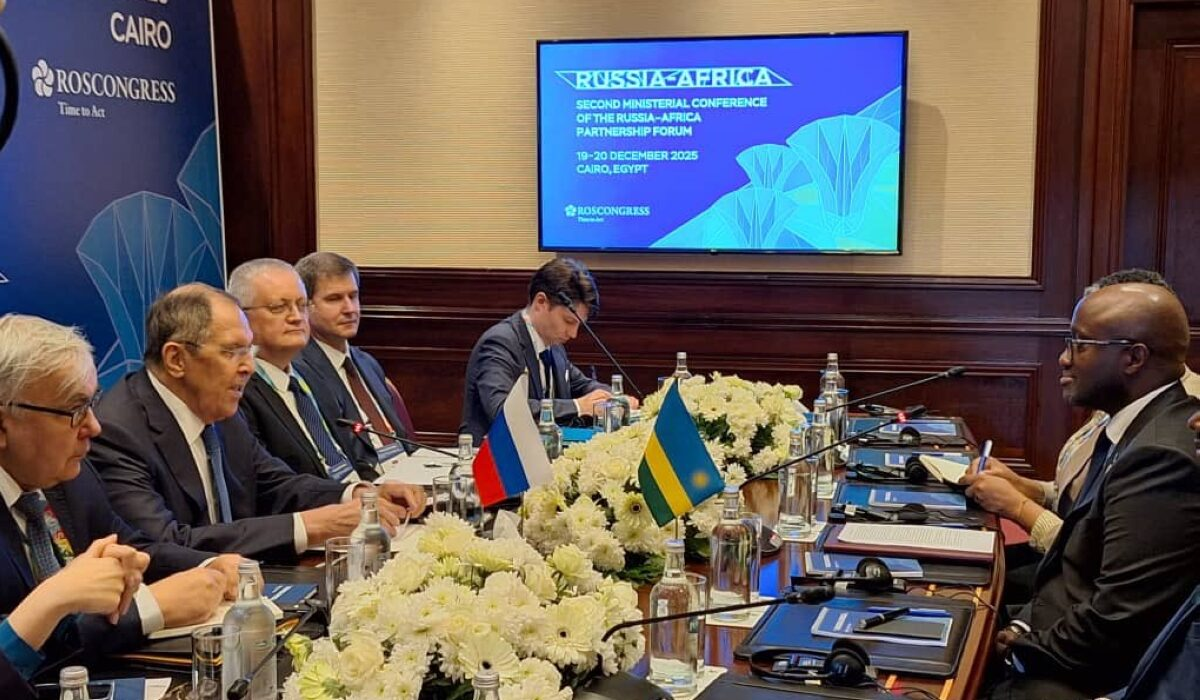
The discussions on the sidelines of the second ministerial conference of the Russia-Africa Partnership Forum centered on enhancing cooperation between Rwanda and Russia, as foreign minister Amb. Olivier Nduhungirehe met with his Russian counterpart Sergey Lavrov for a bilateral meeting.
The second ministerial conference commenced on Friday, December 19, in Cairo, Egypt. Foreign ministers from Russia, African nations, and regional organizations engaged in discussions aimed at enhancing the Russian-African partnership, emphasizing trade, economic cooperation, and investment.
In a post on X, Amb. Nduhungirehe expressed gratitude to Lavrov for “our constructive bilateral meeting yesterday in Cairo, during which we expressed satisfaction” regarding the growing Russia-Africa Partnership Forum, reviewed the excellent bilateral cooperation, and discussed ways to expand it.
He stated, “We also discussed the situation in eastern DRC, which allowed me to convey my appreciation to my counterpart for the ongoing support of the Russian Federation towards the peace processes.”
Analysts indicate that years of inadequate governance in DR Congo, along with Kinshasa’s acceptance and backing of FDLR – a terrorist group established by survivors of the 1994 Genocide against the Tutsi in Rwanda – have contributed to ongoing insecurity and instability in the region. The recent clashes between the coalition of the Congolese government army and M23 rebels began in 2021. M23, a rebel group that reemerged in November 2021 after almost ten years of dormancy, has now joined a broader coalition known as Alliance Fleuve Congo (AFC), which was established in December 2023.
The AFC/M23 movement advocates for governance that upholds fundamental human rights, ensures the safety of all Congolese citizens, and tackles the underlying causes of conflict. Their leaders have committed to eliminating tribalism, nepotism, corruption, and genocide ideology, along with other prevalent vices in DR Congo.
In recent years, a large coalition of Congolese forces, supported by Burundi, SADC troops, FDLR, and Western mercenaries, has exacerbated the security situation in eastern DR Congo. Kinshasa has persistently sought to involve neighboring Rwanda in the conflict and war in its eastern region, claiming that Kigali backs the rising AFC/M23 movement. Kigali has firmly stated its intention to uphold defensive measures along the border with DR Congo, citing ongoing security threats from the Congolese army (FARDC) and its allies, including FDLR, while also rejecting the allegations made against it.
Earlier this year, nearly 300 Romanian mercenaries fighting alongside the Congolese army coalition were captured by the rebels, and Russia stood out as the sole member of the UN Security Council to denounce the silence of Western nations. In February, during a special session of the UN Security Council convened to address the security crisis in eastern DR Congo, Russia’s Permanent Representative, Vassily Nebenzia, remarked that the silence of European nations and the United States contradicted their stated principles.
Nebenzia stated: “We all witnessed the surrender of weapons to MONUSCO peacekeepers, and the footage of the subsequent transportation of European mercenaries to Kigali was aired globally.
“We hold the view that those events do not fully align with Russia’s perspective on the UNSC’s mandate of the mission.”