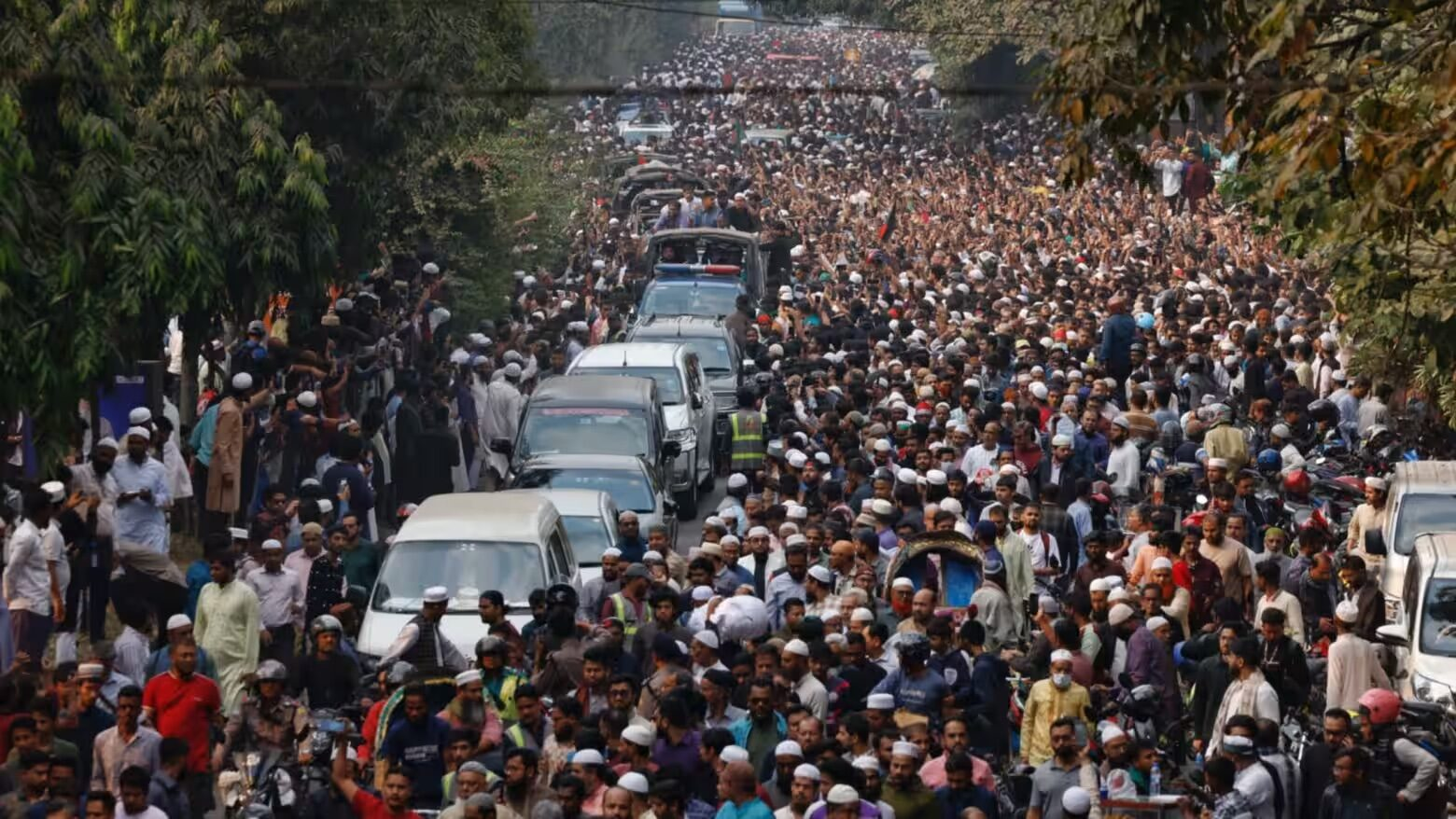
The funeral of a young leader and election candidate who was killed on Saturday was attended by tens of thousands of Bangladeshis under strict security, including the leader of the country’s interim administration.
The 32-year-old Sharif Osman Hadi, a pivotal player in the student-led rebellion that overthrew veteran Prime Minister Sheikh Hasina last year, was shot in the head by masked attackers in Dhaka last week as he began his campaign for the February poll. After six days on life support, he passed away in Singapore on Thursday.
The South Asian country has experienced a surge of turmoil following his murder, including organized mob attacks on important media outlets and cultural institutions.
For the funeral on Saturday, police and paramilitary personnel were stationed throughout the capital, but no additional violence was reported.
Hadi’s legacy will live on, according to interim government head Muhammad Yunus, who described the funeral as a group commitment to preserve the principles he had espoused.
“Today, we have come to promise you (Hadi) that we will fulfil what you stood for,” Nobel Peace Prize winner Yunus said to the mourners, who included officials from various political parties as well as the head of Bangladesh’s army.
Hadi was buried on the campus of Dhaka University next to the tomb of national poet Kazi Nazrul Islam in a unique and symbolic honor.
The election in Bangladesh is expected to put an end to years of instability.
On February 12, Bangladesh will elect a new parliament, which many believe would help the 175 million-person country with a majority of Muslims recover from nearly two years of upheaval and reclaim its status as a regional success story.
However, the national jubilation that followed Hasina’s removal in August 2024 has been pierced by recurrent episodes of violent rallies and political squabbling among various factions, particularly Islamist hardliners.
Analysts claim that it has also revealed the shortcomings of Yunus’ temporary administration, casting doubt on his ability to maintain control over the second-largest production of clothing in the world behind China.
A day of official mourning for Hadi was proclaimed by the government on Saturday, and people were asked to oppose “mob violence by fringe elements” in light of the danger that unrest poses to Bangladesh’s delicate democratic transition.
Human Rights Watch called Hadi’s death a “terrible act” and urged the government to take immediate action to stop the violence that has been raging in the nation since Hasina was overthrown.
The media attacks were denounced by the rights group as an attack on the freedom to free speech.
Bangladesh is ranked 149th out of 180 nations in terms of press freedom. Continued assaults on journalists and activists, according to rights groups, may severely reduce public space before the election.
Amnesty International demanded that the murder of Hadi and the violence that followed—including the destruction of newspaper offices and the harassing of journalists—be looked into immediately and independently.
On Friday, protests persisted in the capital’s Shahbagh neighborhood, as demonstrators called for accountability for the attacks and justice for Hadi. Udichi Shilpigosthi, Bangladesh’s leading progressive cultural organization, had its Dhaka office overrun by a mob.
Beyond the capital, there is more bloodshed. Since Hasina moved to New Delhi following her removal, anti-India sentiment has grown, as seen by the attacks on the Indian Assistant High Commission in Chittagong.
Threats of violence have been made by her party, the Awami League, which has been disqualified from the poll and which some believe could sway the outcome.