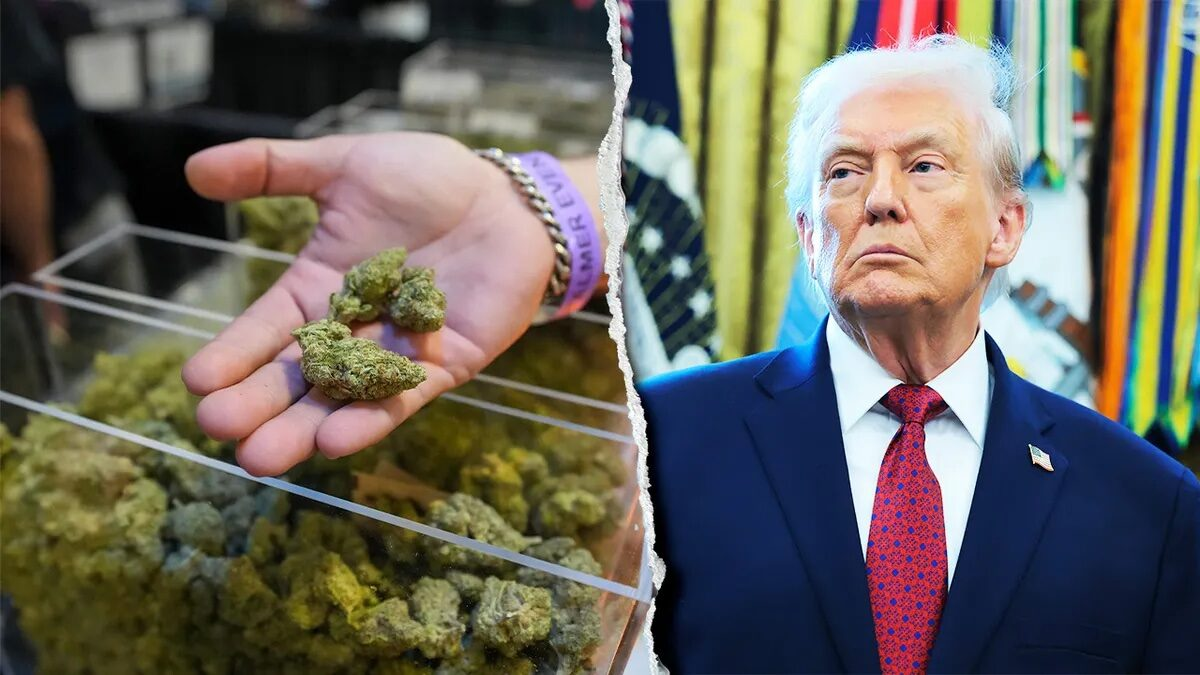
The executive order, which is praised and opposed by Republicans, places cannabis on Schedule 3, increasing access to research while maintaining the federal ban.
The White House claims that President Donald Trump’s executive order increasing access to cannabis represents the biggest change in US drug laws in decades.
The US attorney general is instructed by the ruling to reclassify cannabis from a Schedule 1 narcotic to a Schedule 3 drug, putting it in the same class as codeine-containing Tylenol.
The amendment permits further research into the possible medical advantages of cannabis, but it will still be outlawed at the federal level.
Ketamine and anabolic steroids are classified as Schedule 3 drugs by the US Drug Enforcement Agency because they have a “moderate to low potential for physical and psychological dependence.”
Trump stated in the Oval Office on Thursday that individuals had been “begging” for the change, especially those who were in “great pain” due to epileptic disorders, cancer, and veterans’ disabilities sustained during duty.
He likened cannabis to pharmaceutical medicines, which have valid purposes but “may also cause irreversible harm.”
Due to the present prohibition on some deductions for state-authorized cannabis dispensaries selling Schedule 1 items, the new classification also has tax ramifications.
In addition to the rescheduling order, Trump instructed White House officials to collaborate with Congress in order to get certain Americans access to cannabidiol, or CBD.
Additionally, health officials have been entrusted with creating “methods and models” to investigate the hazards and health advantages of CBD in the actual world.
The decision is a “commonsense action that will let us better understand and study” cannabis and CBD, according to a senior administration official.
Twenty-four US states have legalized cannabis for recreational use, and the majority of states permit limited medical use. Cannabis, however, has been categorized as a Schedule 1 narcotic since 1971, indicating that it has a high potential for misuse and no recognized medical value.
Trump’s action comes after the Biden administration’s failed attempts to reclassify, which was beset by legal and administrative obstacles.
The order was welcomed by advocacy groups. According to Tim Barash, chairman of the Coalition of Cannabis Scheduling Reform, the ruling signified a “fundamental shift” in societal and governmental perspectives.
“This change will empower the 425,000 individuals employed in the cannabis industry in the United States and attract new talent, capital, and awareness to an industry that positively impacts the lives of millions of people,” he stated.
However, the ruling was criticized by a few Republican lawmakers. In an open letter, a group of twenty-two Republican senators cautioned that marijuana usage could jeopardize attempts to “reindustrialize America.”
Concerns over health hazards were mentioned, including connections to “impaired judgment” and “lack of concentration.”
Nine Republican members wrote to Attorney General Pam Bondi separately, stating that “no adequate science or data” supports rescheduling.
The MPs stated, “Marijuana has no scientifically proven medical value and still has the potential for abuse, despite being different from heroin.” Rescheduling marijuana would therefore be both objectively incorrect and give the impression to our kids that it is harmless. The truth couldn’t be further from that.
Public support for legalization is widespread, according to polls. 64% of Americans support legalizing marijuana, according to a Gallup poll published in November, however support among Republicans has decreased.