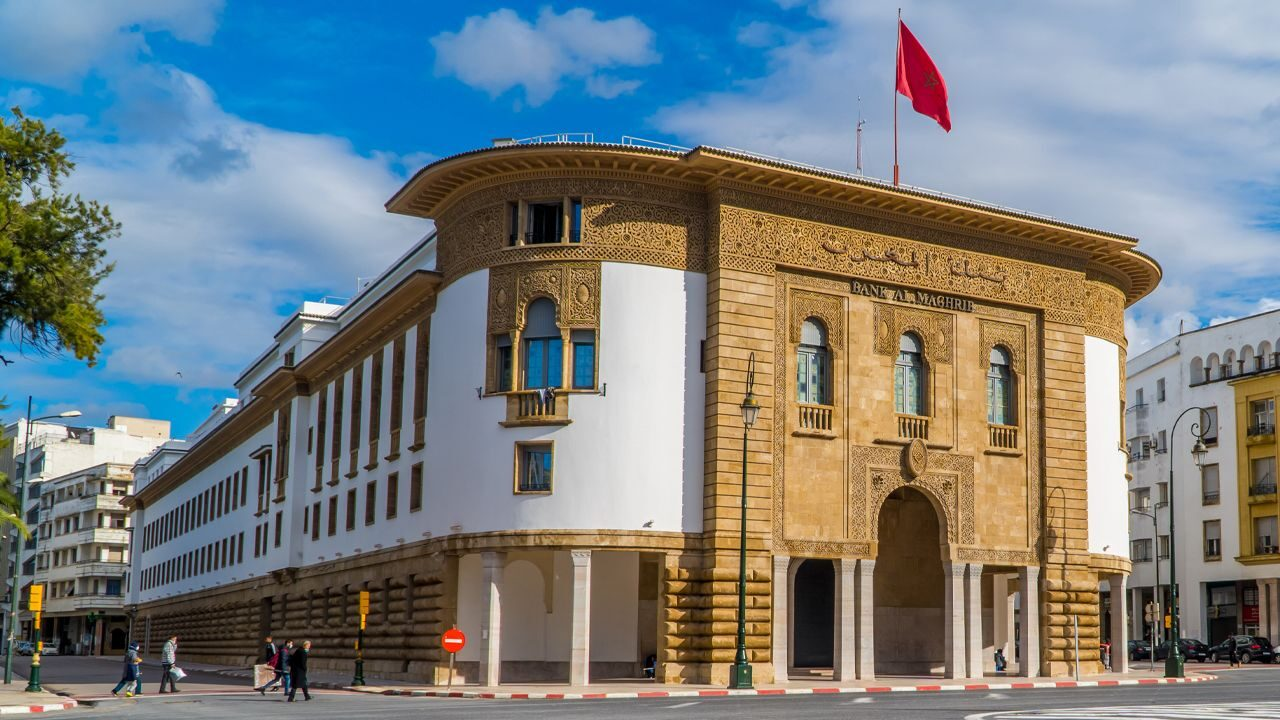
For the third meeting in a row, Morocco’s central bank maintained its benchmark interest rate at 2.25% on Tuesday, stating that the present cost of borrowing was reasonable given the country’s declining inflation and the uncertainty surrounding the world economy.
The central bank stated following its quarterly board meeting that inflation will average 0.8% this year due to a decline in the price of food and fuel, before increasing to “levels in line with the goal of price stability” at 1.3% in 2026 and 1.9% in 2027.
Citing a spike in investments, the bank predicted that the GDP of the North African nation will expand by 5% this year. It predicts that, assuming an average grain harvest of 5 million tons, growth will drop to 4.5% in 2027 and the following year.
According to the bank, the current account deficit would decrease to 1.8% of GDP this year and stay below 2% of GDP in 2026 and 2027 as a result of a decline in energy imports, an increase in exports of vehicles, phosphates, and fertilizers, as well as higher tourism and remittances from Moroccans living outside.
By 2027, Morocco’s foreign exchange reserves are projected to reach 448 billion dirhams ($49 billion), sufficient to meet 5.5 months’ worth of import requirements.
As higher tax revenues help offset increased public investment spending, the budget deficit is expected to shrink from 3.9% of GDP this year to 3.4% of GDP in 2026, according to the bank.
Abdellatif Jouahri, the governor of the central bank, told reporters on Tuesday that government debt is expected to drop from 50.8% of GDP in 2024 to 46% by 2027.
However, he stated that the external debt proportion is anticipated to increase from 16.9% in 2024 to 18.5% of GDP, or 352.8 billion dirhams ($38.5 billion).
Jouahri added that the central bank was aware of first discussions on the possible sale of a majority interest in BMCI, BNP Paribas’ Moroccan subsidiary, to the regional conglomerate Holmarcom Group.
According to him, Moroccan businesses are “not yet ready” for the next stage of the IMF-backed reform that will gradually liberalize the dirham.
The currency has been permitted to move within a 5% range on either side since 2020 and is now tied to a basket consisting of 60% euros and 40% US dollars.
Morocco intends to implement a trial phase of inflation targeting in 2026 before permanently adopting the framework in 2027, while continuing to take a “cautious approach” to the dirham float, according to Jouahri.