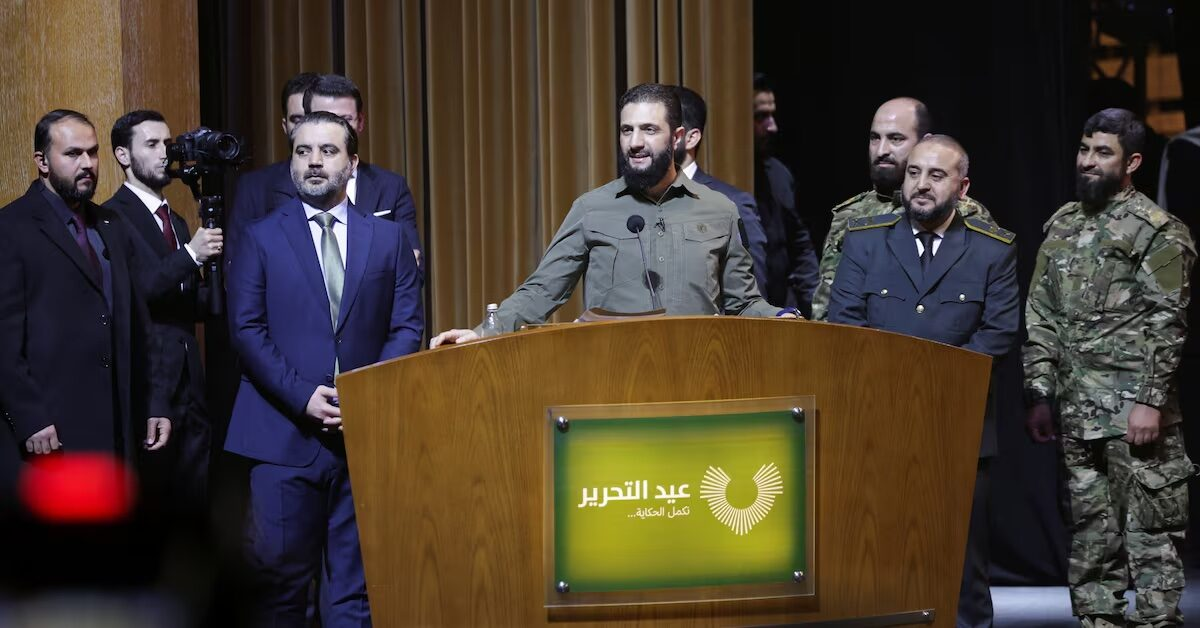
As the divided country fights to regain stability and heal from years of conflict, Syrians celebrated the first anniversary of Bashar al-Assad’s overthrow and his harsh rule on Monday with joyous festivities in major cities.
The administration has “laid out a clear vision for a new Syria as a state that looks towards a promising future,” the new leader, President Ahmed al-Sharaa, told a sizable throng of supporters, describing it as a historic departure from a “dark chapter.”
More than 13 years after an uprising turned into a bloody civil war, Assad’s government came to an end when Sharaa’s rebels captured Damascus after an eight-day blitz through the country. Assad departed Syria for Russia a year ago.
An Alepo resident says, “We began to love the country.”
Dawn prayers were held at the Umayyad Mosque in Damascus on Monday. Sharaa was wearing the military fatigues he wore while leading the al-Qaeda rebel group Hayat Tahrir al-Sham, a uniform he has now replaced with the somber suits of the presidency.
State news agency SANA said he pledged to create a strong and just Syria.
“From north to south and from east to west, God willing, we will rebuild a strong Syria with a structure befitting its present and past,” he added.
Last year, in Aleppo, the first major city to fall to Sharaa’s forces, automobiles with occupants holding Syria’s new flag honked their horns as they paraded through the streets.
“We fell in love with our homeland. Mohammed Karam Hammami, a citizen of Aleppo, stated, “We used to try to flee from the country because we didn’t love it.”
Syria’s international relations have undergone significant transformation as a result of Sharaa. He has shifted away from Assad’s supporters, Iran and Russia, and established ties with the United States, Gulf Arab nations, and Turkey. Most of the crippling Western sanctions have been withdrawn.
He has pledged to establish a just and inclusive system in lieu of Assad’s cruel police state.
As he works to restore all of Syria to Damascus’ control, hundreds of people have been killed in episodes of sectarian violence, leading to fresh displacements and escalating hostility among minorities toward Sharaa’s administration.
The Kurdish-led government that controls the northeast forbade events or gatherings on security concerns, claiming that “terror cells” were more active and trying to take advantage of the situation. On this anniversary, it congratulated Syrians.
While some Druze, members of a minority sect that is an offshoot of Islam, have been calling for independence in the southern province of Sweida since hundreds of people were killed there in deadly clashes with government forces in July, the Kurdish-led government has worked to protect its regional autonomy.
ANOTHER FOUR YEARS OF PROCESS PRIOR TO ELECTIONS
Despite the violent episodes, Sharaa declared at a gathering in Qatar over the weekend that “Syria today is living its best times” and promised to hold those guilty accountable.
He stated the country would have elections after a four-year transitional period under his leadership to establish institutions, laws, and a new constitution that would be placed to a popular vote.
Sharaa has extensive authority under a provisional constitution that was enacted in March. In October, the government held an indirect vote to create a parliament, although Sharaa has not yet chosen one-third of the 210 members required by the constitution.
For 54 years, the Assad family, who belonged to the Alawite minority in Syria, dominated the country.
Since 2011, the Syrian conflict has resulted in hundreds of thousands of deaths and millions of displaced people, forcing about five million to flee to neighboring nations.
Since Assad was overthrown, some 1.2 million refugees and 1.9 million internally displaced persons have returned home, according to the U.N. refugee agency on Monday. However, a reduction in international financing may discourage others.
Last week, during a Reuters NEXT conference, Syria’s central bank governor stated that the economy was expanding due to the return of about 1.5 million refugees.
There are around 16.5 million Syrians in need of humanitarian assistance in 2025, according to the U.N. Office for the Coordination of Humanitarian Affairs.