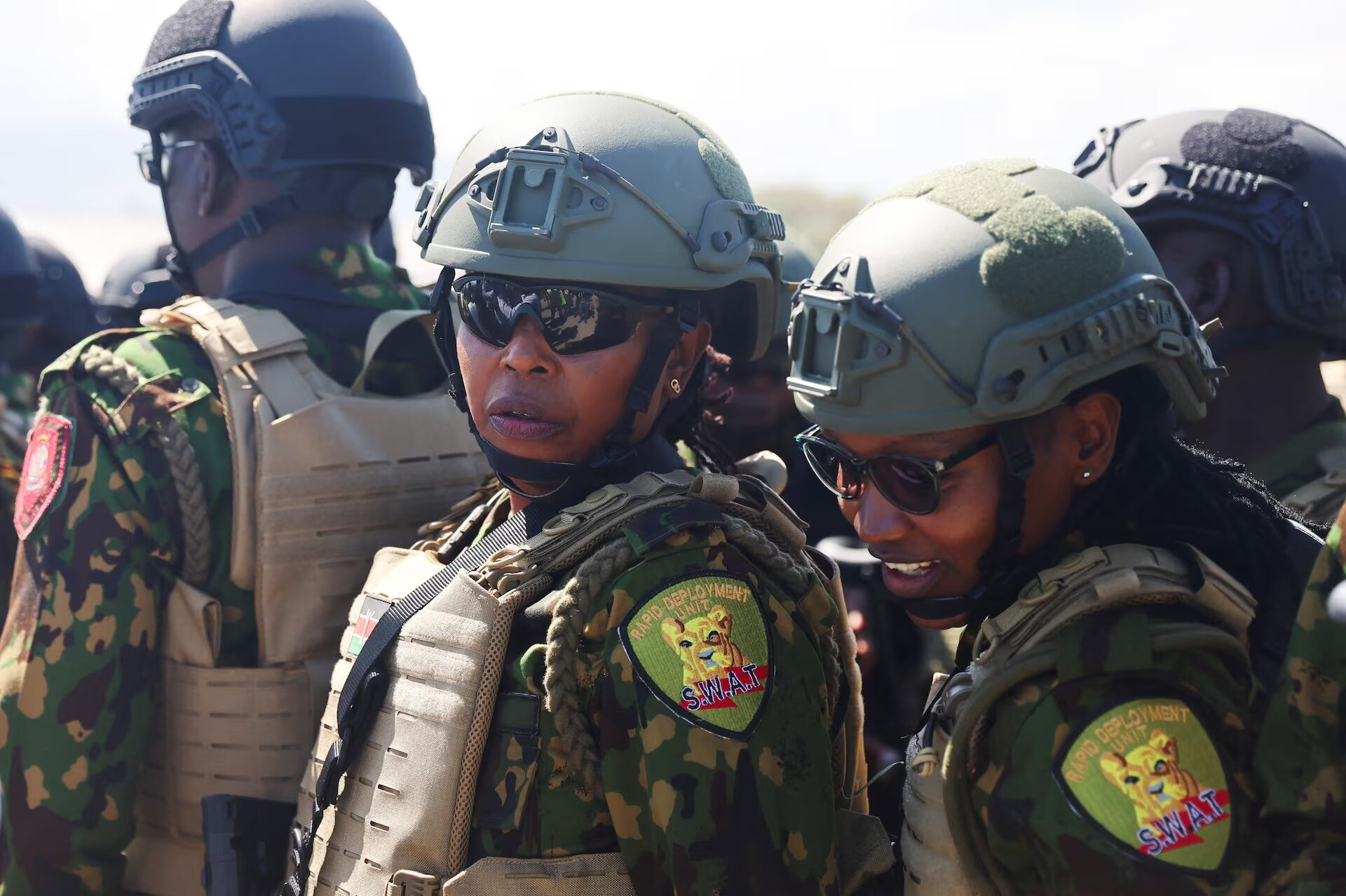
The first foreign deployment since the U.N. Security Council authorized enlarging an existing gang-fighting force in the Caribbean island occurred Monday, according to Haiti’s national police, when 230 Kenyan police officers landed in the country.
The force now has 980 troops, according to force spokeswoman Jack Ombaka, who told Reuters that this is the first deployment since the unit was last strengthened in February of this year.
The mission’s purpose is to combat gangs that have come to dominate most of the capital and spread to central Haiti in recent years, destroying the country’s economy. These gangs are armed with weaponry that are mainly supplied in from the United States.
Haiti’s gangs, which are widely allied under the Viv Ansanm coalition, are charged with extortion, arson, gang rapes, and mass murders in a protracted struggle that has displaced about 1.4 million people.
At the end of September, the U.N. Security Council decided to expand the current mission into a larger “Gang Suppression Force” because the deployment was only about 1,000 soldiers, far less than the 2,500 it had hoped for.
Though donations have been sluggish to come in, the new structure is authorized to deploy up to 5,500 soldiers. These depend on voluntary pledges made by governments, just like the previous approach.
Although Jamaica, the Bahamas, Belize, Guatemala, and El Salvador have also supplied personnel, Kenya, which was chosen to spearhead the first operation, is by far the biggest donor.
The United States claims to have contributed more than $1 billion to the force’s support, including logistics, food, lodging, vehicle maintenance, and medical expenditures, but it has stated that it is no longer prepared to shoulder the majority of the costs.
Canada has contributed over $63 million, while the United States has only contributed $15 million to a special U.N. trust fund established to support the operation. According to U.N. data, the fund has not received any contributions since August of this year.
The force was originally projected to need $800 million annually, but the fund’s $113 million is far less than that amount.