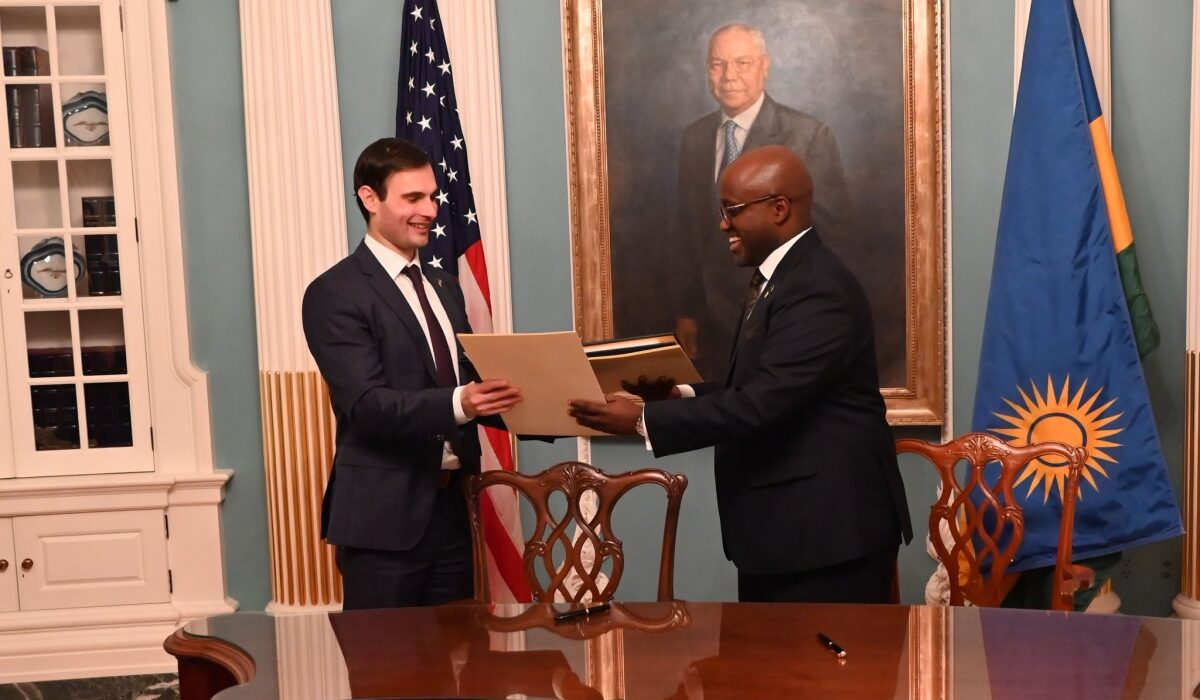
A five-year, $228 million agreement that defines a comprehensive vision to save lives, develop Rwanda’s health system, and make America safer, stronger, and more prosperous was signed by Rwandan and US officials on Friday, December 5, according to a statement from the US Department of State.
According to government spokesperson Yolande Makolo, the collaboration marks the beginning of “a new era” in Rwanda-US health cooperation.
The second bilateral health cooperation memorandum of understanding between the United States and Rwanda was signed in Washington by Jeremy Lewin, the Under Secretary for Foreign Assistance, Humanitarian Affairs, and Religious Freedom, and Amb. Olivier Nduhungirehe, the Minister of Foreign Affairs and International Cooperation.
Under the agreement, the United States plans to work with Congress to commit up to $158 million over the next five years to help Rwanda fight HIV/AIDS, malaria, and other infectious diseases, as well as to improve disease surveillance and outbreak response, according to the U.S. Department of State. In response, it is reported that the Rwandan government intends to raise its own domestic health investment by $70 million, assuming more financial responsibility as U.S. assistance is progressively diminished over time.
“This partnership also helps further American commercial interest in Rwanda and Africa more broadly,” the statement goes on. The deal, for instance, expands upon the Department’s historic November 2025 award to Zipline International Inc. to assist in the development of advanced robotics manufactured in the United States for the delivery of life-saving medical supplies.
The award stipulates that Rwanda, Africa’s first user of Zipline’s technology, will be in charge of running and maintaining the state-of-the-art supply infrastructure financed by U.S. aid.
Additionally, Ginkgo Bioworks, an American technology company, will get $10 million as part of the agreement to enhance its disease outbreak surveillance in Rwanda. This will entail the establishment of a biothreat radar system that will assist in monitoring possible outbreaks in the wider region.
The agreement also lists a number of healthcare domains in which Rwanda is eager for further private sector collaboration and investment from the United States, such as creating next-generation HIV therapies and utilizing artificial intelligence (AI) in healthcare.