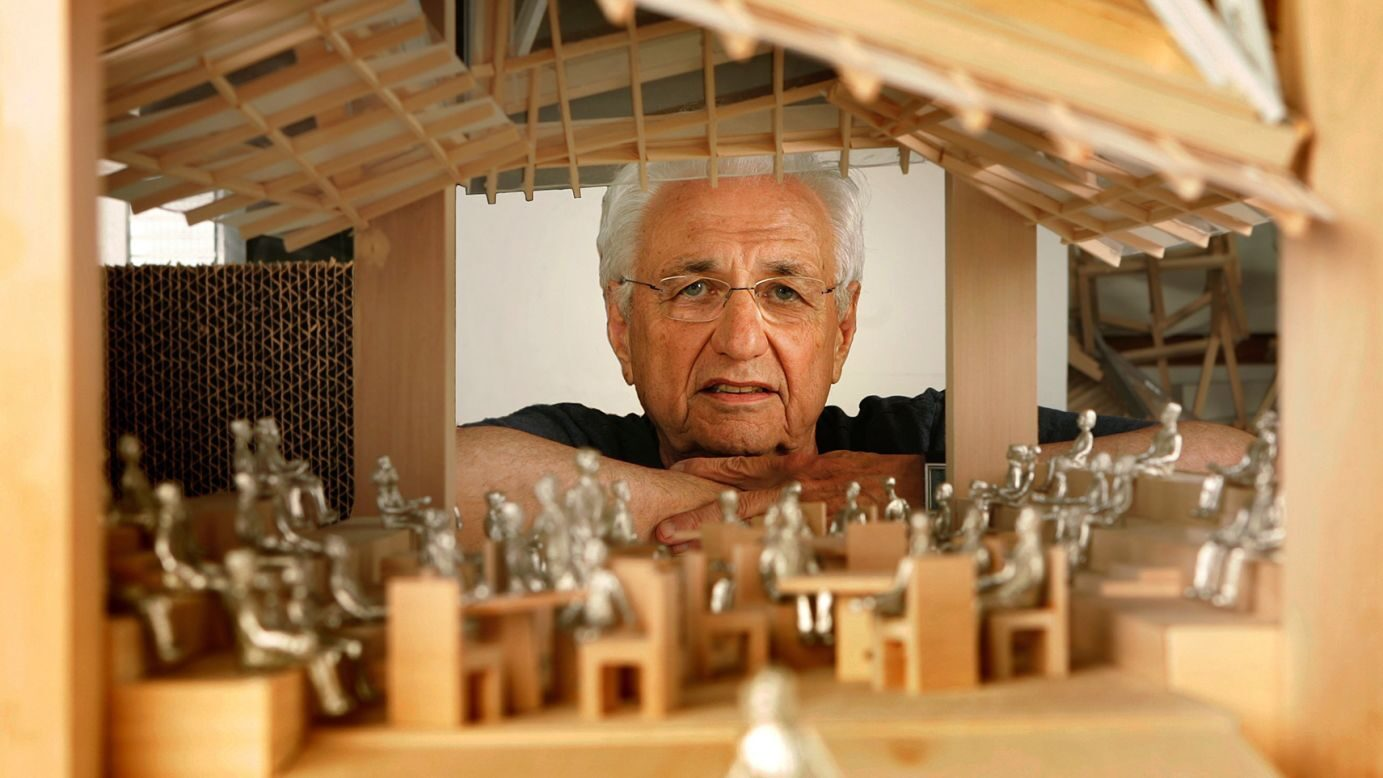
Frank Gehry passed away at the age of 96, and his innovative ideas are still changing cities and contemporary architecture, inspiring tributes around the world.
At the age of 96, Frank Gehry, the visionary architect whose avant-garde, sculpture-like structures transformed skylines and revolutionized architecture worldwide, passed away. Meaghan Lloyd, his chief of staff, confirmed his death.
After the 1997 opening of his titanium-clad Guggenheim Museum in Bilbao, Spain, Gehry became well-known throughout the world. This building is widely credited with boosting the city’s economy and igniting the “Bilbao effect,” which holds that daring architecture has the power to change an urban’s fortunes.
Gehry was born in 1929 in Toronto, relocated to Los Angeles as a teenager, and attended the University of Southern California to study architecture before finishing his graduate studies at Harvard’s Graduate School of Design. After starting his own firm, he swiftly abandoned architectural tradition in favor of asymmetry, unusual materials, and unfinished, raw surfaces—a strategy that would eventually be dubbed deconstructivism.
When he redesigned his Santa Monica house using corrugated metal, plywood, and chain-link fencing, he had an early breakthrough. Later, he was able to create sweeping, curved buildings that were previously thought to be unachievable by using sophisticated 3D modeling that was adopted from aeronautical engineering.
Gehry received the Pritzker Prize, the highest honor in architecture, in 1989. The panel lauded his “highly refined, sophisticated, and adventurous aesthetic,” likening the improvisational nature of his work to jazz.
The Walt Disney Concert Hall in Los Angeles, the Jay Pritzker Pavilion in Chicago, the Gehry Tower in Germany, the Louis Vuitton Foundation in Paris, the Dancing House in Prague, and the Hotel Marqués de Riscal in Spain are just a few of the famous buildings that Gehry designed.
Made of titanium, glass, and limestone, his Guggenheim Museum in Bilbao is still regarded as one of the best structures of the contemporary era. It was previously referred to as “the greatest building of our time” by architect Philip Johnson.
The public was fascinated and mocked by Gehry’s unusually flowing and erratic designs. Despite the intricacy of his actual work, he later said that the cultural joke about a crumpled piece of paper allegedly inspiring a skyscraper design from his guest appearance on The Simpsons “haunted” him.
From all across the world, tributes have flooded in. The CEO of LVMH, Bernard Arnault, referred to Gehry’s Paris structure as “his greatest masterpiece.” Gehry was “one of the few architects to engage people emotionally,” according to author and architecture critic Paul Goldberger, who also noted that he worked with full creative vitality until the very end.
In his mourning message to Gehry’s family, Canadian Prime Minister Mark Carney stated that Gehry’s vision “lives on in iconic buildings around the world.” The Guggenheim Museum in Bilbao also paid tribute to him, stating that his legacy “will always remain connected to Bilbao.”
Gehry is survived by his wife, Berta Isabel Aguilera; two sons, Alejandro and Samuel; and two daughters, Brina and Leslie, from his first marriage.