Dangote: Fuel lines are history as the refinery is prepared to deliver 50 million liters every day
Dangote announces significant expansion and export plans, ends fuel lines, and has a refinery prepared to surplus local demand.
Alhaji Aliko Dangote, the president of the Dangote Group, has reassured Nigerians that the days of long lines for gasoline are over.
As a result, he promised a steady supply of gasoline both during and after Yuletide.
Following a private meeting with President Bola Tinubu at the State House in Abuja on Friday, Dangote emphasized to reporters:
Nigeria has always struggled with fuel lines since 1972. We are removing those lines for the first time by producing locally rather than importing. There were no lines, not even when we were servicing the refinery. Queues are a thing of the past, I promise.
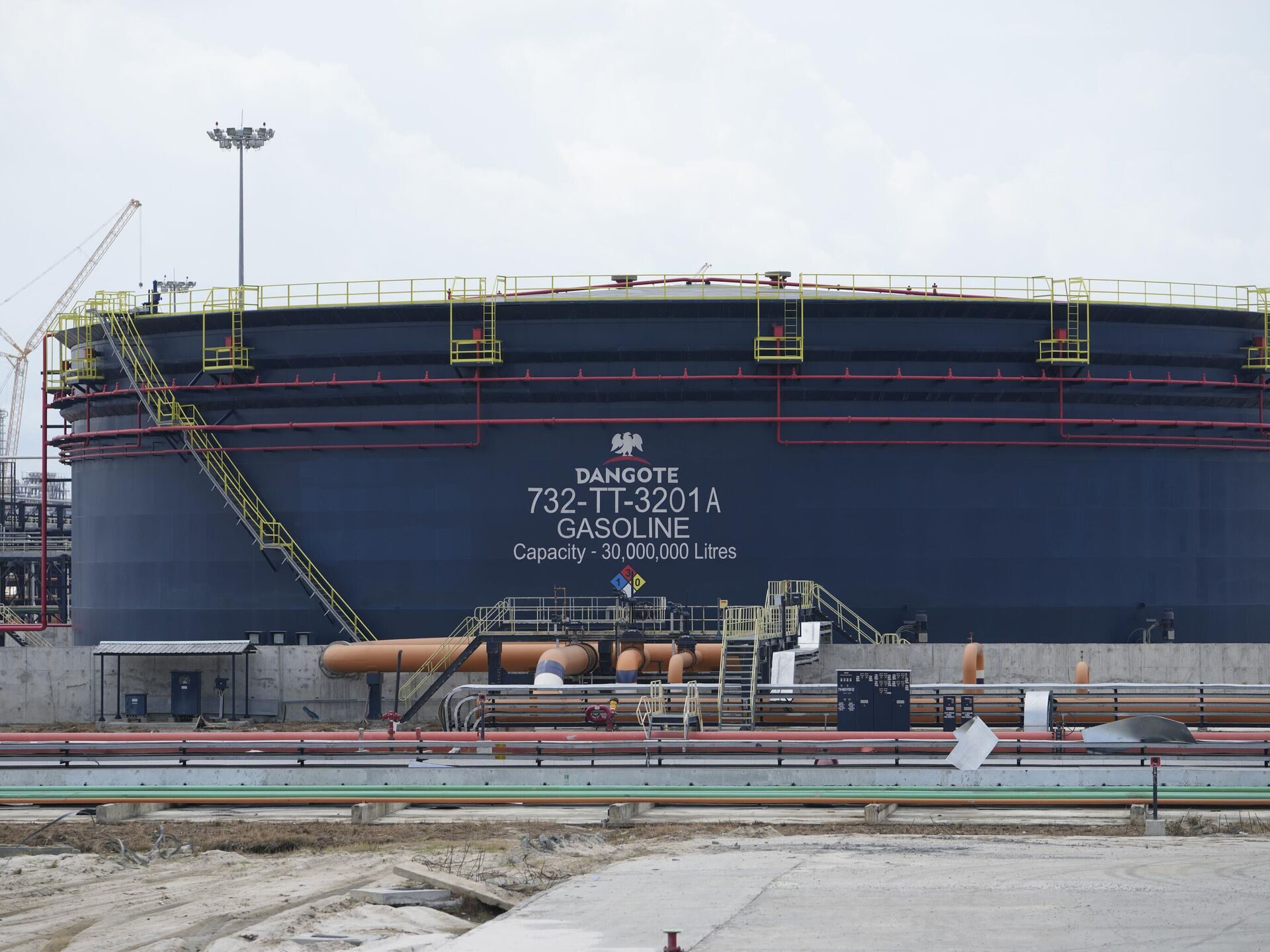
He said that the Nigerian Midstream and Downstream Petroleum Regulatory Authority (NMDPRA) has been officially informed by Dangote Refinery that it is prepared to supply 50 million liters of Premium Motor Spirit (PMS) per day, which is much more than the country’s demand.
According to Dangote, the refinery will quickly generate excess volumes; by February, it would provide 15–20 million liters more than Nigeria requires.
According to him, this will enable exports to nearby nations, lowering the prevalence of fuel scarcity in West Africa.
Additionally, he revealed that domestic firms, particularly those in the plastics sector, will now have dependable access to locally produced feedstock, putting an end to years of reliance on imports worth an estimated $400 million a year.
By 2028, Dangote’s expansion plan will increase the refinery’s capacity to 1.4 million barrels per day, surpassing the world’s largest refinery, Reliance, in India, which currently operates at 1.25 million barrels per day.
“But going forward, what do we really want to do?” he said. What we plan to accomplish is surpass Reliance by 2028 and expand this refinery to become the biggest refinery globally. At 1.4 million barrels per day, we will surpass Reliance’s daily production of 1.25 million barrels. We have already signed and launched, and we plan to begin piling for the refinery by the end of January, and it will be delivered on schedule.
The well-known businessman also disclosed plans to increase the company’s urea production to 12 million tonnes per year, which would put Nigeria in a position to surpass Qatar and Russia as the world’s top producer.
He stated, “We want to use our fertilizer company to supply the entire African continent.”
In response to recent drops in the price of gasoline and diesel, Dangote said that the trend was caused by less smuggling and more competition.
Because we have to compete with imports, prices are declining. Fortunately, though not entirely, smuggling has decreased.
“We’re not here to recover $20 billion overnight,” he emphasized, stressing that the refinery industry is a long-term national commitment. I want to leave a legacy of helping Nigerians get whatever they need, including power, fuel, and fertilizer.
Dangote also emphasized the logistical challenges facing Nigeria’s solid minerals industry, specifically the overcrowding at its main ports.
“Apapa is completely occupied. The tin can is full. Containers are the major focus of Lekki. If you have nowhere to ship from, you can’t export copper or coal,” he said.
He stated that in order to solve this, the Group is building Olokola, which is anticipated to be finished in two and a half years and would become the largest deep-sea port in West Africa.
Despite acknowledging opposition from foreign oil firms, he expressed support for the Tinubu administration’s naira-for-crude program, characterizing it as a patriotic gesture to build the economy.
He declared, “It’s a teething issue, but it will be fixed, either by legislation or administrative action.”
Dangote insisted that the refinery will prosper despite worries about international competition.
“Our goal is to establish Nigeria as Africa’s refining center. Fuel is imported by every African nation. We want local production of the goods we use.
Additionally, he encouraged affluent Nigerians to direct their resources toward profitable investments rather than extravagant consumption and supported the government’s Nigeria-first industrial policy.
“Invest in industries and create jobs if you have money for a private jet,” he added, emphasizing that in order to draw in foreign investment, indigenous businessmen must spearhead industrialization.
Dangote expressed optimism that the nation is now on a secure path toward sustainable industrial growth, despite acknowledging previous obstacles, policy instability, smuggling, and factory closures.
“Local investors need to take the lead. Foreign investors will follow after they do. A decent restaurant doesn’t advertise itself; when the food is good, word gets out,” he remarked.
He called his discussion with President Tinubu “a very fruitful meeting” and characterized it as a standard chat on the business environment and economy.