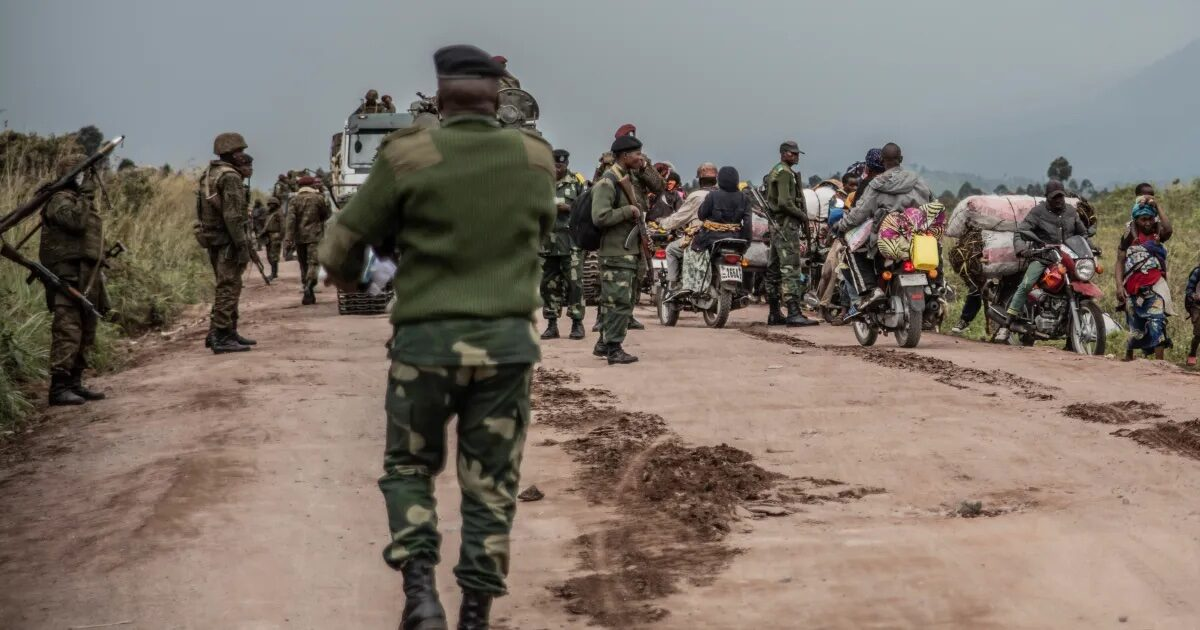
A day after U.S. President Donald Trump welcomed Congolese and Rwandan leaders to Washington to sign new agreements intended to put an end to years of strife in a mineral-rich region, fighting broke out in the eastern Democratic Republic of the Congo on Friday.
On Thursday, Rwandan President Paul Kagame and Congolese President Felix Tshisekedi reiterated their vows to a June agreement mediated by the United States to stabilize the large nation and pave the way for additional Western mining investment.
“We’re settling a war that’s been going on for decades,” declared Trump, whose administration has interfered in a number of international disputes to promote American corporate interests and enhance his reputation as a peacemaker.
On the ground, fierce fighting is still going on.
However, intense combat persisted on the ground, with the opposing factions accusing one another.
Forces loyal to the government were carrying out broad attacks, according to the Rwandan-backed AFC/M23 rebel group, which took control of the two biggest cities in eastern Congo this year and is not bound by the Washington deal.
According to the M23, bombs fired from Burundi had been hitting villages in North and South Kivu for more than three days, killing women and children, injuring civilians, and destroying homes, schools, and medical facilities. It charged Congo’s ally Burundi of organizing airstrikes using heavy artillery and drones.
Burundi’s representative was not immediately available for comment.
Congo’s army, meanwhile, claimed that while fighting was still going on and Rwandan forces were conducting strikes, it was not aiming at people.
It accused M23 rebels of regularly breaking a ceasefire and claimed to have destroyed an enemy drone that had entered Congolese airspace from Bugarama in Rwanda.
A Congolese army spokeswoman reported that 11 civilians had been killed in the conflict, whereas M23 reported that 23 people had been murdered and numerous others had been injured.
Analysts claim that although U.S. diplomacy prevented the war in eastern Congo from intensifying, it was unable to address the fundamental problems, as neither Rwanda nor Congo fulfilled their June commitments.
Numerous displaced families were seen escaping on foot with their possessions and animals in the vicinity of the eastern Congolese town of Luvungi in videos posted online. Reuters was unable to verify them right away.
PEOPLE CAPTURED IN CONFLICT
“Numerous homes have been destroyed, and women as well as children have tragically lost their lives,” AFC/M23 spokesperson Lawrence Kanyuka stated.
Using fighter jets, drones, and heavy artillery, Congolese government-aligned forces “continued their relentless attacks on densely populated areas of North Kivu and South Kivu,” he wrote on X.
Conflicts were occurring in South Kivu province along the Kaziba-Katogota-Rurambo axis, a Congo army spokesperson told Reuters.
According to South Kivu army spokeswoman Reagan Mbuyi Kalonji, the Congolese army had only attacked combatants in the slopes above Rurambo and Kaziba.
“The Rwandan Defense Force’s bombing of Luvungi is displacing residents. He declared, “They are bombing mindlessly.
The government and army of Rwanda were not immediately available for comment.
According to a senior AFC/M23 official, rebel troops destroyed a Congolese army drone and retook the town of Luberika. He stated that the fight was ongoing regardless of the Washington deal, requesting anonymity because he was not permitted to speak to the media.
Since December 2, there has been fierce combat that has killed, injured, and displaced civilians, according to the U.N. Office for the Coordination of Humanitarian Affairs.
Unknown numbers of injured civilians are unable to go to medical facilities for treatment because of clashes and barriers, according to U.N. spokesperson Stephane Dujarric.
Conflicts on December 3 and 4 in South Kivu that struck three schools and another location close to a school, purportedly killing at least seven children and injured others, prompted the U.N. children’s organization UNICEF to express alarm on Friday.
Its statement called for an end to attacks on educational facilities, saying, “In 2025, fighting has intensified to levels not seen in years, and children, as always, are bearing the brunt.”