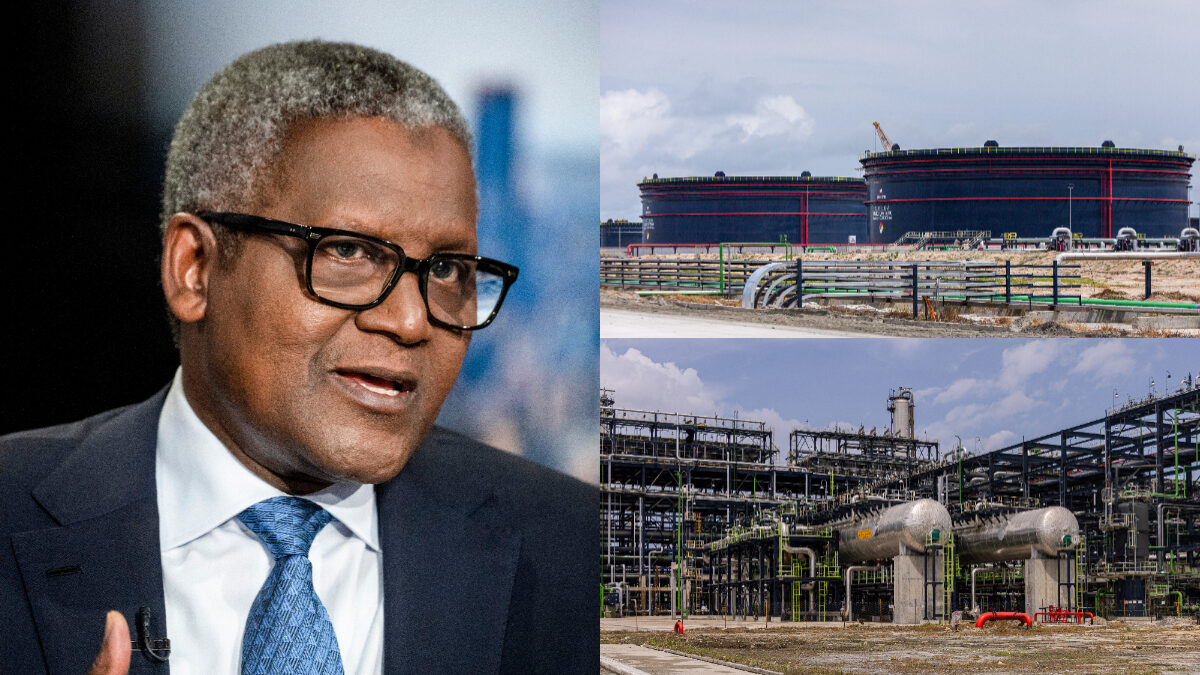
Dangote Expands Refinery Capacity From 650,000 BPD To 1.4 Million BPD With US Company Honeywell
Dangote Group has chosen the US company Honeywell to double polypropylene production, treble refinery output, and fortify Nigeria’s industrial and energy security.
In order to facilitate the next stage of the Dangote 650,000 barrels per day Petroleum Refinery’s development by more than 100%, the Dangote Group has announced that it has partnered strategically with Honeywell International Incorporated.
Dangote said in a statement on Tuesday that the partnership would supply cutting-edge technology and services that would allow the refinery to boost its processing capacity to 1.4 million barrels per day by 2028, which would be a significant step toward their long-term goal of creating the largest petroleum refining complex in the world.
The announcement claims that Honeywell will provide specialized catalysts, machinery, and process technologies as part of this arrangement, enabling the refinery to process a wider range of crude grades effectively and to further improve product quality and operational dependability.
A Fortune 100 industrial and technology business based in the United States, Honeywell provides a broad range of solutions in the fields of advanced materials, automotive, aviation, and industrial automation.
Since 2017, Honeywell’s UOP business has been Dangote’s technological partner, offering high-performance column trays, heat exchanger technologies, catalyst regeneration apparatus, and proprietary refining systems to support our best-in-class operations.
The cooperation is in line with the oil company’s plan to add a new single-train unit last month in order to meet Nigeria’s local demand while creating surplus volumes for export, even if the deal’s financial parameters were not made public.
Additionally, the Dangote Group stated that it is expanding its petrochemical presence. The business said that it was utilizing Honeywell’s Oleflex technology to increase its capacity for polypropylene to 2.4 million metric tons per year as part of the larger partnership.
One important industrial material that is frequently utilized in manufacturing, packaging, and automotive applications is polypropylene. Dangote Group said it was moving forward with the next stage of its fertilizer growth plan in Nigeria in addition to refining expansion.
Our yearly urea manufacturing capacity will be increased from three million metric tons to nine million metric tons. Two trains of 1.5 million metric tons each make up the current plant. Four more trains will be added as part of the expansion to accommodate the rising demand for premium fertilizer in both African and international markets.
The statement went on, “Dangote Group remains fully committed to delivering world-class industrial capacity, strengthening Nigeria’s energy security, and driving sustainable economic growth through long-term investment, innovation, and strategic global partnerships.”
Outside of the pandemic, JP Morgan analysts have projected that oil prices will drop to their lowest point in 20 years. Nigeria’s benchmark, Brent crude oil, is expected to average $42 in 2027 due to a supply glut caused by an increase in production by the Organization of Petroleum Exporting Countries (OPEC) cartel.
The bank predicted that prices would “slip into the $30s by year-end” if nothing was done. Prices peaked in 2004 at $30, excluding the pandemic, when travel was severely restricted due to lockdown regulations.
As the Saudi-led OPEC cartel of oil-producing nations has increased output to preserve its market share, the price of Brent has dropped from over $82 in January to $62 on Tuesday.
As Chinese consumers switch from gasoline and diesel cars to electric vehicles, demand has been negatively impacted.
According to the UK Telegraph, drivers usually benefit from lower oil prices because forecourts should pass on declining wholesale costs to customers. JP Morgan predicted that the excess oil production will increase from 1.5 million barrels per day this year to 2.8 million barrels per day next year.
The analysts predicted that under these circumstances, Brent prices will fall below $60 in 2026, reach the low $50s by the last quarter, and end the year at $4.
In 2027, JP Morgan stated, “the outlook worsens as mounting surpluses drive Brent to an average $42, with prices sliding into the $30s by year-end.”
By the end of this year, analysts at Deutsche Bank and Macquarie have predicted that oil prices will drop to the mid-$50s. A decline “would be a huge boost to the finances of families with cars and, more importantly, the cost of haulage,” according to AA’s Luke Bosdet.
“That would significantly affect customer prices, which ought to be passed on to customers,” he stated. “Inflation should significantly decline as a result. But given the state of the world economy and current events, I’ll believe it when I see it,” Bosdet remarked.
According to the International Energy Agency’s (IEA) most recent study, the world’s oil output has increased by a “massive” 6.2 million barrels per day since January. In September, the world’s oil reserves increased by 77.7 million barrels, or 2.6 million barrels per day, to their highest level since July 2021.
The Agency cautioned that the recent tariff unrest, the US federal government shutdown, and the British and American sanctions on Russia’s two biggest producers, Rosneft and Lukoil, had not yet revealed how supply would be affected.
In accordance with its increased quota, Saudi Arabia increased supplies by over 1.5 million barrels per day between January and October, according to the Agency. In comparison, sanctions and a difficult operating environment have hindered Russian output growth, which has increased by just 120,000 barrels per day during the same time period.
It also stated that while crude supply “is on course to rebound further, adding to market balances that look increasingly askew,” the growth in global oil consumption “is expected to ease” in the last three months of this year compared to the previous quarter.