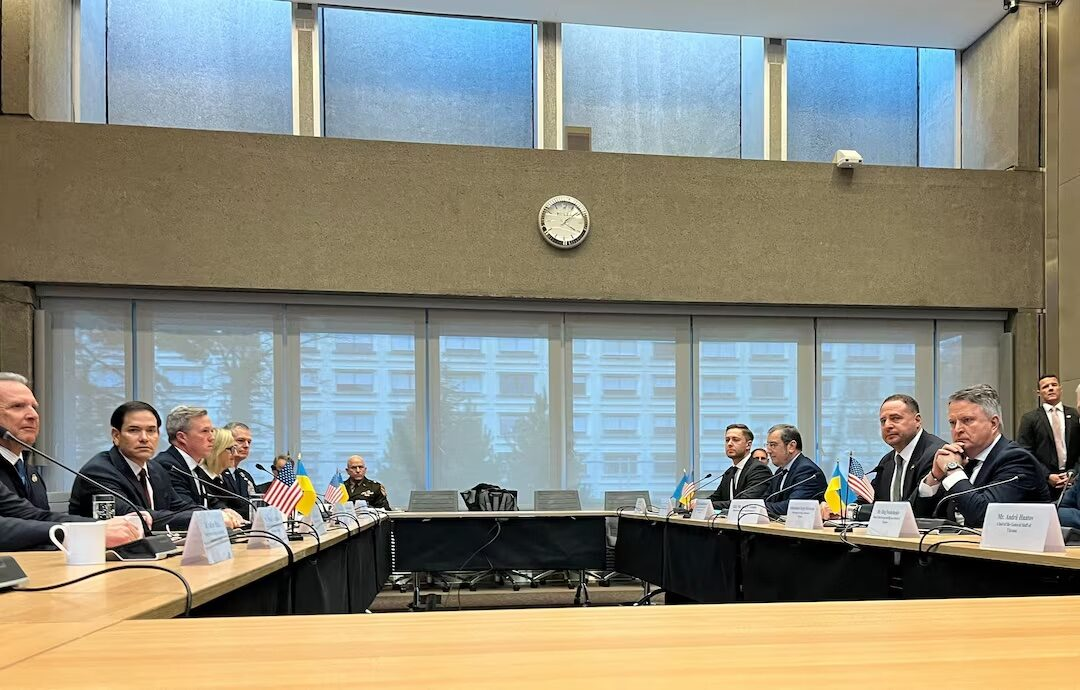
The US and Ukraine have announced advancements regarding a peace framework following discussions in Geneva.
The United States and Ukraine have announced significant advancements on a “updated and refined peace framework” intended to conclude the Russia-Ukraine war, after what both parties characterized as “highly productive” discussions in Geneva. On Sunday, officials issued a joint statement confirming that discussions regarding the US-backed proposal will continue intensively in the coming days, as negotiators strive to close the remaining gaps.
US Secretary of State Marco Rubio stated that the Geneva discussions yielded “a tremendous amount of progress” in narrowing the disputed sections of the 28-point draft plan. He noted that while negotiators experienced a “very good day,” there remained several unresolved issues that needed additional attention. Ukrainian President Volodymyr Zelensky expressed a sense of cautious optimism, mentioning that there are “signals that President Trump’s team is hearing us.”
Rubio stated that the primary objective of the meeting was to minimize the number of “open items” in the draft, noting that this had been accomplished “in a substantial way”. He stressed, however, that any final agreement would require the approval of both the US and Ukrainian presidents before it could be presented to Russia.
The upbeat atmosphere of the Geneva talks stood in stark contrast to comments made earlier by President Donald Trump, who claimed that Ukraine displayed “zero gratitude” for what he characterized as US efforts to resolve the conflict. Trump criticized European nations for their ongoing purchases of Russian oil, contending that these transactions indirectly bolster Moscow’s war efforts. His remarks introduced an additional layer of tension to an already fragile negotiation process.
Reports from various media outlets indicated that the diplomatic landscape was further complicated by European allies, spearheaded by the UK, France, and Germany, who had formulated an alternative plan to bring an end to the war. The BBC stated that it had not reviewed the document, whereas Rubio claimed to have no awareness of it.
While the complete US-backed draft remains unreleased to the public, important details have emerged in recent days, raising concerns among Ukrainian and European officials. The outlined provisions involve Ukraine pulling back its forces from areas in eastern Donetsk under its control, alongside the international acknowledgment of Russia’s de facto authority over Donetsk, Luhansk, and Crimea. The proposal reportedly includes freezing the front lines in Kherson and Zaporizhzhia at their current positions, decreasing Ukraine’s armed forces to 600,000 personnel, and necessitating that Kyiv relinquish its pursuit of NATO membership in return for unspecified “reliable security guarantees.”
Furthermore, the draft allegedly outlines a vision for Russia’s reintegration into the global economy by lifting sanctions and possibly reinstating Moscow into the G7.
The draft plan’s origins have sparked political controversy in Washington. Rubio has maintained that the document was created by the United States with contributions from Ukraine and Russia, dismissing assertions from a bipartisan group of senators who claimed he had earlier referred to the plan as being authored by Russia. The State Department characterized the senators’ account as “blatantly false.”
Trump initially indicated that Ukraine had until Thursday to accept the proposal, but he later clarified that the leaked draft was not a “final offer.” Rubio emphasized that negotiations were progressing quickly and expressed his strong optimism about reaching an agreement in a timely manner, indicating that a resolution might be possible as soon as next week.