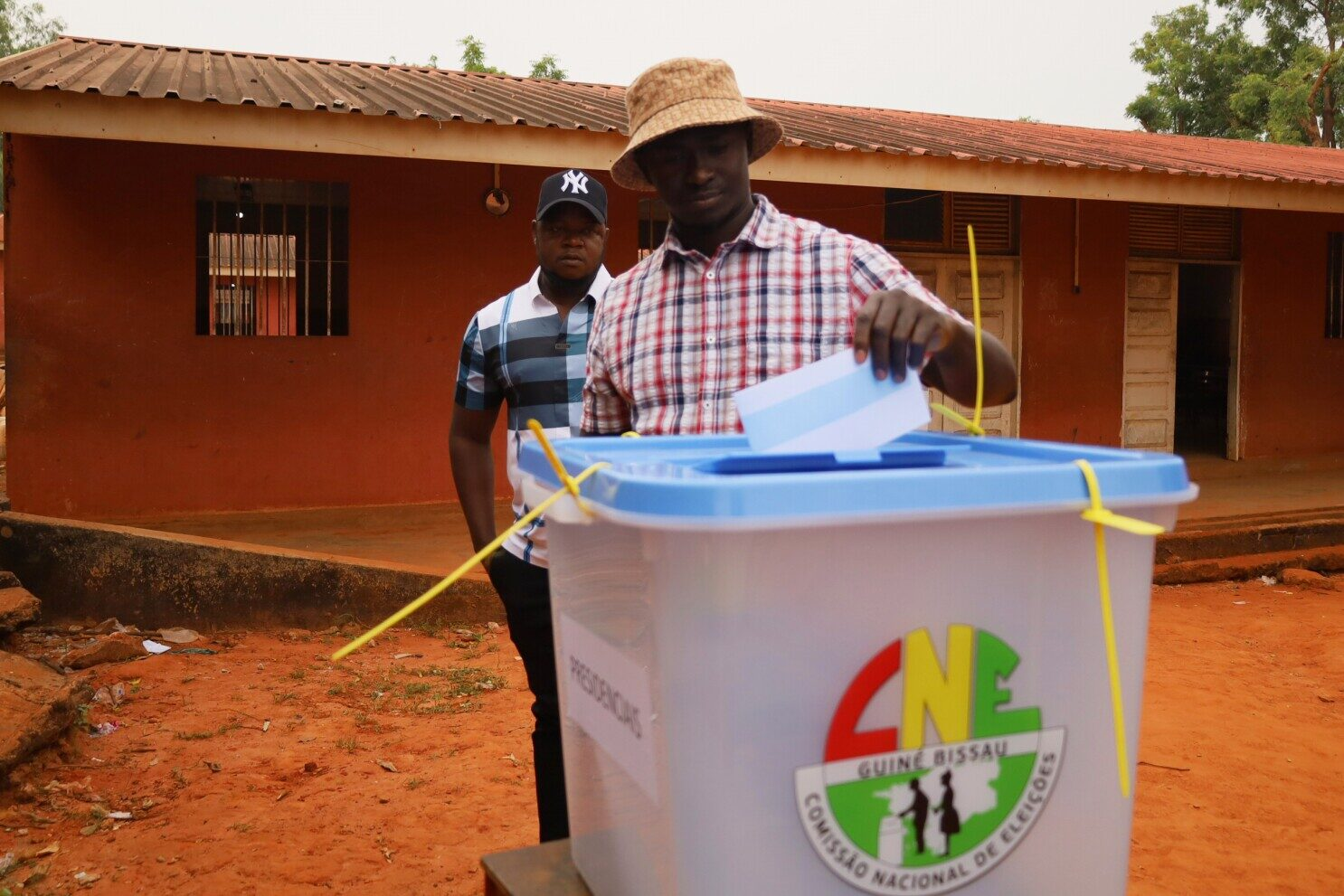
Coup-prone President Umaro Sissoco Embalo faced a fierce challenge to become the first leader in thirty years to win a second consecutive term in Guinea-Bissau, which held presidential and legislative elections on Sunday.
Fernando Dias, a relative political novice who has the support of the party that spearheaded the struggle for independence from Portugal in the 1960s and 1970s, is the strongest of the 11 candidates vying for his support.
For the first time, the African Party for the Independence of Guinea and Cape Verde was prohibited from running its own candidates due to alleged late filing of paperwork.
Embalo and Dias are expected to compete closely, and if no candidate receives more than 50% of the vote, a runoff will take place.
Embalo cast his ballot in the eastern city of Gabu on Sunday while sporting his traditional red keffiyeh, indicating his confidence in winning.
“I call on everyone to vote massively, to elect the person who will bring stability and progress to Guinea-Bissau, to build this country,” he stated.
Shortly after the polls closed at 1700 GMT, vote counting got underway.
The national electoral commission’s spokeswoman, Idrissa Diallo, told a news briefing late Sunday that the turnout had above 65% and that provisional results would be released on Thursday.
SUCCESSING COCAINE MARKET
Between 1974, when it became independent of Portugal, and 2020, when Embalo assumed power, the little coastal country between Senegal and Guinea had at least nine coups.
Although his opponents have accused him of fabricating crises to justify crackdowns, a claim he denies, Embalo claims he has weathered three more since then.
If elected to a second term, he has promised to increase water availability, create more roads, and establish stability. However, his opponents claim that his mandate expired in February, and he has been plagued by doubts about his legality throughout the year.
According to Dias, Embalo intends to weaken Guinea-Bissau’s institutions in order to increase the president’s authority should he be reelected.
Dias criticized Embalo for not reducing the drug traffic in Guinea-Bissau, which continues to be a major transit hub for cocaine traveling from South America to Europe, in an interview with Reuters on the eve of the vote.
He is in charge of the government. “Nothing is done without his consent,” Dias told Reuters.
Claims that his government is involved in the drug trade have been denied by Embalo.
According to a report published in August by the Global Initiative Against Transnational Organized Crime, Guinea-Bissau’s cocaine trafficking may be more lucrative currently than it has ever been.
As he cast his ballot in Bissau’s capital, 38-year-old customs officer Jorge Monteiro declared, “On the subject of drug trafficking, only the political will of our leaders can help our country wage a crusade against this scourge.”
A POLITICAL CLIMATE POLARISED
Of Guinea-Bissau’s approximately two million citizens, about half were registered to vote. On Sunday, voting went off without a hitch.
“The current electoral climate is extremely tense, with a very polarized political landscape,” stated Lucia Bird Ruiz-Benitez de Lugo, director of GI-TOC’s Observatory of Illicit Economies in West Africa.
“The opposition have significant and longstanding popular support, however their campaigning efforts have been very restricted, and it is not an even playing field.”
As the campaigns staged their last rallies on Friday, voters seemed split.
Tailor Saico Cande expressed optimism that Embalo will resolve the nation’s food and security issues.
However, businesswoman Berta da Goya expressed her concern about Embalo’s move to dissolve parliament following what his government claimed was a coup attempt in late 2023.