Nigeria wants ethical AI and fair mineral trade at the G20 Leaders’ Summit
Nigeria warns that existing methods marginalize developing countries and calls for value addition, equity in the mineral trade, and universal AI standards at the G20.
Nigeria advocated on Saturday for a global framework that ensures value addition at the source and helps communities in Nigeria and Africa that contain vital minerals.
This coincides with Nigeria’s support for the development of international ethical guidelines for artificial intelligence (AI) with the goal of advancing global progress.
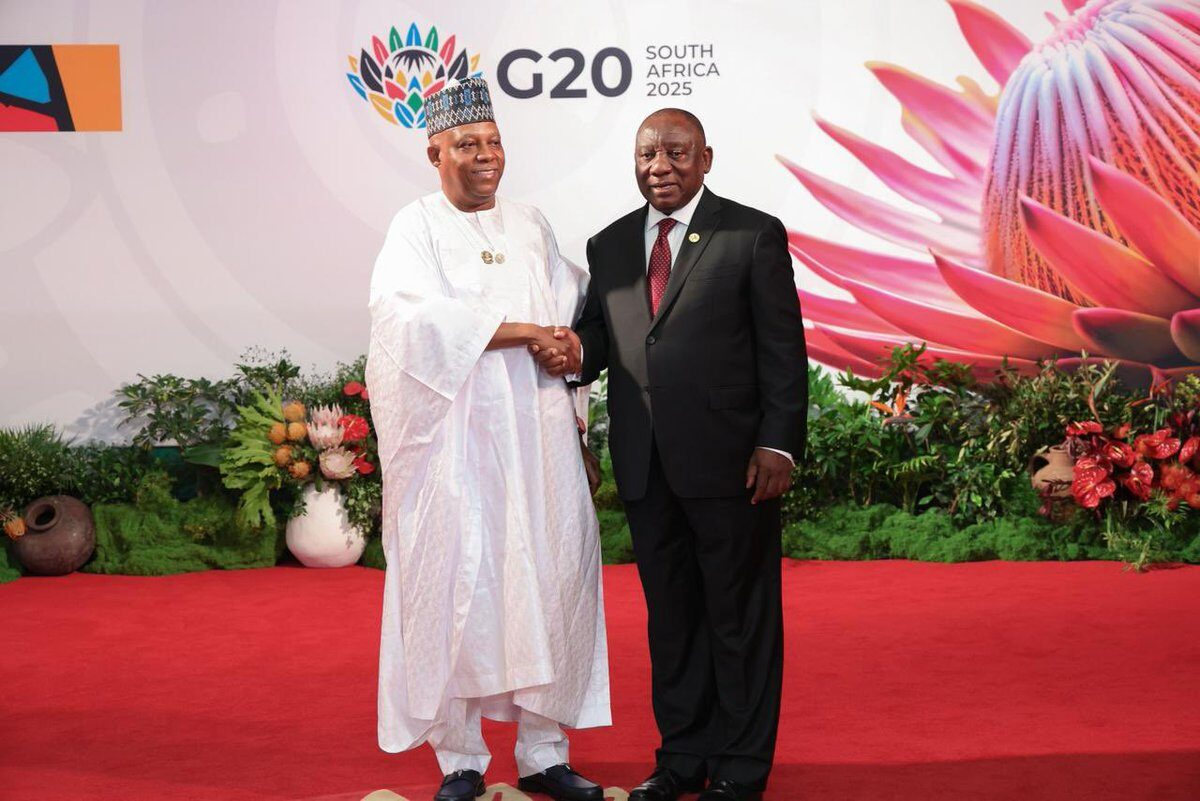
Nigeria submitted the request during the Third Session of the 2025 Group of 20 (G20) Leaders’ Summit, which had as its topic “A Fair and Just Future for All: Critical Minerals, Decent Work, Artificial Intelligence” and was hosted at the Johannesburg Expo Centre in South Africa.
Vice President Kashim Shettima spoke on behalf of President Bola Tinubu, who emphasized that key minerals are more than just natural resources for Nigeria and Africa because they have the potential to revolutionize the continent’s industrial sector.
He emphasized that while having resources does not bring prosperity on its own, stakeholders and relevant authorities must make sure that the trade and extraction of vital minerals are controlled by accountability, transparency, and fairness.
Tinubu clarified that in order to guarantee that the wealth created by hosting communities is converted into advancement for all, such conscientious extraction and commerce are required.
“Nigeria calls for a global framework that supports local beneficiation, encourages value addition at the source, and makes sure that communities hosting these resources are not left behind,” he said.
“The matter at hand pertains to the moral nature of the world we hope to create and extends well beyond the limited scope of economics.”
He added that progress must continue to be people-centered even as the globe undergoes digital and ecological transformations.
“The foundation that ensures these changes are equitable, inclusive, and long-lasting is decent work. Every individual has the chance to participate, flourish, and partake in the prosperity of the country because it is the cornerstone of development.
The President revealed that Nigeria is investing in skills that will be useful in the future by empowering Nigerian young through entrepreneurship, digital literacy, and vocational training as part of the Renewed Hope Agenda.
Tinubu called on G20 leaders to strengthen cooperation on technology transfer, capacity building, and inclusive investments that put human dignity ahead of profit alone in order to ensure a just and equitable future.
Regarding artificial intelligence, which has the potential to significantly speed up global development, the president stated that the challenge facing governments, development partners, and G20 leaders is to make sure AI continues to serve humanity rather than reshape society at the expense of those it should uplift.
“We must make sure that AI becomes a tool of empowerment, not exclusion; of job creation, not displacement,” the President stated, adding that Nigeria supports the development of international ethical standards for AI that protect safety, transparency, and equity.
Tinubu urged intentional collaborations between developed and developing countries, the public and private sectors, and innovation and inclusion in order to fully realize AI’s promise for job creation and empowerment.
In order to guarantee that the advantages of AI are distributed fairly and its hazards are appropriately addressed, he continued, “the G20 must thus address systemic bias and foster sustained multilateral dialogue.”
The President pointed out that critical minerals, decent work, and artificial intelligence are all united by a single calling within a larger vision of shared responsibility and global stewardship: to create an economy that uplifts rather than excludes; an economy that measures its strength not only by growth but also by the dignity it affords every human being.
He called on the G20 leaders and allies to create a future in which Africa is a continent of innovation, value creation, and respect for labor, rather than just a provider of raw commodities.
In a similar vein, Tinubu has urged world leaders to devise a more responsive and equitable framework for managing international financial flows and genuinely addressing the ongoing debt crisis in a way that satisfies the requirements of every country.
He claimed that this was now required because many emerging nations continue to struggle with structural obstacles that hinder economic expansion, impair trade, and restrict financial inclusion.
Tinubu noted that this year’s summit theme, which borders on “inclusive and sustainable economic growth, trade, financing for development, and the debt burden, speaks to the realities of developing nations.” The president expressed regret that the multilateral frameworks currently in use no longer reflect the complexity of the modern world because they were “built in an era far removed from” the current challenges.
“For trade to be truly inclusive, the G20 must take bold and deliberate steps towards reforming the international financial architecture and the global institutions that sustain it,” he said, calling for a fair deal for Africa and other developing nations.
“Only a more responsive and equitable system can truly handle recurrent debt crises, manage global financial flows fairly, and meet the needs of all countries, particularly those in the Global South that have far too frequently been on the periphery of global opportunity.”
According to the President, without the G20’s united will, Africa would find it challenging to achieve a favorable paradigm change “in its development trajectory.”
He pointed out that without addressing the enduring regional issues facing the continent, especially “the urgent need for sustainable financing to ensure the effective implementation of our developmental priorities,” the continent cannot rise on its own two wings of aspiration.
Growing debt loads have persisted in “dragging economies back into cycles of fragility,” turning “local difficulties into global vulnerabilities,” according to Tinubu.
He therefore pleaded with the G20 to prioritize debt sustainability and the ethical use of vital minerals in its inclusive development agenda.
The President went on to say, “The G20 must take very seriously the responsibility to advance policies that drive sustainable growth, promote financial inclusion, and confront emerging risks in adopting the Leaders’ Declaration.”