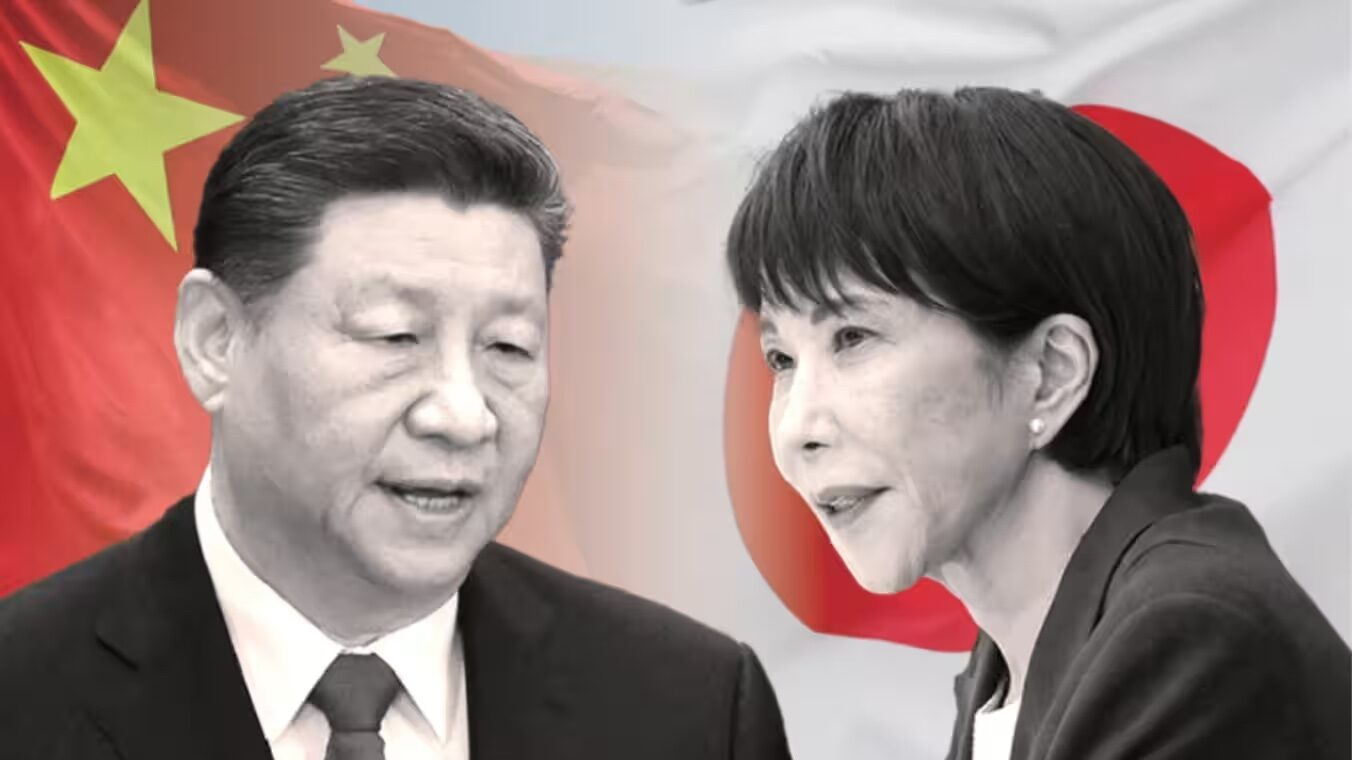
China has escalated its ongoing dispute with Japan by bringing the matter to the United Nations, alleging that Tokyo is posing a threat of “an armed intervention” regarding Taiwan and pledging to protect itself with its most assertive rhetoric to date in this two-week-old conflict.
Japanese Prime Minister Sanae Takaichi has been accused of committing “a grave violation of international law” and diplomatic norms after stating that a Chinese attack on Taiwan could provoke a military response from Tokyo, according to a letter from China’s U.N. Ambassador Fu Cong to U.N. Secretary-General Antonio Guterres on Friday.
“Should Japan choose to engage in armed intervention regarding the cross-Strait situation, it would be considered an act of aggression,” Fu stated, as per a release from China’s U.N. mission. “China will firmly uphold its right to self-defense as outlined in the U.N. Charter and international law, steadfastly protecting its sovereignty and territorial integrity.”
MAJOR BILATERAL CRISIS IN YEARS
Beijing considers Taiwan, which is governed democratically, to be part of its territory and has not dismissed the possibility of using force to assert control over the island. The government of Taiwan firmly dismisses Beijing’s assertions, stating that it is solely the people of the island who hold the authority to determine their future.
Japan’s Foreign Ministry stated in an emailed response to Reuters that it was aware of Fu’s letter, marking the most significant criticism of Takaichi to date from a high-ranking Chinese official amid the largest bilateral crisis in years.
The ministry underscored that Japan’s dedication to peace remains steadfast and rejected China’s assertions as “completely unacceptable”.
Takaichi, a conservative nationalist who assumed office last month, eliminated the longstanding ambiguity between Japan and the U.S. concerning Taiwan. During a parliamentary session on November 7, she stated that a hypothetical Chinese attack on Taiwan, located just over 100 km (60 miles) from Japanese territory, could be regarded as “a situation threatening Japan’s survival.”
This designation grants a Japanese prime minister the authority to deploy the nation’s military.
Takaichi’s comments ignited a reciprocal conflict with China that has extended beyond diplomatic channels in recent days, with China asserting that it has “severely damaged” trade cooperation, while performances by Japanese musicians in China have been suddenly cancelled.
Fu insisted that Japan “cease its provocations and overstepping, and withdraw its incorrect statements”, which he claimed were “a direct challenge to China’s core interests”.
As the 80th anniversary of Japan’s World War Two defeat approaches, Beijing has been increasingly highlighting Tokyo’s wartime atrocities and China’s postwar contributions to the establishment of the U.N. This serves as a critique of its Asian neighbor while aiming to influence the international governance system.
China, as a permanent member of the U.N. Security Council, has consistently highlighted two postwar declarations that foresee the “restoration” of Taiwan and other territories previously occupied by Japan to Chinese governance.
The Potsdam and Cairo declarations serve as the foundation for China’s legal assertions of sovereignty over Taiwan; however, numerous governments regard them as expressions of intent rather than legally enforceable agreements.
Additionally, the declarations were endorsed by the government of the Republic of China, which retreated to Taiwan in 1949 following its defeat in a civil war against Mao Zedong’s communist forces. Taiwan occupied China’s U.N. seat until 1971, at which point it was handed over to the Beijing government of the People’s Republic of China.