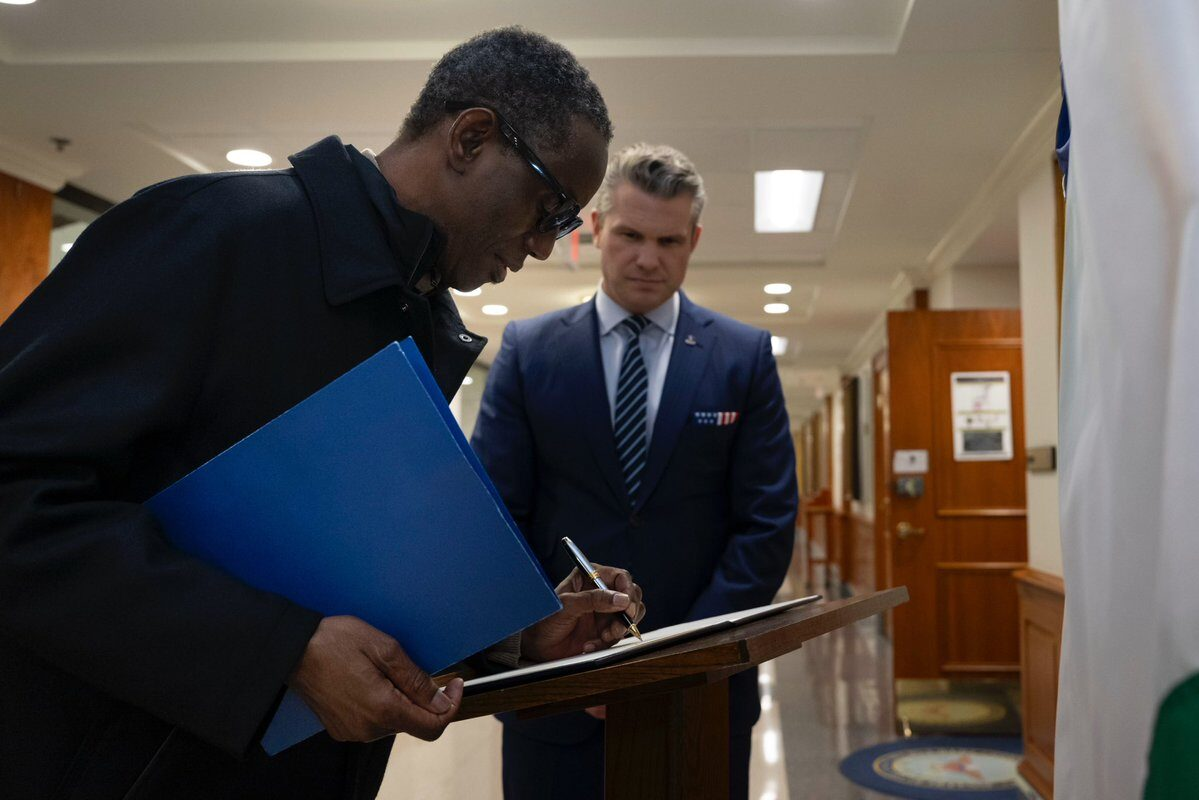
Defense Secretary Hegseth and NSA Ribadu have high-level Pentagon discussions to refute claims of Christian persecution in Nigeria.
Following President Donald Trump’s explosive threat of immediate US military intervention in Nigeria over alleged Christian killings, Nigeria’s National Security Advisor, Mallam Nuhu Ribadu, and US Defense Secretary Pete Hegseth held a high-level security meeting at the Pentagon on Thursday.
The sensitivity of the conversations was highlighted by the fact that the closed-door meeting, which was also attended by Gen. Dan Caine, Chairman of the US Joint Chiefs of Staff, was not noted on official calendars.
As part of the Nigerian government’s efforts to combat what it refers to as “harmful mischaracterizations” regarding religious freedom and the nation’s security situation, Ribadu had previously met with senior US defense and intelligence officials.
Days before to the encounter, Trump issued a warning that the US military may “go in fast, vicious, and sweet” against what he described as “Islamic terrorists killing Christians in Nigeria,” further instructing his “Department of War” to get ready for potential action.
Republican lawmakers, such as Sen. Ted Cruz and Rep. Riley Moore, and far-right media sources, who have emphasized allegations of Christian genocide in Nigeria, heavily covered the US President’s comments.
Nigeria has objected to the US’s decision to re-designate the country as a Country of Particular Concern (CPC) amid the controversy due to alleged breaches of religious freedom.
Insisting that the decision was founded on “misinformation and inaccurate data,” President Bola Ahmed Tinubu stated that Nigeria is still dedicated to defending the right of all citizens to practice their religion freely.
Additionally, US military engagement in Nigeria is logistically unfeasible and has the potential to destabilize the region, according to security analysts in Abuja and Washington. Due in large part to its withdrawal from important drone bases in Niger, the United States today has a little military presence in West Africa.
Jacob McGee, the deputy assistant secretary of state, told reporters that Trump’s warning had sped up “frank conversations” with Nigerian officials.
“The Nigerian side is showing engagement. The CPC redesignation was welcomed by civil society organizations, and we anticipate concrete action from Abuja,” he stated.
During discussions with the Nigerian delegation on Capitol Hill, Rep. Riley Moore said he asked for more robust assurances for the safety of Christians.
In response to mounting pressure, the Nigerian government has reiterated that attacks by armed bandit groups, ISWAP, and Boko Haram are only a few of the complex security environment that causes casualties for both Christians and Muslims.
Abuja’s larger diplomatic effort to avoid strained US-Nigeria relations, preserve current security alliances, and rectify myths portraying Nigeria as antagonistic to Christians includes Ribadu’s visit to Washington, which includes military, intelligence, and congressional contacts.
Inspector General of Police (IGP) Kayode Egbetokun, Attorney General of the Federation Lateef Fagbemi, and Chief of Defense Staff Olufemi Oluyede are also traveling with the NSA.