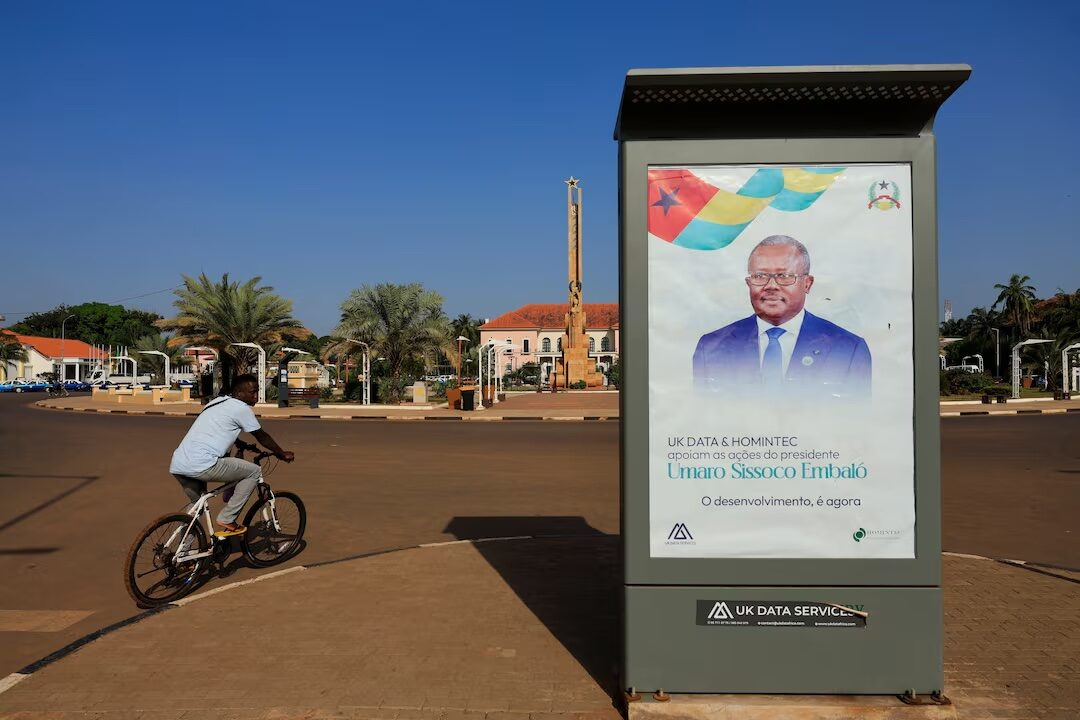
In Guinea-Bissau’s presidential election on Sunday, incumbent Umaro Sissoco Embalo will face unexpectedly fierce competition in a highly polarized political environment and a thriving cocaine trade.
Fernando Dias, 47, of the Party for Social Renewal (PRS), who has gathered sizable audiences with promises to advance security and peace and stop troops from meddling in politics in the coup-prone West African country, is his primary rival.
According to T Hamilton Teixeira, a sociologist at the Catholic University of Bissau, Dias has a good chance of winning even if there are 12 contenders. The contest ultimately comes down to 53-year-old former army general Embalo and Dias.
According to Teixeira, the victor will face a formidable challenge in attempting to reverse Guinea-Bissau’s lengthy history of political unrest and unsuccessful attempts to diversify an economy heavily reliant on cashew production and enhance basic services.
“A future Guinea-Bissau president must do the exact opposite of everything that has been done if he wishes to do things differently,” Teixeira stated.
It is anticipated that the preliminary findings would be made public within 48 hours.
Former prime minister Domingos Simoes Pereira, who lost to Embalo in a fiercely contested 2019 runoff, has backed Dias. Prior to his disqualification after authorities said he filed his papers late, Pereira was regarded by many as Embalo’s strongest opponent this year.
Due to Pereira’s absence, the African Party for the Independence of Guinea and Cape Verde (PAIGC), which spearheaded the nationalist drive for independence from Portugal, will not have a candidate in this race.
Teixeira stated that the other contenders might prove “important and decisive” in a runoff if neither Embalo nor Dias receive more than 50% of the vote.
After losing in the first round in 2019, Embalo received support from former President Jose Mario Vaz, who is also running this year. This helped Embalo in the runoff against Pereira.
QUESTIONING THE PRESIDENT’S LEGITIMACY
Throughout the year, Embalo’s authenticity has been called into question. Although the Supreme Court of Justice had earlier stated that his term will finish in September, the opposition claims that it legally ended in February.
After Embalo threatened to remove it, a delegation dispatched by the regional body ECOWAS in March to assist in reaching an agreement on how to hold elections departed early.
Critics claim that Embalo’s contemptuous reaction to inquiries regarding the expiration of his mandate is indicative of a larger lack of regard for national institutions.
Since Embalo disbanded the legislature in late 2023 following what his government called a coup attempt—one of three it claims has occurred during his tenure—Guia-Bissau has been without a sitting legislature.
“If Umaro Sissoco Embalo is re-elected, the agenda of democratic regression initiated in 2020 with his rise to power as President of the Republic will be consolidated,” Rui Jorge Semedo, a political analyst, stated.
In the meantime, under Embalo’s leadership, Guinea-Bissau’s position as a vital transit hub for cocaine traveling from South America to Europe has, if anything, grown stronger.
“Many Bissau-Guineans are arrested with cocaine both in the subregion and overseas, providing ample evidence that Guinea-Bissau is a drug hub,” stated Vincent Foucher, senior research fellow at the National Centre for Scientific Research in France.
There are over two million people living in Guinea-Bissau, and about half of them are registered to vote in the parliamentary and presidential elections on Sunday.