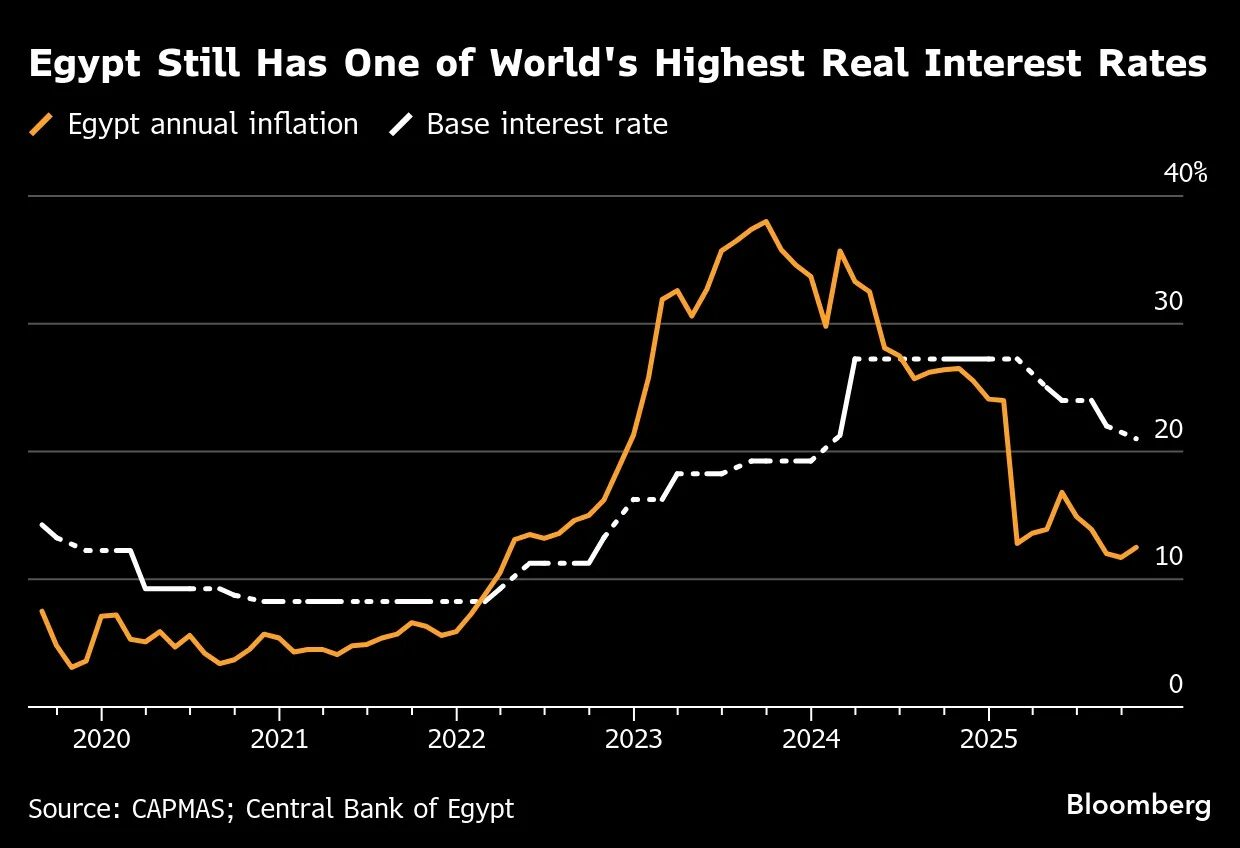
The Central Bank of Egypt decided to maintain its overnight interest rates on Thursday, expressing its intention to manage the rising inflation as the economy approaches full capacity.
The monetary policy committee maintained the deposit rate at 21% and the lending rate at 22%.
A Reuters poll released on Monday indicated that analysts are split evenly between maintaining the current rate and implementing a 100-basis-point cut, although the median forecast suggested a reduction of 50 basis points.
The CBE has implemented rate reductions this year, including cuts of 225 basis points in April, 100 points in May, and 200 points in August. Nonetheless, Egypt’s actual interest rates continue to rank among the highest globally.
The central bank projected that real GDP growth increased to 5.2% in the third quarter of 2025, up from 5.0% in the second quarter, fueled by a rise in non-petroleum manufacturing, trade, and tourism.
The central bank’s Monetary Policy Committee stated, “Output continues to move closer to full capacity utilization, which is expected to be realized by the end of FY 2025/26.” The fiscal year concludes on June 30.
In October, headline inflation increased to 12.5%, up from 11.7% in September, while core inflation rose to 12.1%, compared to 11.3%, as reported by the state statistics agency CAPMAS.
Annual headline inflation is expected to rise slightly as the effects of energy price increases become evident toward the conclusion of Q4 2025. The committee stated, “Subsequently, annual headline inflation is expected to steadily decrease in the second half of 2026, aligning with the CBE target.”
The central bank aims for an inflation rate ranging from 5% to 9%.
The rise in inflation was partly fueled by an increase in state-controlled fuel prices and by a new regulation permitting landlords to raise rents at a faster pace.
“The Committee has opted for a wait-and-see strategy, choosing to maintain the CBE key policy rates at their current levels in order to manage inflationary pressures, stabilize expectations, and return to a disinflation trajectory,” the statement noted.