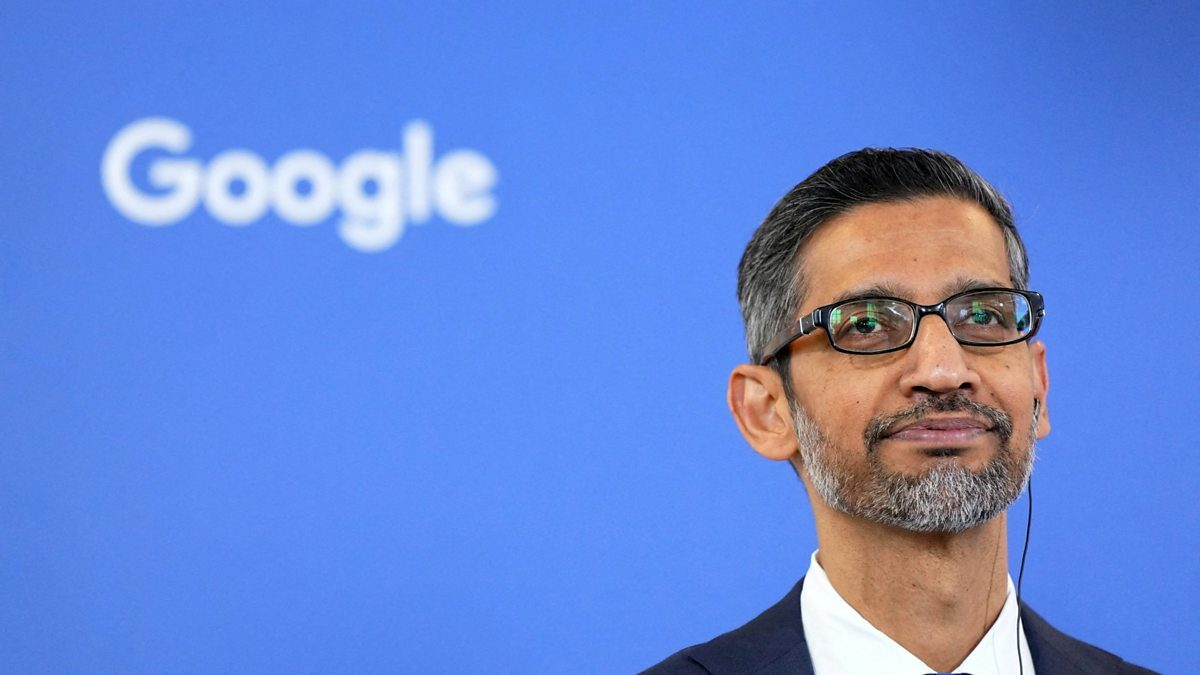
Sundar Pichai of Google warns that if the global AI bubble bursts, no company is safe
Pichai cautions that growing AI valuations are irrational and that a market meltdown might affect even Google.
One of the most severe warnings yet on the state of the artificial intelligence (AI) market has come from Google CEO Sundar Pichai, who stated that if the current surge in AI investment collapses into a bubble burst, no company—not even Google—would be immune to the repercussions.
Pichai stated at Google’s Mountain View, California, headquarters that although the quick development of AI marks a turning point in the history of technology, the volume and speed of investment have produced indisputable evidence of “irrationality” in the sector.
He pointed out that the financial dynamics in Silicon Valley are comparable to those leading up to the 2000 dot-com bust, with valuations increasing more quickly than actual adoption. However, he emphasized that such cycles are common during times of revolution.
“At this moment, we can look back at the internet. None of us today would dispute if the internet was profound, despite the obvious excess spending, Pichai stated. AI should be the same, in my opinion. Therefore, I believe it to be both rational and irrational at this particular moment.
“I think no company is going to be immune, including us,” Pichai said simply in response to a direct question about whether Alphabet, the second-most valuable internet company in the world, could survive a possible catastrophe.
As investors placed significant bets on Google’s advancements in AI model creation and its new specialized processors, which are increasingly competing with Nvidia’s massively dominant technology, Alphabet’s own valuation quadrupled in just seven months, reaching $3.5 trillion.
Due in large part to the demand for its AI processors, Nvidia recently became the first business in history to reach a $5 trillion valuation, which heightened concerns about overheating within the market.
Even while OpenAI’s projected revenue this year is still a very small portion of the $1.4 trillion worth of stacked deals around the company, analysts have expressed worries about them.
Financial experts caution that the larger AI ecosystem may be quickly impacted if OpenAI slows down, fails to meet revenue goals, or encounters regulatory obstacles.
Indirectly acknowledging these worries, Pichai stated that the industry needs to be ready for “overshoots” and adjustments.
Despite the dangers, Pichai maintained that because Alphabet controls every aspect of the AI stack—from chips to data sources like YouTube to model training infrastructure to cutting-edge research labs—it is fundamentally better positioned to withstand any turbulence.
He said that Google had a competitive edge over many AI-only businesses that are consuming cash at unsustainable rates because “we own the full stack,” which lessens reliance on outside vendors.
He emphasized, nevertheless, that no company can be completely protected against a market-wide correction by this advantage alone.
Pichai also emphasized Alphabet’s growing dedication to the UK, which is establishing itself as a major hub for artificial intelligence worldwide. With intentions to increase infrastructure, research, and a new stage of model training domestically, Alphabet has announced a £5 billion investment in the UK’s AI ecosystem.
Ministers who want Britain to become the third-largest AI “superpower” in the world, behind the US and China, have praised Google’s decision to train some of its huge models in the UK for the first time.
The corporation sees the UK as a long-term strategic partner, and Pichai stated, “We are committed to investing in the UK in a pretty significant way.”
Pichai also expressed concern about the growing global energy load caused by AI, noting out that in 2024, AI systems used 1.5% of global electricity, a percentage that is predicted to rise significantly as generative AI adoption increases.
He cautioned, “You don’t want to constrain an economy based on energy,” and urged governments throughout the world to increase grid infrastructure and electricity generation.
He acknowledged that Google’s own rapid expansion in AI had caused delays in achieving its sustainability and climate goals. Despite Alphabet’s continued commitment to achieve net zero emissions by 2030, Pichai claimed that the rate of advancement had “been impacted.”
Regarding employment, Pichai called AI “the most profound technology” that humanity has ever created, one that will revolutionize every profession, from journalism and law to education and medicine.
“Some jobs will change and evolve, and people will have to adjust,” he stated. He went on to say that those who learn to use AI tools “will do better,” and that those who don’t could be at a financial disadvantage.
In the same way that the internet gave rise to industries that did not exist in the 1990s, Pichai also predicted that completely new job classes will develop.
The interview was conducted at a time when the AI industry is under unprecedented scrutiny. While investors question if the industry is going through a speculative bubble or a sustainable rise, regulators in the US, Europe, and Asia are looking into everything from market concentration to training data methods.
Analysts claim that Pichai’s remarks are among the most blatant admissions by a significant industry executive that the AI business might be overheated.