The Democratic Republic of the Congo and the M23 rebel group signed a framework agreement for a peace deal on Saturday. The goal is to end the killing in the east of the country that has killed thousands of people this year and forced hundreds of thousands more to leave their homes.
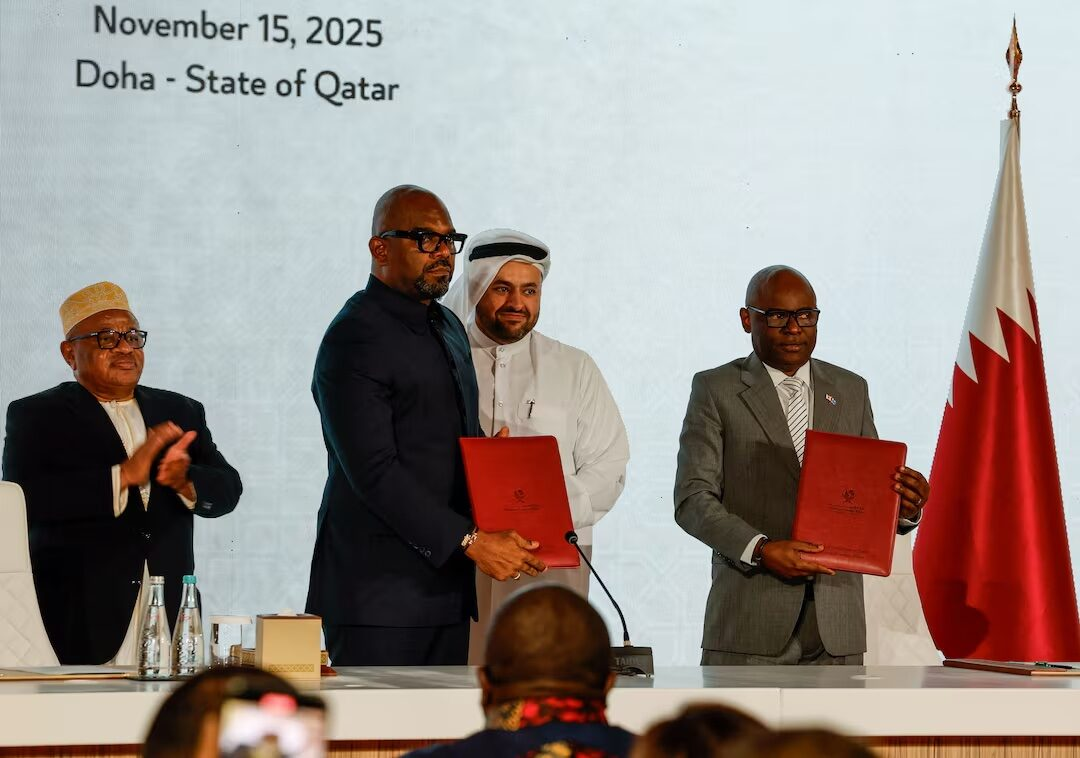
At a ceremony in Doha, the capital of Qatar, people from both sides signed the deal.
It was the most recent document signed in a series of recent months as part of efforts, backed by the US and Qatar, to end decades of fighting in Congo that has been a threat to stability in the area.
America and Qatar said the plan was a big step toward peace, but there are still many more to come.
A LOT OF DETAILS STILL NEED TO BE WORKED OUT.
Massad Boulos, the top U.S. diplomat in the area, told Reuters that the plan included eight protocols, but that work still needed to be done to agree on how to put six of them into action.
According to Boulos, the first two agreements—to trade prisoners and keep an eye on a peace that was reached in the past few months—had not been carried out quickly.
“Yes, certainly, people were hoping to see effects right away, but this is a process… Forget about turning this light switch on and off, he told reporters after the signing.
M23 took over Goma, the biggest city in eastern Congo, in January. This was the latest in a series of actions backed by neighboring Rwanda. They then made gains in North Kivu and South Kivu provinces.
Rwanda has denied for a long time that it has helped M23, the rebel group that has taken over more land in Congo than it ever had before.
As the top envoy to Africa during the first term of President Trump, Tibor Nagy said that a lot more work needed to be done to really deal with the causes of the conflict and the deep distrust between the warring sides.
“Instead of several “drive-by” peace processes, it needs a lot of hand-holding,” he told Reuters. “The players seem more interested in getting credit than results.”
Congo still has conflict, but talks are moving forward.
Violence has continued in Congo even though there have been diplomatic efforts in Washington and Doha. The Congolese government and M23 have been blaming each other for breaking earlier deals and purposely delaying talks.
The long talks also don’t address the threat posed by the many other armed groups that operate in the unstable east. Local officials said on Friday that Ugandan rebels with ties to the Islamic State killed up to 28 people in North Kivu.
The Congolese government and M23 have had several rounds of direct talks in Qatar since April. Most of the time, the talks have been about setting conditions and gaining trust.
In July, the two sides agreed to a statement of principles that didn’t solve many of the main problems that caused the conflict. In October, they came to an agreement on how to keep an eye on a possible peace.
Minister of State for Foreign Affairs of Qatar, Mohammed bin Abdulaziz Al-Khulaifi, said that the deal reached on Saturday put both sides on the path to peace.
“Peace cannot be enforced by force, but is built through confidence, mutual respect and sincere commitment,” said he.