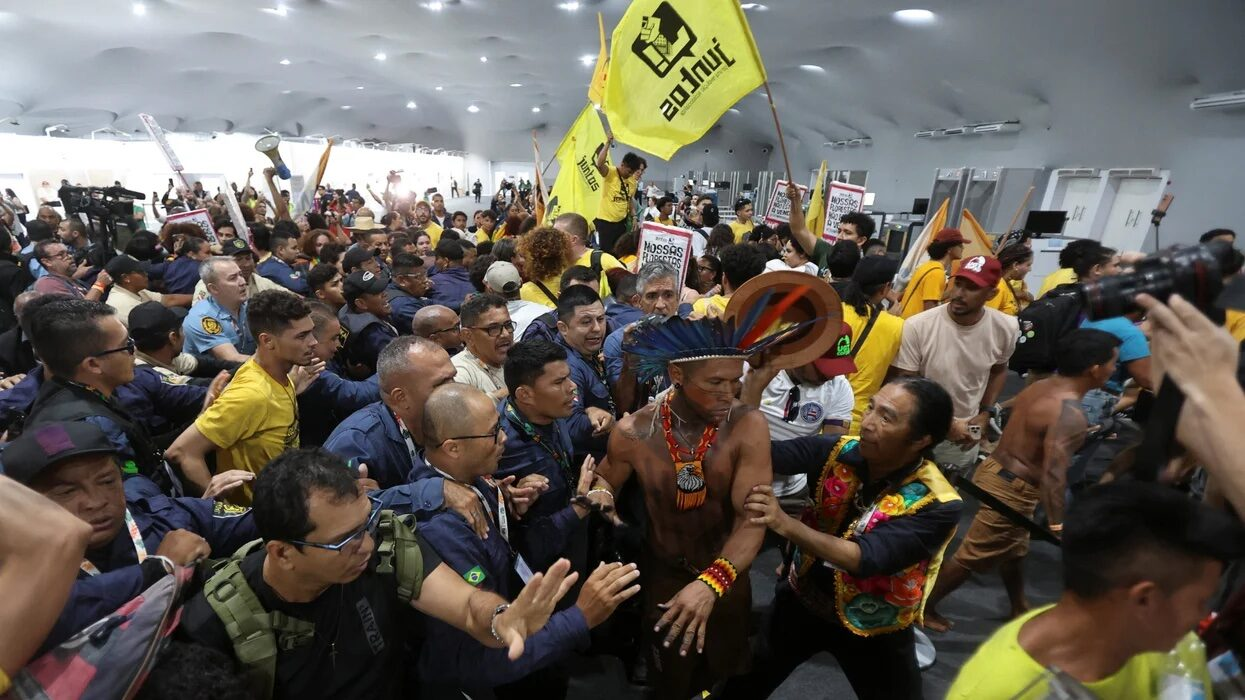
Indigenous organizations and activists demand immediate protection for the Amazon rainforest by breaking into the COP30 venue in Belém, Brazil.
On Tuesday evening, demonstrators seized the COP30 climate summit in Belém, Brazil, calling for swift action to save the Amazon rainforest and stop environmental degradation. Indigenous leaders and activist organizations were among the protesters who clashed with Brazilian and UN security forces while holding posters that said, “Our forests are not for sale.”
Videos of protestors, some dressed in traditional indigenous garb, chanting, kicking down doors, and waving Juntos flags—a left-wing youth movement—were making the rounds on social media. Two employees were reported to have minor injuries, and the venue had minimal damage, according to security officials. A demonstrator threw a drum at one security guard, striking him in the head. The UN acknowledged that although demonstrators broke through the venue’s initial security measures, they were prevented from moving farther inside.
As is uncommon for a high-profile international conference with stringent regulations, authorities from Brazil and the UN have opened investigations into the unexpected security violation. Rising tensions between governments hosting international environmental discussions, indigenous people, and climate campaigners are highlighted by the incident.
Nearly 200 nations send representatives to COP30, which takes place from November 10–21, to discuss global climate policies and pledges. At this year’s summit, ten years had passed since the Paris Agreement, wherein nations committed to keeping global warming to 1.5°C.
It has been controversial to choose Belém, on the outskirts of the Amazon rainforest, as the venue for the conference. Environmentalists and indigenous organizations contend that the biodiversity and local populations of the Amazon are in danger due to Brazil’s continuous deforestation, licensing of oil and gas, and growth of agribusiness. “We can’t eat money,” stated Tupinamba leader, highlighting the necessity of defending indigenous territories against illicit mining, logging, and major economic initiatives.
Concerns about climate justice and the role of indigenous communities in forest protection are reflected in the demands made by protesters at COP30. Deforestation in the Amazon is a major contributor to global greenhouse gas emissions, which impacts global climate patterns, according to environmental organizations.
Many people have responded to the protest on social media, emphasizing both the bravery of the protesters and the pressing necessity for world leaders to take decisive climate action. Brazil’s hosting of COP30, according to analysts, serves as a sobering reminder of the tension that exists in the Amazon region between environmental preservation and economic growth.
As COP30 goes on, delegates are under more pressure to address indigenous rights and global climate commitments. This demonstration highlights the increasing demand for immediate action to stop deforestation and save the greatest rainforest in the world before irreparable harm is done.