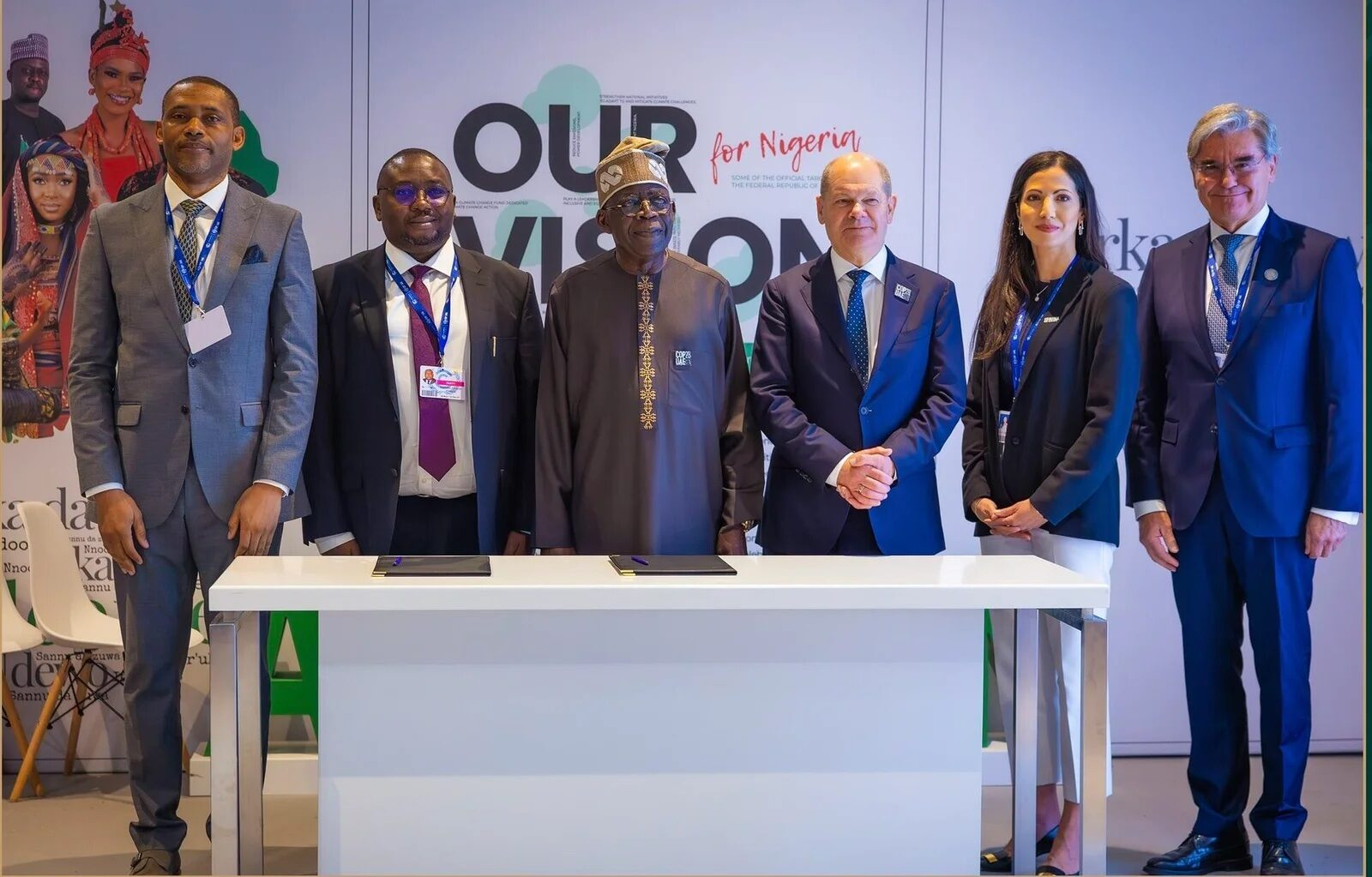
Tinubu To Siemens: Nigeria Is Dedicated To Reforming The Power Sector And Improving Electricity Supply
Tinubu authorizes the expansion of transformer substations, reiterates Nigeria’s complete commitment to the Siemens power project, and asserts that economic growth cannot occur without electricity.
Siemens Energy, the technical contractor managing the Presidential Power Initiative (PPI), has received assurances from President Bola Tinubu that his administration is fully committed to boosting livelihoods and the nation’s electrical supply.
The President stated that the power sector is still essential to boosting the economy, especially in the industrial, educational, and healthcare sectors, during a meeting with a Siemens Energy delegation at State House in Abuja on Monday. The delegation was led by Dietmar Siersdorfer, Managing Director of Middle East and Africa.
President Tinubu emphasized that the completion of the phased power project will give Nigeria a place of pride on the continent by harnessing the latent potential in human and material resources across various sectors. Vice President Kashim Shettima, Coordinating Minister of the Economy Wale Edun, his Power counterpart Adebayo Adelabu, and Special Adviser on Energy Olu Verheijen were present at the meeting.
He asserts that without power, neither industrial expansion nor economic development can occur. Power, in my opinion, is the most important thing humanity has discovered in the past 1,000 years. I am grateful for the collaboration on the project. We can sense that the initiative is making significant development thus far. However, we don’t want it there.
“We value Siemens’ and the German government’s dedication and support. Your dedication and the investment you are making are in line with this nation’s future.
Energy is necessary for our transportation, healthcare, and education, and these goals are unattainable without it. We are treating it with great seriousness.
In order to increase the nation’s power supply, the President also ordered the expansion of a few significant transformer substations from two to three phases.
“We are all joyful and inspired. On the continent, this is what we hope to accomplish. He declared, “We want everyone to witness the splendor of our economic recovery and the eradication of poverty.”
The team was reassured by the president that the government will continue to supply the necessary funds for the power project.
In a previous statement, electricity Minister Adelabu said that the electricity industry has reached numerous significant turning points, such as the liberalization and decentralization of the industry.
He pointed out that after 24 years, a National Integrated Electricity Policy was created and the President signed the Electricity Act 2023, drawing in over $2 billion in new investments.
According to the minister, fifteen state power markets have been activated as a result of the initiative.
“The PPI has achieved significant milestones throughout its implementation phases since the Accelerated Agreement was signed at COP28 in Dubai in December 2023, an event you personally attended with German Chancellor Olaf Scholz.
We have made major infrastructure improvements and capacity expansions during the Pilot phase (Phase Zero), which are already having an effect on the stability and dependability of the nation’s grid.
“The grid now has 984mv of transmission capacity thanks to Siemens Energy’s successful delivery and commissioning of 10 units of 132/33kV mobile substations, three units of 75/100MVA transformers, and seven units of 60/66MVA transformers across key load centers nationwide,” the minister said.
The start of the Engineering, Procurement, and Construction (EPC) contract for Phase One, Batch One of the PPI was authorized by the Federal Executive Council in December 2024, Adelabu told the President.
The scope, he said, includes the modernization, installation, and opening of five important substations located in Abeokuta, Offa, Ayede-Ibadan, Sokoto, and Onitsha.
Hus’s words: “I am happy to announce that preparations for the mobilization of civil works at all five locations have been finalized, that the necessary equipment is currently being manufactured concurrently, and that two of the five substations are expected to be completed by the end of 2026.
We are getting ready to move on to Phase One-Batch two, which has the potential to build new substations and renovate existing ones in important load centers around the country, as we build on the successes of the Pilot Phase and Phase One-First Batch. With a combined effect of 4,104MW, Phase One-Batch Two of the PPI consists of six Brownfield and ten Greenfield substations.
Wale Edun, Minister of Finance and Coordinating Minister of the Economy, also spoke, saying that the PPI’s completion will make conducting business in Nigeria easier, provide employment opportunities for young people, and lower poverty.
According to Siersdorfer, the head of the Siemens delegation, two of the five substations currently being built should be finished by December 2026.
In order to ensure that local talent in electrical engineering is trained, new jobs are created, local content is captured, and technology is transferred, he mentioned that a training center was already being built.
“The PPI is a platform for long-term development and prosperity, not just a project.”
He told the President that, in keeping with the close ties between Germany and Nigeria, the PPI will turn Nigeria into a regional power center.
“Thousands of jobs would be made possible in the surrounding communities through purchased services, lodging, and transportation, among other things, while Nigerian professionals will be directly involved in the site works at the five project sites in Batch 1. Siersdorfer stated, “These will further demonstrate the strength of our collaboration and the feasibility of the roadmap we have developed together.”
Johannes Lehne, a representative of the German Ambassador, promised President Tinubu more assistance and cooperation with the German government.