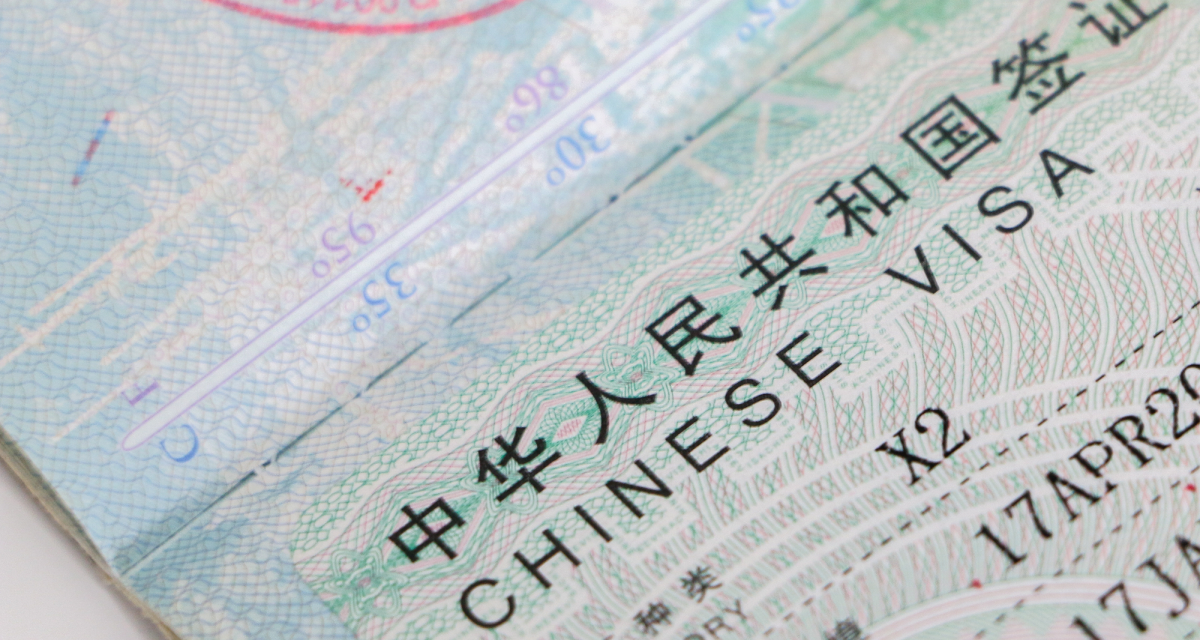
The K-visa is introduced by Beijing, which makes it easier for skilled foreigners to enter the country as Trump’s stricter US visa regulations push them east.
In a calculated attempt to compete with the United States in the global talent and innovation competition, China has introduced a new K-visa to draw in foreign technology specialists, according to observers.
Last month, Beijing launched the K-visa as part of a larger initiative to improve its technology superiority and close a widening skills gap at home. In the wake of President Donald Trump’s stricter immigration rules, the new plan comes as the US H-1B program is becoming increasingly questionable.
“The K-visa for China (is) comparable to the H-1B for the United States,” stated Srinivasagopalan, who is fascinated by the culture and working conditions of China because her father was employed at a Chinese university a few years ago. “For people like me, working overseas is a good option.”
For foreign professionals, the K-visa relaxes entrance restrictions, enabling applicants to apply without a verified employment offer, in contrast to the current R-visa.
As a result of the Trump administration’s decision to increase the cost of an H-1B visa for talented foreign workers to $100,000 for new applications, many overseas professionals and students are being discouraged from looking for job in the United States.
“This is a problem right now, but students studying in the US hoped for a (H-1B) visa,” said Bikash Kali Das, an Indian master’s student at Sichuan University studying international relations.
China’s ruling Communist Party has made it a priority to dominate the world in cutting-edge technologies, giving enormous subsidies to robots, semiconductors, and artificial intelligence research and development.
Barbara Kelemen, assistant director and head of Asia at security intelligence company Dragonfly, stated that Beijing sees the US tightening immigration laws as a chance to emphasize its openness to international talent and investment in general.
The government maintains the new policy is necessary to address crucial skills shortages, even though Chinese graduates have significant unemployment rates—nearly 18% of job searchers between the ages of 16 and 24 are unemployed. China’s top students have been leaving the country for decades to study in the US and Europe, causing a “brain drain.”
Although it hasn’t completely changed, that pattern is changing. More experts are moving to China, including leading scientists and Chinese-Americans. This year, some people took teaching positions in China, including Ming Zhou, a senior engineer at Altair, and Fei Su, a chip architect at Intel.
The outside world is likewise becoming more interested. As stated by Edward Hu, immigration director at Newland Chase in Shanghai, “many skilled workers in India and Southeast Asia have already expressed interest about the K-visa.”
But not everyone is excited. Zhou Xinying, a 24-year-old postgraduate student at Zhejiang University studying behavioral science, stated that the current labor market is already characterized by intense rivalry. Although foreign experts might assist in “introducing new technologies,” Zhou continued, “the implementation of the K-visa policy may put pressure on some Chinese young job seekers.”
Similar worries were expressed by Guangzhou software programmer Kyle Huang, 26, who said that the new visa “may threaten local job opportunities.”
State-sponsored publication Shanghai Observer, however, stated in a column that the policy would eventually boost the economy, pointing out that “as China advances in areas such as AI and cutting-edge semiconductors, there is a gap and mismatch between qualified jobseekers and the demand for skilled workers?”