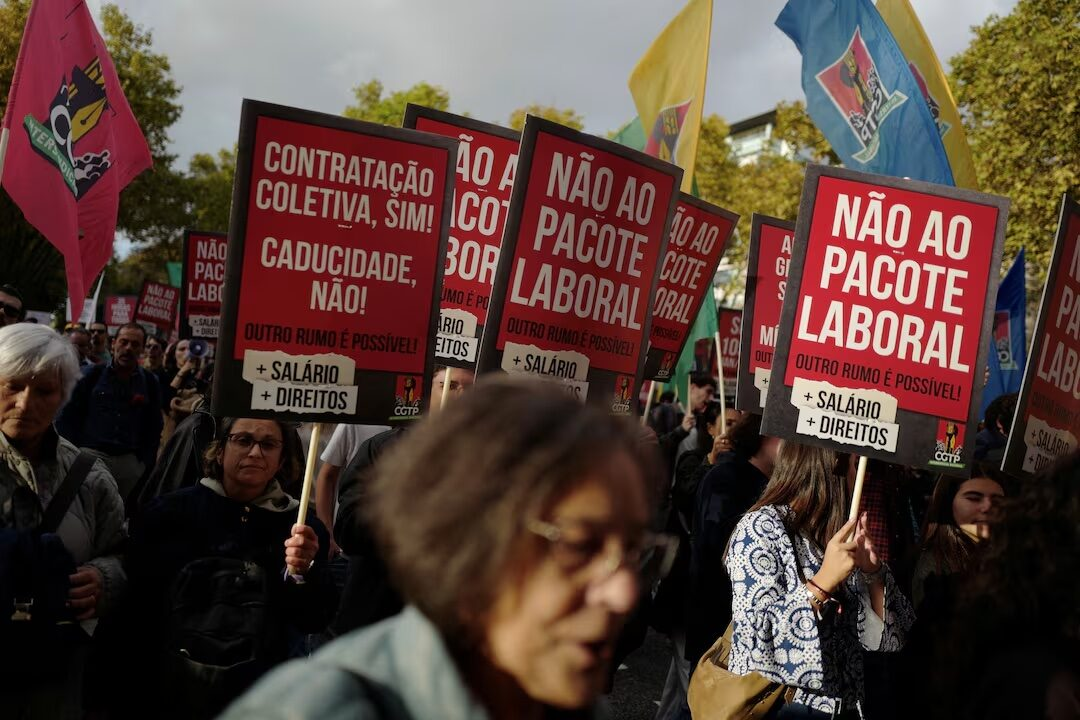
Tens of thousands of people demonstrated in Lisbon on Saturday against the center-right government’s proposal to raise wages and change labor regulations, which unions claim will violate workers’ rights.
The protest was organized by Portugal’s largest union, CGTP, which charged that the government was favoring large corporations at the expense of low-wage workers who are struggling to keep up with the rising cost of living.
According to the union, some 100,000 protesters blocked the main thoroughfare in the capital. There was no police assessment of the size of the crowd.
In September, the government of Prime Minister Luis Montenegro adopted a draft bill to alter the labor code, claiming that the goal was to increase competitiveness.
Miriam Alves, 31, who works for a medical device company, joined the demonstration on Saturday and stated that the labor reform is “clearly a step backward in working conditions and could lead to a complete lack of job security.”
“Even if it may not be my case, I’m speaking for the many young people with precarious jobs, low wages, and whose future would be to continue with fewer rights, tired and afraid of their future,” she stated.
The government was overturning labor rights “in an unfair, subtle, and cunning way, without having said anything before the election” in May, according to 34-year-old archival technician Madalena Pena.
Employers would find it simpler to fire employees for good reason under the proposed reforms since they would not have to listen to witnesses or provide evidence at the worker’s request.
Outsourcing restrictions would be loosened, and businesses may establish “individual time banks” that would allow workers to put in up to two extra hours a day, with a maximum of 150 hours per year.
With the backing of the far-right Chega, the bill is expected to pass parliament.
According to official data, over 50% of workers in Portugal made less than 1,000 euros ($1,166) per month last year, making it one of the poorest countries in Western Europe. The minimum wage is among the lowest in the EU at just 870 euros.