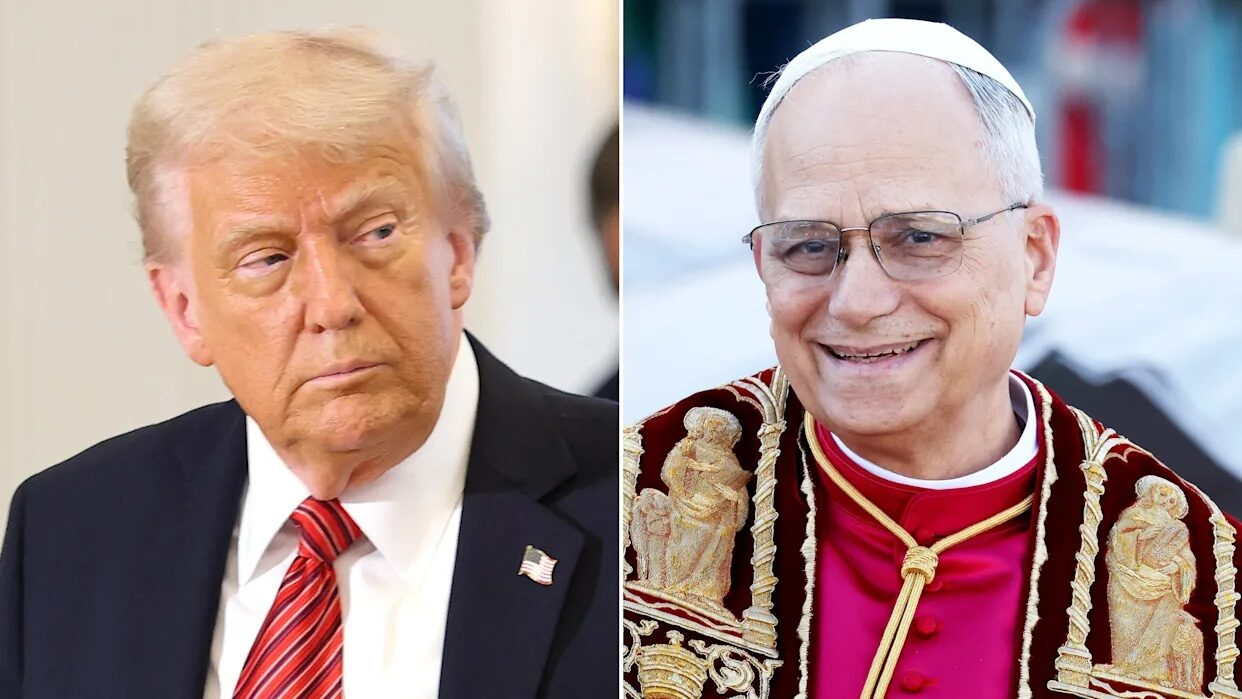
Pope Leo cautions that Trump’s assertive foreign policy may exacerbate instability in Latin America and calls for consideration of how migrants are treated.
Pope Leo Encourages Conversation in Tanzania and Demands a Ceasefire and Humanitarian Access in Sudan
In his harshest criticism of US President Donald Trump’s administration to date, Pope Leo XIV has called for “deep reflection” on the treatment of migrants and cautioned that Washington’s recent military measures may exacerbate tensions in Latin America.
Speaking outside his papal retreat at Castel Gandolfo, the first US-born pope claimed that Trump’s mass deportation strategy has “deeply affected” a large number of Americans. He said that every Christian would eventually be evaluated on how they accepted “the foreigner.” “There are people who have lived in the US for years and years without causing problems, who have been deeply affected,” he stated.
The statements were characterized by observers as Pope Leo’s most outspoken critique of the US government since his appointment six months prior. “I was struck by how direct his reference was because he’s obviously talking about the ICE round-ups,” wrote Catholic historian Austen Ivereigh. It’s really powerful.
Pope Leo’s most recent remarks gradually depart from his previous prudence on international issues. Conservative Catholics who had welcomed Trump as a “American Pope” were uneasy when he called his crackdown on undocumented immigration “inhuman” last month.
Ivereigh claims that they are now realizing that Leo will not alter church doctrine for their benefit. Though his teaching and priorities are the same, they recognize that his approach differs greatly from Francis’. He is definitely a continuation.
Pope Leo was born Robert Prevost in Chicago and served as a missionary in Peru for a large portion of his career, which academics claim profoundly influenced his opinions. “He has lived in countries affected by these policies, and been welcomed himself as a migrant,” noted Durham University professor Anna Rowlands. In actuality, he was a migratory bishop.
According to her, Leo’s stance on migration “offers an entirely orthodox response” that is based on a century-old Catholic tradition that prioritizes pastoral care for displaced persons and family unity.
“I would certainly invite the authorities to allow pastoral workers to attend to the needs of those people,” the Pope said in response to allegations that detainees at an immigration center outside Chicago were being denied communion.
Pope Leo criticized the bombing of ships suspected of transporting drugs in Venezuela, pointing out that such acts run the risk of escalating unrest. In Italian, he urged negotiation, saying, “I think that with violence we won’t win.” He went on to say that rather than serving to “defend the peace,” the US Navy’s presence in the area of Venezuelan waterways seemed to be escalating tensions.
The comments, according to analysts, represent a watershed in Pope Leo’s relationship with the Trump administration. “It does put pressure on the US administration, especially those who identify as Catholics, when the Pope speaks so strongly like this,” Ivereigh stated. Leo has thus far managed to stay out of the Trump apparatus. Perhaps he is now taking that chance.