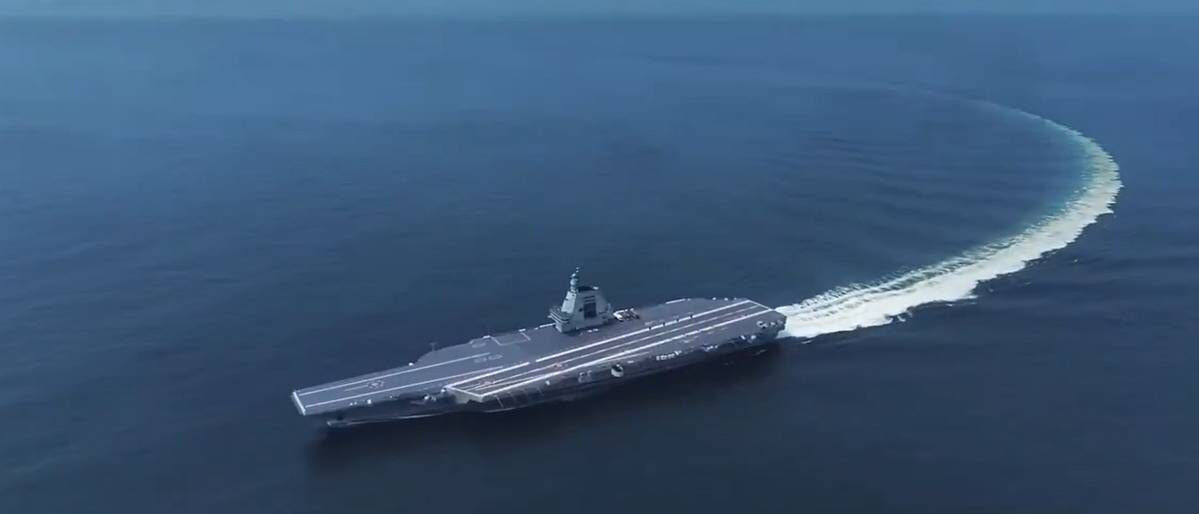
China expands its strategic influence and naval reach globally with the debut of the Fujian, its third and most sophisticated aircraft carrier.
An important step in China’s efforts to make the largest navy in the world a truly global force has been taken with the official commissioning of the Fujian, its newest and most sophisticated aircraft carrier.
President Xi Jinping was present at the commissioning ceremony in Hainan Island, according to state media, highlighting the ship’s strategic and political significance. China’s long-term goal of developing a “world-class” military by the middle of the century has advanced significantly with the launch of the Fujian, its third aircraft carrier and the first completely planned and constructed domestically.
An Advancement in Power Projection and Technology, With an electromagnetic catapult launch system akin to the US Navy’s state-of-the-art Ford-class carriers, the Fujian differs from its predecessors, the Liaoning and Shandong, which are based on outdated Soviet designs. With the backing of heavier jets like the J-35 stealth fighter, J-15T, and KJ-600 early warning aircraft, this technology enables quicker and more effective aircraft launches, extending China’s carrier-based air force well beyond its borders.
According to experts, the Fujian will allow China to project power well into the Indo-Pacific, including regions that have historically been dominated by US forces, such as the Second Island Chain and the region surrounding Guam. Greg Poling of the Center for Strategic and International Studies stated, “The Chinese leadership’s vision of China as a great power with a blue-water navy depends heavily on carriers.”
Strategic Objectives and Worldwide Aspirations, With aspirations to protect its interests abroad and counter US dominance in vital sea routes, China’s navy strategy has changed from coastal defense to blue-water operations. Military analysts claim that Beijing wants to increase its presence throughout the South and East China Seas and beyond while constructing a force that can prevent foreign intervention in hotspots like Taiwan.
According to Song Zhongping, an expert based in Hong Kong, “China’s carriers cannot just operate near home; they must operate in distant oceans and far seas.” “We must be globally present because China is a great power and we have global interests abroad.”
Though still lagging behind the US, the gap is narrowing. China still lags behind the US Navy, which has 11 nuclear-powered carriers, despite its advancements. The operational range of China’s three carriers is constrained by their conventional power. In addition, the US has a much more extensive network of bases abroad and more sophisticated supporting fleets, such as nuclear submarines, destroyers, and cruisers.
Nevertheless, experts claim that China is closing the gap quickly. Its shipyards, which are among the busiest in the world, are building missile destroyers, carriers, and submarines at a rate never seen before. A nuclear-powered carrier is reportedly already in development.
An emblem of Xi’s push for military modernization. Xi Jinping’s broad military upgrade, which aims to create a combat-ready, globally capable army by 2035, is symbolized by the Fujian. China’s expanding arsenal, which includes modern drones, electronic warfare systems, and hypersonic missiles, is highlighted by recent military parades and satellite photos.
Experts warn that equipment by itself does not equate to preparedness. According to Singapore-based researcher Tang Meng Kit, “China’s capabilities may be exaggerated, as real-world operational readiness lags behind its showcased arsenal.”
Growing Tensions, Expanding Influence. The Fujian’s commissioning demonstrates Beijing’s resolve to establish itself as a major maritime force that can defend its interests outside of Asia. However, it also exacerbates tensions with the US and its allies, who see China’s growing military might as a threat to the status quo.
China is now one step closer to achieving its objective of having a cutting-edge navy that can redefine power in the Indo-Pacific and influence global security dynamics thanks to the Fujian.